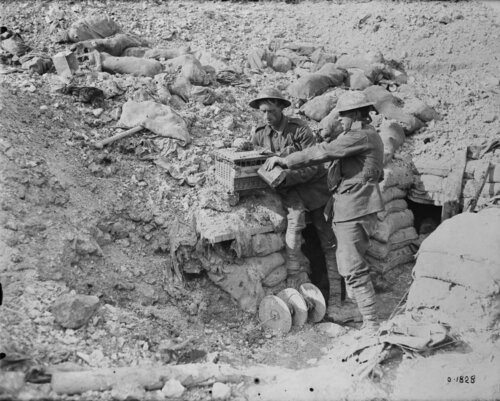



Canadian pigeon carriers give the birds water in captured trenches on Hill 70 in August 1917. [DND/LAC/O-1828]
Thousands perished. Others made it home safely to Britain amid extraordinary feats of endurance and daring.
None understood the high stakes of their wartime service. After all, they were pigeons— small, stoic birds conscripted into the war to carry out vital tasks that no human ever could.
During the raid on Dieppe on Aug. 19, 1942, a pigeon named Beach Comber was carried ashore by Canadian soldiers, then released. Dodging machine-gun fire, the bird flew back across the English Channel carrying a message attached to its leg: the first confirmation for authorities in England that Allied troops had landed in France.
Before the arrival of satellite communications and compact, long-range radios, pigeons were among the most reliable means of sending messages across large distances, particularly over water.
Homing pigeons (Columba livia domestica) are marvels, selectively bred from rock pigeons over centuries. These birds can be trained from a young age to “home” back to the loft from where they made their first flight, knowing that is where they will find food, water and companionship. Homing pigeons can be taken far from their lofts—to strange new countries, for example—and will still race back home, flying for hundreds of kilometres across seas, through storms and myriad other obstacles, with single-minded determination.
“Just like the superpowers of comic book heroes, the homing instinct of pigeons is something scientists cannot explain,” wrote British author and journalist Gordon Corera. “They have tried over the years, with theories about magnetic fields and the sun, but no one has satisfactorily managed it.
“It is a strangely comfy superpower though. The pigeon is not on a mission to save the world. It just wants to go home.”

Homing pigeons were used for emergency communication by Canadian bush pilots in the 1920s. [LAC/BC-115]
In the First World War, pigeons also served on all sides of the conflict, sometimes carrying messages home through shellfire and poison gas.
In October 1918, a pigeon named Cher Ami (“Dear Friend”) serving with the U.S. Army Signal Corps was sent aloft by a member of the famous Lost Battalion—hundreds of American soldiers who were surrounded and cut off by Germans in the Argonne forest during the final months of the war. The bird carried a critical message providing the battalion’s location and imploring Allied artillery to stop shelling its own men.
Miraculously, Cher Ami made it back to his home handlers despite suffering a deep wound in his breast and having one his legs shredded by shrapnel. The message he carried eventually led to the battalion’s relief. For his bravery, the pigeon was awarded the Croix de Guerre with palm by the French government.
The bird carried a critical message providing the battalion’s location and imploring Allied artillery to stop shelling its own men.
Cher Ami died from his wounds months later, and today his taxidermized remains are on display at the Smithsonian Institution’s National Museum of American History in Washington, D.C.
During the Second World War, pigeons were used extensively by British intelligence as part of a clandestine program code-named Operation Columba. From April 1941 to September 1944, more than 16,500 pigeons were secretly dropped by air across Nazi-occupied Europe from Denmark to the south of France.
Some of the pigeons were carried by British commandos who parachuted behind enemy lines—the pigeons providing a means of sending messages back to England.
Other pigeons were dropped directly from aircraft, with the pilots ejecting them in wicker cages suspended by miniature parachutes. The hope was that residents, either active resistance members or ordinary people, would find the pigeons.
Inside each cage was a small supply of bird food, as well as instructions asking residents to send back—on small pieces of rice paper enclosed in canisters on the legs of the pigeons—information about German military installations and troop movements, the mood of the community, and other intelligence for the Allies.
The program was made possible by thousands of British civilian pigeon breeders—or “fanciers” as they were called—who raised and raced homing pigeons in lofts all around the U.K. Pigeon racing was a popular working-class pastime in western Europe in the decades preceding the 1940s. Upon the outbreak of war, British fanciers did their part by registering their birds for government service, though most had no idea how the pigeons would be used.
When pigeons returned to their home lofts from occupied Europe, fanciers handed over the tiny canisters on their birds to government handlers, who in turn transferred them to intelligence officers.
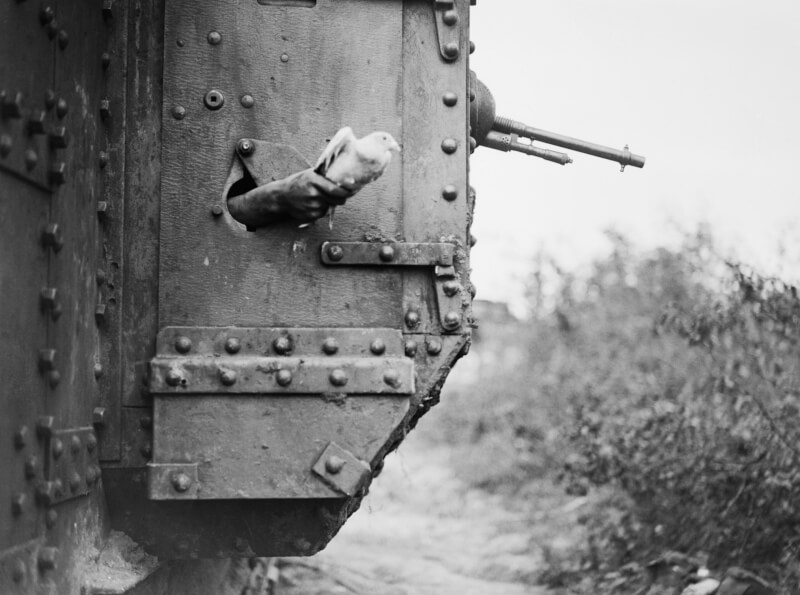
A message-carrying pigeon is released from a porthole on the side of a Mark V tank of the British Army’s 10th Battalion, Tank Corps during the Battle of Amiens. [Imperial War Museums/Wikimedia]
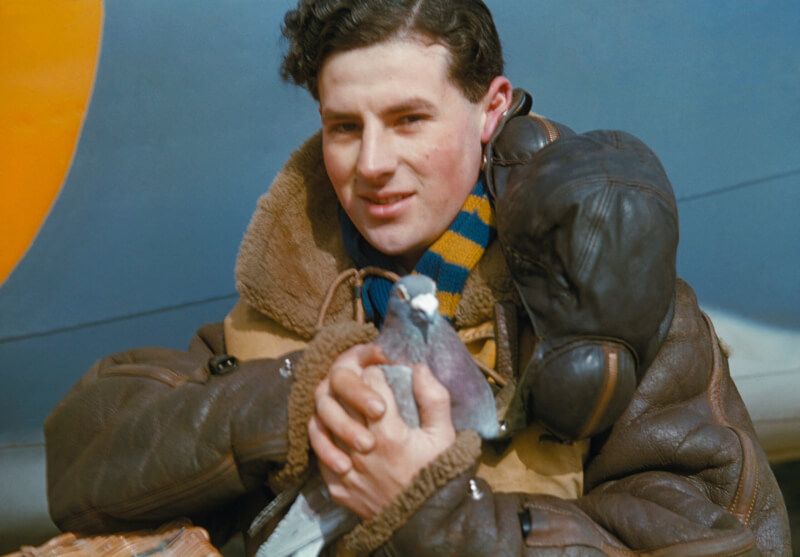
A member of the crew of a Lockheed Hudson for Royal Air Force Coastal Command holds a homing pigeon in 1942. [Imperial War Museums/Wikimedia]
The pigeon “knew nothing of the war that raged around it,” Corera wrote. “But for those involved in Columba, the values of sacrifice, duty and a love of home all came to be embodied in the humble pigeon’s flight.
“For a Frenchman or woman, or a Belgian living under occupation, there was the knowledge that the pigeon they released up into the sky was racing back to its home, bearing their message, to a land still free.”
The risks were high. Only one of every 10 pigeons dispatched by Columba made it home alive. Some were lost on planes shot down before the birds could be released. Others were dropped into the European countryside but never found, or were discovered and killed by German soldiers. Still others were found and eaten by hungry civilians.
“For a Frenchman or woman, or a Belgian living under occupation, there was the knowledge that the pigeon they released up into the sky was racing back to its home, bearing their message, to a land still free.”
Some pigeons were intercepted on the journey home by predatory hawks released by the German military along the European coastline.
Despite the obstacles, hundreds of these indomitable birds did make it to occupied Europe and back, carrying messages of interest to British intelligence.
One of the most celebrated messages—classified as Number 37—was sent back to England from Belgium early in the war containing invaluable details about enemy troop strength and movements, suggested co-ordinates for future bombing targets, as well as tiny hand-drawn maps. It amounted to pages of raw intelligence condensed in microscopic handwriting on pieces of rice paper—all carried home inside a canister on a pigeon’s leg.
So impressed was British intelligence by the message that its contents made it all the way to the desk of Prime Minister Winston Churchill. Three of the courageous Belgians in the group of friends who crafted the message—and carried out other acts of resistance throughout the war—were eventually discovered and executed by the Germans before Belgium could be liberated.
“Messages like Number 37 provided vital intelligence on Nazi plans to invade England during its darkest hour,” wrote Corera. Others provided “a unique and untapped insight into the realities of daily life under Nazi occupation, from the struggles over food, to the attitude toward collaborators, and even the often terrible impact of Allied bombing on those living under occupation.”
For their feats of heroism during the Second World War, 32 pigeons were awarded the Dickin Medal, the highest award for animal bravery in military service. The medal was created in 1943 by Maria Dickin, founder of the British charity People’s Dispensary for Sick Animals.
The only pigeon in the service of Canadian forces honoured with the Dickin Medal is Beach Comber, recognized for his “conspicuous gallantry or devotion to duty” for crossing the channel against all odds to deliver news of the Canadian landing at Dieppe.
Advertisement