



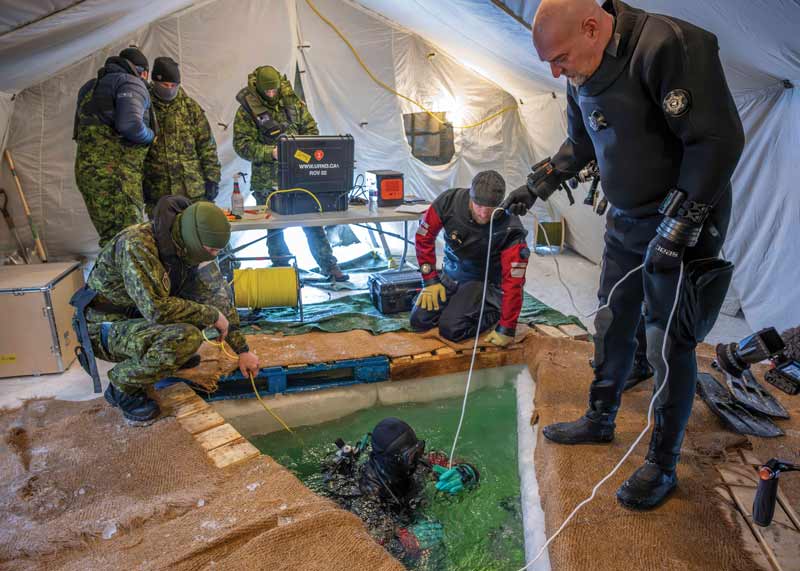
Canadian Armed Forces members work with colleagues of the Belgian Explosive Ordnance Disposal and Destruction Service during a February 2025 exercise near Tuktoyaktuk, N.W.T. [Master Corporal Alana Morin/Combat Camera]
Major Tristan Alie, a medical specialist and cold-weather expert with the Canadian Armed Forces, has long understood the stakes of military inaction in the Arctic.
Like an ever-increasing number of compatriots, the Quebec-raised anesthesiologist recognizes that climate change is warming the Arctic three to four times faster than the global average; that new shipping routes will open as a result; and that foreign powers, friend or foe, loom large in discourse concerning the vast, unforgiving landscape at the country’s remote edge.
Alie also appreciates the CAF’s role in this. “What we need to realize and own is that Canada is NATO’s Arctic expert,” he explained during a presentation at the Canadian Institute for Military and Veteran Health Research (CIMVHR) forum in October 2025.
“In all of NATO, we are the only ones that have the landmass and the sea-mass with, furthermore, populated communities, including populated military bases…that [are] equitable to one of NATO’s main adversaries: Russia.”
Asserting sovereignty and deterring foreign encroachment through the CAF’s growing northern presence, however, come with seldom-discussed hurdles from a medical standpoint.
“As we’re pushing more people up north,” said Alie, “we need to also make sure that we’re able to care for them and bring them back home. No soldier wants to be wounded in operations, but unfortunately, working in the Arctic is dangerous.”
The Arctic environment itself poses one of the greatest threats to soldiers, including medics. “Cold weather,” continued Alie referencing NATO doctrine, “requires special equipment, techniques [and] training for troops; otherwise, operations and personnel will suffer, goals will become unattainable and efforts will become a matter of simple survival against the elements.”
“As we’re pushing more people up north, we need to also make sure that we’re able to care for them and bring them back home.”
Knowledge is key, asserted the major, whose experience in the Finnmark region of northern Norway helped inform his presentation. “What we need to do at this present moment is get our medics loaded on courses,” he said. “That will give them that proficiency to survive in those cold-weather environments.”
Factors from nutritional considerations to contingency preparedness—if a soldier falls through ice or needs to build a shelter in a blizzard, for example—are vital for risk mitigation. “These are the kinds of training [components] that you need to know; to know how to look after yourself even before you can provide medical care.”
Nevertheless, precautionary measures can only stretch so far. Alie used blood as an example of the logistical complexities encountered in the Arctic, noting that it “has to be kept in very tight temperatures between one to six degrees Celsius. And also, once it leaves the blood bank, it lasts for about 21 to 28 days.”
Dried plasma and airdrops, albeit not without their own limitations in a capricious Arctic climate, were mooted as potential solutions to partly address transfusion constraints.
“We certainly hear a lot about drones,” added Alie, “but they’re not necessarily the easy fix button.”
Starker still were the realities of evacuating the wounded when point-of-injury trauma aid proved insufficient. In acknowledging a “big capability gap amongst NATO countries,” Alie insisted that “we can’t use a one-size-fits-all approach in terms of transporting these casualties,” namely due—once again—to unpredictable climatic conditions.
Compounding the issue is the deterioration of the CAF’s northern infrastructure. According to an evaluation of Arctic operations published by the government in October 2024 prior to recent investment announcements, military structures were “well below the CAF average and, without intervention, will soon move to the ‘rust out’ stage.” For instance, of 102 Arctic airfields—many of which were deemed “outdated”—less than 48 per cent could accommodate the admittedly large, but notably versatile CC-130 Hercules, with only 13 per cent usable for the CC-177 Globemaster.
Nor did structural assets fare well on a broad scale, 81 per cent of which were more than 30 years old, while 38 per cent of buildings were over 50 years old. The government has since pledged to increase the military’s Arctic footprint through infrastructural upgrades, among other commitments.
Complications persist beyond physically evacuating patients, many of whom could sustain wounds outside of CAF bases and airfields.
“There are only three hospitals with surgical capabilities in the North,” said Alie: “Iqaluit, Whitehorse and Yellowknife. If you look at a map, there’s a big empty space with no surgical care, and we need to be able to fill the void.”
Alie suggested that authorities could “bring some of our medical or surgical assets further forward,” even temporarily within smaller health centres. Such practices could play into the role of “medical diplomacy…ensuring that we still maintain that tight relationship with our communities up north because the Rangers are so essential, as we all know and appreciate in terms of our efforts right now.”
Of course, beyond a military context, that same medical diplomacy could help tackle wider challenges related to regional medical services—or lack thereof—that have disproportionately affected local Indigenous populations. The extent to which it could offset systemic failings is another question.
Establishing medical equipment caches throughout the Arctic could be another option, although Alie conceded that concerns remain surrounding the prolonged functionality of certain apparatuses, including ventilators, in the dry climate. “These are all things that we need to trial,” he explained.
With momentum underway, Alie spoke exclusively to Legion Magazine about his future outlook. “My vision is that working in an Arctic environment should be no different than doing any other kinds of exercises. It shouldn’t be seen as this gargantuan task if we provide the progressive, evolving training.”
Calling cold-weather operational readiness “not optional,” Alie equally hopes that “from a medical perspective, we’re there for the soldier.”
Advertisement