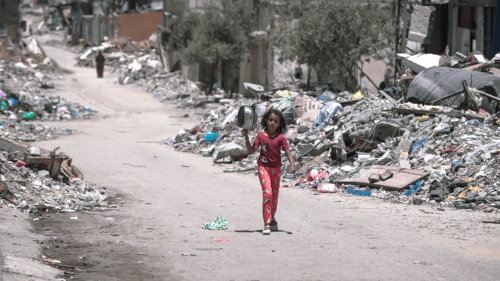



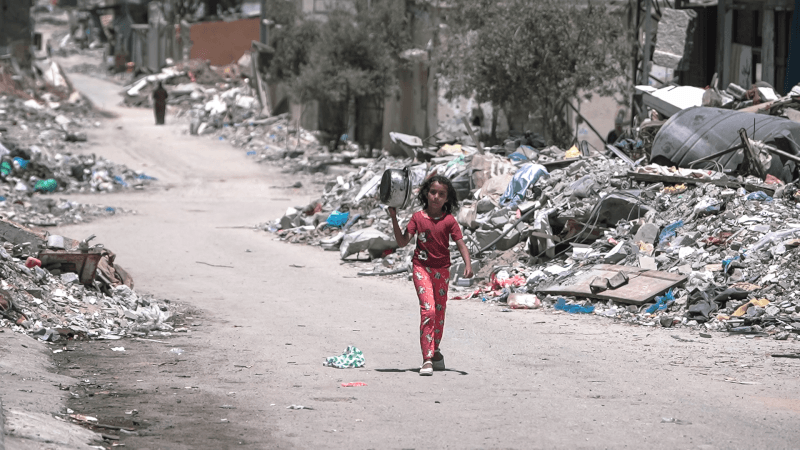
A girl walks in Gaza in Aug. 2024 during the Gaza–Israel war. [Jaber Jehad Badwan/Wikimedia]
Every year as Remembrance Day approaches, memories surface of my childhood growing up in the shadow of war.
One memory stands out. It’s Christmas eve in the late 1970s, and I’m with family gathered outside the front door of my grandparents’ cottage singing Christmas carols by candlelight. Some of the adults among us have semi-automatic FN rifles slung over their shoulders and emergency radios on their belts, in case we get attacked—in the midst of “Good King Wenceslas”—by guerrilla fighters lurking in the darkness.
Those rifles are locked and loaded as our merry group of carolers walks back across a field to the main farmhouse where my aunt and uncle live. Once an attractive, colonial-era home with large windows and spacious verandahs, the house has now been turned into a fortress, with a high brick gun tower and outer defensive walls designed to protect against possible grenade attacks.
I grew up in the Rhodesian Civil War, and although I never personally experienced the true horrors of the conflict, its dystopia was all around—older cousins and parents called up for military service and combat duty in the bush; guns and camouflage everywhere; war propaganda in the form of songs and nationalist mantras; nightly reports on the TV news about murdered civilians and soldiers killed in “contacts” with the enemy.
My mother eventually had enough of that madcap life and moved with her children to Canada, where I have enjoyed the peaceful blessings of this country ever since.
However, as a journalist I’ve seen how war has also disfigured other peoples and places.

In Rwanda, I once stood inside a church filled with the skeletons of hundreds of people who had taken refuge there during that country’s genocide but were hacked to death in the pews. In Beirut, I’ve marvelled with sadness at the bomb-scarred ruins of a once-lovely Mediterranean city. In Afghanistan, I’ve seen the ashen faces of shaken troops in the aftermath of a roadside bomb explosion, and I’ve encountered other soldiers who came home to Canada missing limbs or inside flag-covered caskets.
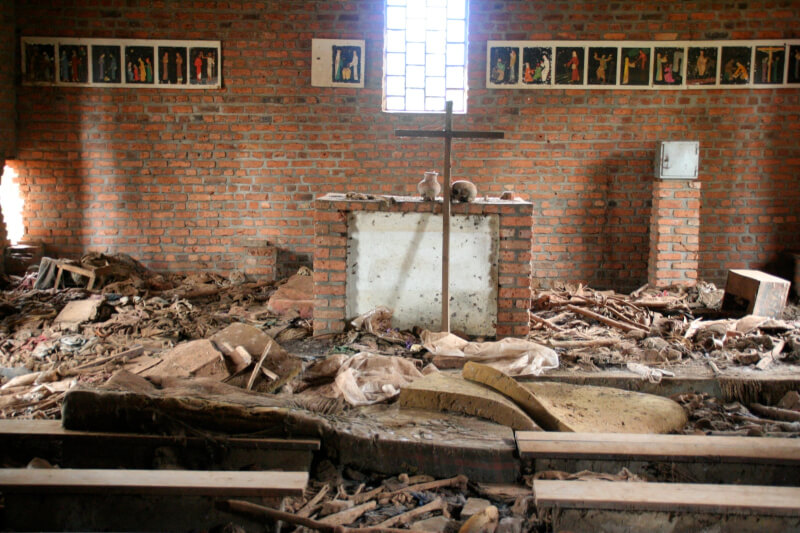
The altar of Ntrama Church, where 5,000 people were massacred on April 15, 1994, during the Rwandan genocide. [Scott Chacon/Wikimedia]
There is no splendour in war. It breaks people, it traumatizes families, it twists and warps societies. As the great American Civil War General William Tecumseh Sherman once said, “I am tired and sick of war. Its glory is all moonshine.”
But such truths are easy to forget.
Canadians’ eager participation in the early wars of the 20th century was fuelled by jingoism and deep loyalty to the British Empire. In 1899, many newspapers were filled with frenzied calls to join the Boer War. When the survivors of the first Canadian contingent—those who had not died of dysentery or from Boer bullets—returned home after a year of service, poet Wilfred Campbell described them in hallowed terms:
“Canadian heroes hailing home,
War-worn and tempest smitten,
Who circled leagues of rolling foam,
To hold the earth, for Britain.”
Although Canada was automatically engaged in the First World War, ardent patriotism and a sense of foreign adventure once again gripped the country and helped fuel the mass mobilization of troops from 1914 onward. The horrors of the Western Front would later dampen enthusiasm for participating in yet another European conflagration, but Nazi aggression and the threat of fascism convinced most Canadians to do their duty and support the cause of the Second World War.
Half-a-century after the Korean War, the shock of 9/11 also persuaded many Canadians to once again go to war and support the country’s allies in Afghanistan.
Honouring the immense sacrifices of this long and justifiably proud history of military service is the broad reason behind Remembrance Day and the activities that surround it. But exactly what is being remembered—and in what spirit—is a question worth considering.
Alongside the reflections on service and sacrifice, should remembrance also not require an acknowledgement that war, even “necessary” war, is a tragic undertaking representing collective human failure?
There is a fine line between remembering wars authentically—understanding their causes and conduct, and honouring those who fought them—and viewing them with sentimentality or with a kind of glib fascination in which war passes as spectacle or entertainment.
Alongside the reflections on service and sacrifice, should remembrance also not require an acknowledgement that war, even “necessary” war, is a tragic undertaking representing collective human failure?
This is not an argument for pacifism, which carries its own more serious delusions and dangers. Pacifism—and the willful ignorance of history—provides no solution to the problems posed by Adolf Hitler, Osama bin Laden and Vladimir Putin. Rather, this is a plea to keep the cold, merciless realities of war at the centre of military history, and at the heart of all remembrance.
Too often, those of us who write about war slip into the trap of nostalgia. Sometimes we sensationalize war stories or glamourize the Canadian experience. I’ve been guilty of stepping over this line. When this happens though, we lose sight of the fact that war—despite compelling extraordinary acts of courage—radiates violence on all fronts, inflicting trauma that lasts for generations.
Poet and novelist Rudyard Kipling, one of the great cheerleaders of imperial Britain, was an early and vocal advocate of going to war against Germany in 1914. Kipling encouraged his only son John to enlist and even used his influence to obtain a commission for John in the British army after he was initially rejected for having poor eyesight.
In September 1915, John Kipling was killed at the Battle of Loos, France, at 18. His death devastated his father, and—along with the wider carnage of the First World War—changed Rudyard Kipling’s attitudes on war. He would later write one of the most powerful anti-war epitaphs of all time:
“If any question why we died,
Tell them, because our fathers lied.”
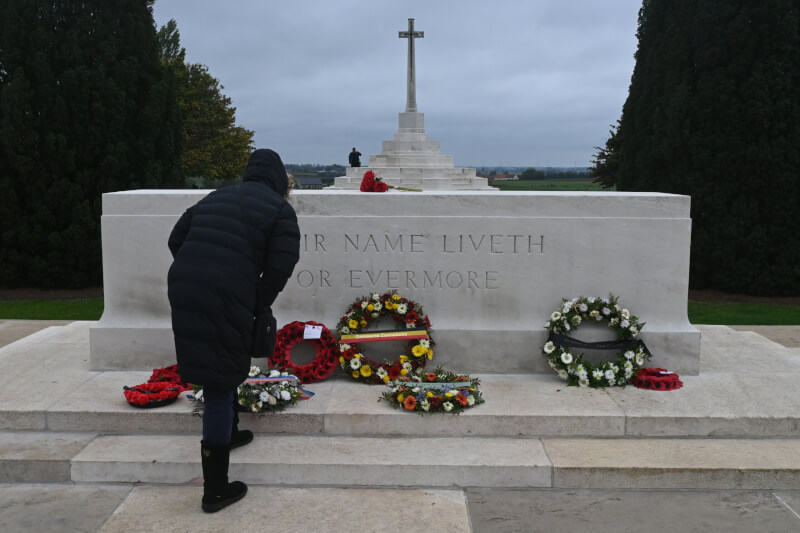
A visitor examines wreaths laid at Tyne Cot Cemetery near Ypres, Belgium, which holds the graves of nearly 12,000 Commonwealth soldiers killed in the area during the First World War. [Richard Foot/LM]
Advertisement