


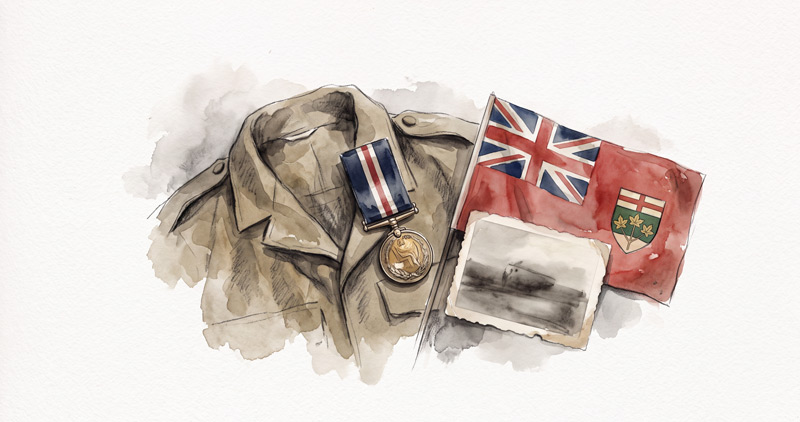
Legion branch that surrendered its charter more than 80 years ago is poised to return after a fashion. No. 9 branch in Vancouver, its members all Japanese-Canadian veterans of the First World War, voluntarily relinquished its status in 1942 as a sign of good faith.
“The members of the Japanese branch, Canadian Legion, are resolved to pledge our unflinching loyalty to Canada, as they did in the last Great War, and furthermore resolved to make supreme sacrifice in defence of Canada in this unprecedented crisis which faces her now,” wrote Branch President Masumi Mitsui, a Great War sergeant who had earned the Military Medal, in a telegram to Prime Minister Mackenzie King on Dec. 11, 1941, just four days after the Imperial Japanese Navy attack on Pearl Harbor.
King’s private secretary responded on the prime minister’s behalf to, “express the government’s appreciation of the promptness of the action taken by its members in making immediately known their readiness to serve Canada whenever their services may be required.”
As a community historian, I have spent nearly 20 years researching Japanese-Canadian veterans of the First World War. While working on a book about the 196 original Japanese-Canadian volunteers rejected by B.C. who then travelled to Alberta to enlist, I learned about the fate of No. 9 branch. It intrigued me greatly and, as The Royal Canadian Legion celebrates its 100th anniversary in 2026, I worked to not only uncover the mystery, but to push to establish a branch in its honour.
Branch 9 had been formed as part of the Great War Veterans’ Association in 1924. Fifteen veterans of Japanese descent who had fought for Canada became charter members of the Canadian Legion after its formation in 1926. While some Japanese-Canadian veterans joined local branches, most living in the Greater Vancouver Area joined No. 9.
Particularly notable among the branch’s endeavours was its support in efforts to get Japanese-Canadian Great War veterans the right to vote, which was granted in 1931 after more than a decade of lobbying. That work was led by Saburo Shinobu, an advisor to Japanese-Canadian veterans, who had also worked tirelessly to help them reintegrate into civilian life after the war and as an interpreter. He attended every Legion national and B.C. convention between 1925 and 1942 and was one of the first Canadians to be named an honorary lifetime member of the organization. In 1936, Shinobu led a delegation of seven on the pilgrimage to the unveiling of the Canadian National Vimy Memorial, placing a wreath at the monument on behalf of No. 9. The names of 24 Japanese-Canadian soldiers are included on the memorial.

After the outbreak of the Second World War, the branch was as supportive of the country’s efforts as any other. In May 1941, it donated 31,000 Legion cigarettes to Canadian soldiers. And all 45 members at the time, average age 53, reported for Home Guard duty. Still, despite their support and loyalty, No. 9 members were forcibly uprooted from their communities along with some 22,000 other Japanese-Canadians in spring 1942 as part of a federal internment policy.
In March, No. 9 surrendered its charter “to prevent any embarrassment to the Legion through its continued membership,” David McKee, B.C. secretary of the Legion, told The Vancouver Daily Province in April 1948. “They were assured when they surrendered it that every consideration would be given to [reclaim their charter],” said McKee. One historic document reports the charter was only to be relinquished until “the end of the war with Japan.”
But that April, Branch No. 2 in New Westminster, B.C., voted down a resolution to reinstate No. 9. “Considerable controversy arose over the recommendation and it was only with a small margin that the motion was defeated,” wrote the newspaper. “Supporters of the resolution asserted that the Japanese who served Canadian forces in World War I, were still loyal to this country and that they were still Canadian citizens living in a democratic country.
“Opposition stated that the Canadian Legion did not want to be responsible for bringing the Japanese element back to the coast,” the story continued, “and suggested that if a charter was granted that it be in an area already designated by law for them.”
Regardless, the branch remained in limbo until I contacted the Legion in March 2026. After providing the organization with historical evidence, it agreed that it would consider a charter for a new branch. Twenty-nine descendants of No. 9 members—including David Mitsui, grandson of the president who relinquished the charter, and a granddaughter of Shinobu—formed a group of prospective Legionnaires and made a resolution for a new branch charter. It was approved in the summer. History in action.o
Learn more about the history of Branch No. 9 at https://acrobat.adobe.com/link/spaces/urn:aaid:sc:US:653c32cf-b7ce-408a-809e-dedc80c90fe6.
Advertisement