

Kanyen’kehà:ka (Mohawk) Corporal Huron Brant (left) of the Hastings and Prince Edward Regiment receives the Military Medal from Lieutenant-General Bernard Montgomery on Sept. 23, 1943, in Catanzaro, Italy. [DND/LAC/PA-130065]
Alongside those listed are their Indigenous nations—Mi’kmaq, Mohawk (Kanyen’kehà:ka) and Ojibwe. Anishinaabe, Cree and Saulteaux (Nahkawininiwak). Coast Salish, Shuswap (Secwepemc), Squamish (Sḵwx̱wú7mesh) and on and on.
Some survived the wars they fought, others died from disease or wounds, while others went missing or were killed in action. But what is most striking about this list is the sheer number of entries—19,152—all Indigenous soldiers who fought for Canada from colonial times to the present day.
This week, as Canada marks the National Day for Truth and Reconciliation, it’s appropriate to remember the singular, often unsung contributions of Indigenous veterans throughout the country’s history.
Officially, about 7,000 First Nations people from across Canada served in the First and Second world wars. How many non-status Indigenous people also served was unknown until relatively recently, when Castelnot—an amateur researcher and historian—began digging deeper.
His research suggests that approximately 14,800 Indigenous people, including Métis and Inuit, served Canada in the two world wars.
Castelnot grew up in France before immigrating to Canada in 2005. Coming of age in the Pas-de-Calais region of northern France—bounded by Vimy Ridge and the Somme on one side, and the fields of Flanders on the other—he was surrounded by First World War cemeteries and monuments, or what he calls “powerful reminders of the cost of war and freedom.”
Castelnot became curious about the history of Indigenous Peoples in North America, and he later created the Research Association of Native American Veterans. So began a self-funded, lifelong volunteer project to document and collect stories of Indigenous people’s involvement in war from colonial times to the present.

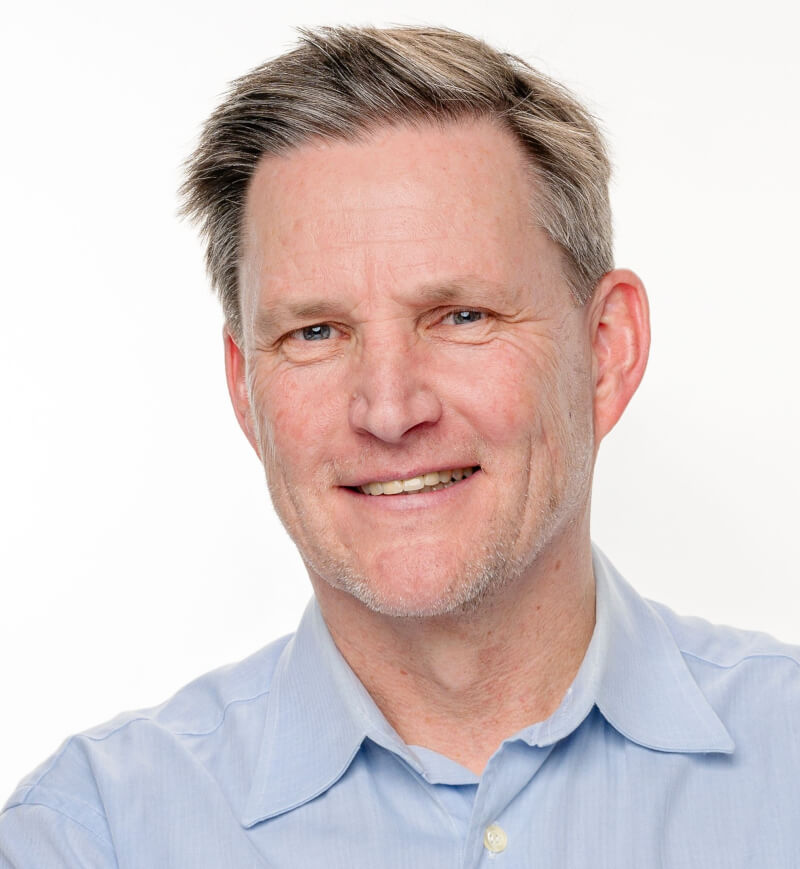
Yann Castelnot receives a commendation for his work from then-Veterans Affairs Minister Seamus O’Regan in 2018. [Courtesy Yann Castelnot]
His main historical sources include federal government records, war diaries, enlistment forms, as well as local cemeteries and memorials.
A member of The Royal Canadian Legion who works as an accountant in Rivière-du-Loup, Que., Castelnot’s two decades of research were recognized by the Canadian government in 2018, when he was awarded the Sovereign’s Medal for Volunteers by the governor general, as well as a commendation from Veterans Affairs Canada.
His motivation, he has said, is simply to remind society of the contributions of Indigenous veterans, many of whom did not have the right to vote, nor were considered equal citizens, when they enlisted to serve the country.
Also worth remembering is the discrimination that Indigenous veterans experienced upon returning home from the battlefields of the early 20th century. After the First World War, many were denied the same financial benefits paid to non-Indigenous veterans.
And when some status First Nations soldiers returned home from the Second World War, the government said they had forfeited their status under the Indian Act, because they had been absent from their reserves for four years.
“We forget,” Castelnot has said, “that during modern wars [Indigenous people] massively engaged voluntarily, and were brave soldiers respected by their brothers in arms.”
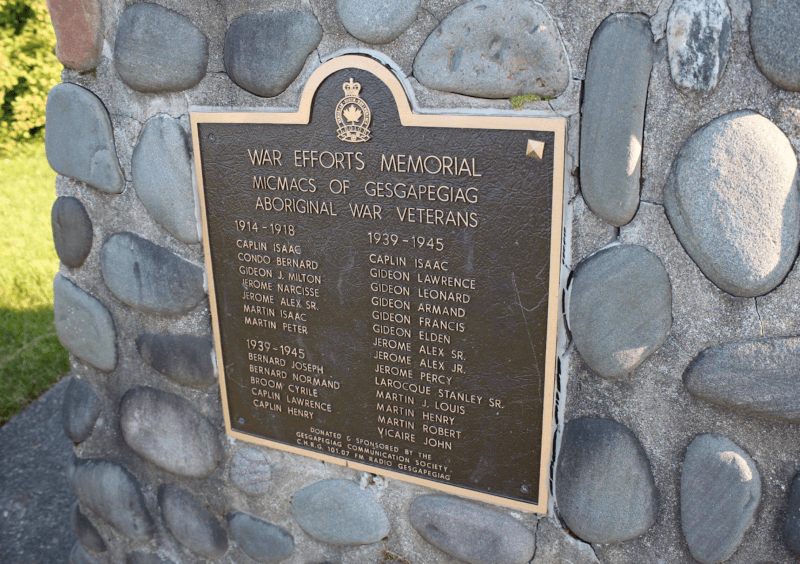
The Gesgapegiag Cenotaph inscribed with the names of the community’s fallen soldiers, including Frank Narcisse Jérome. [nativeveterans.e-monsite.com]
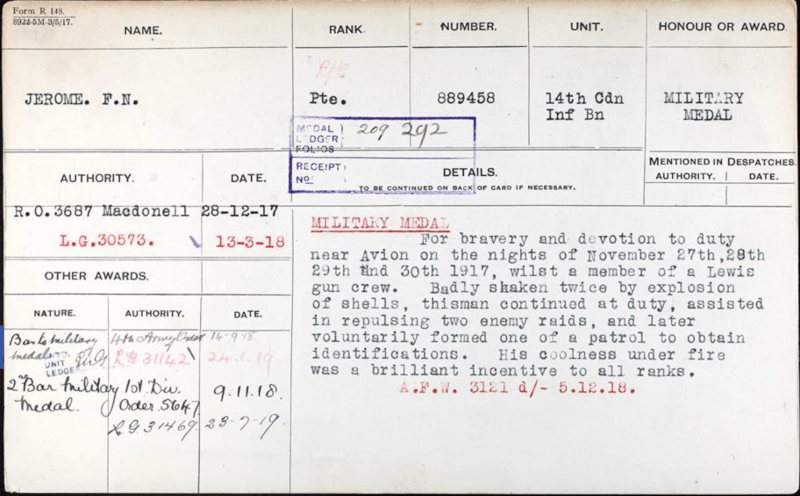
The citation for Jérome’s first Military Medal. [nativeveterans.e-monsite.com]
In late November 1917, as part of a Lewis machine-gun crew manning a front-line trench, Jérome, under fire from intense shelling, helped fight back a series of enemy raids on his lines. He then organized a volunteer patrol to go out and search no man’s land to identify his fallen comrades. He was awarded the Military Medal for “coolness under fire.”
During the fighting of 1918, Jérome’s bravery earned him two more citations—adding two bars to his Military Medal—in one case, for assisting a wounded comrade despite being wounded himself.
Jérome made it home from the war, but died in 1934 of pneumonia, aged 47 or 48, according to The Canadian Encyclopedia.
“Although Jérome is one of the most decorated Canadian soldiers of the First World war, and one of the most honoured Indigenous veterans on record, he is only recently receiving the attention he deserves,” states an Encyclopedia entry published in 2019, which credits Castelnot’s research for bringing Jérome’s heroics to light.
“Jérome is now recognized as one of only 39 Canadian soldiers who received the Military Medal with two bars during the Second World War,” reads the entry.
Also in Castelnot’s database are the Tomkins brothers—Charles, Frank, Henry, James, Peter and stepbrother John—members of a large Métis family in Alberta, all six of whom served in the Second World War.
As a result of his fluency in Cree, Charles was one of dozens of Indigenous people recruited into Canada’s code talker program. He translated military intelligence messages and other vital communications into Cree to hide their meaning from the enemy. On the receiving end, another Cree speaker would translate them back into English for the commanders in their unit.
After serving in France, Holland and Germany, Charles returned to Canada, but the details of his service in the war remained a mystery to his family because code talkers had been sworn to secrecy. Most of Charles’ family only learned about his exploits shortly before his death in Calgary in 2003 at age 83. His story has since been told in a documentary, Cree Code Talker (above), by director Alex Lazarowich.
The Canadian names on Castelnot’s list include more than 2,000 Indigenous soldiers who died during their wartime service. One such soldier is among the most recent additions to the database:
Master Corporal Kristal Giesebrecht, a medic with 1 Canadian Field Hospital at Canadian Forces Base Petawawa, Ont.—and a member of Kenhtè:ke Kanyen’kehá:ka (Mohawks of the Bay of Quinte)—died during her second tour in Afghanistan, in June 2010, when she and medical technician Private Andrew Miller were struck by an improvised landmine that exploded in a doorway of a home near Kandahar.
At the time of her death at age 34, Giesebrecht’s military colleagues remembered her as a devoted wife and stepmother, and an “absolute sweetheart” who “loved helping people.”

Master Corporal Kristal Giesebrecht. [VAC]
Advertisement