


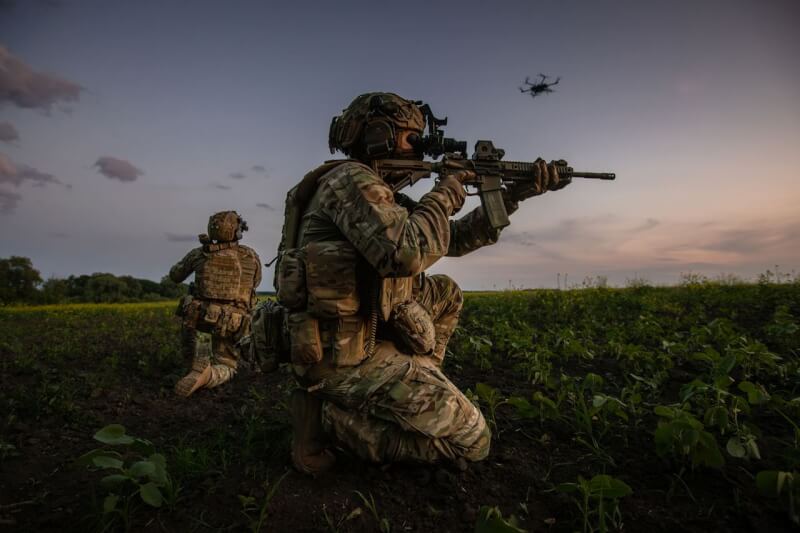
Ukrainian Special Group Alpha operators alongside a multirotor FPV drone in 2023. [Lycksele-Nord/Wikimedia]
This is, for better or worse, a revolutionary time in military terms. The world is witnessing one of those game-changing moments when a new idea or technology tested on the battlefield upends conventional wisdom about how to fight a war.
Drones and autonomous weapons have humbled both Russia in Ukraine and the U.S. in the Persian Gulf, sending their militaries reeling like prizefighters unexpectedly knocked to the mat.
So far this year, drones were mostly responsible for killing and wounding more than 30,000 Russian soldiers every month in Ukraine, according to the U.S. Center for Strategic and International Studies. In the Persian Gulf, Iranian drones have stymied the U.S. and Israel, allowing Iran to flex its muscles over the Strait of Hormuz.
Traditional military forces around the world, including NATO’s, are scrambling to adapt.
“The army NATO built to meet Soviet tanks is meeting a battlefield made transparent by $20 optics and ruled by hobbyist explosives,” wrote Rafal Rohozinski, founder and CEO of the SecDev Group, an Ottawa-based consultancy, in a recent column in the Globe and Mail.
“The old way of fighting,” he wrote, “is no longer survivable.”
While drones may be new, changes imposed on warfare by transformative technologies have occurred throughout history, forcing combatants to adapt—or die. Here are seven other innovations that radically altered the approach to war.
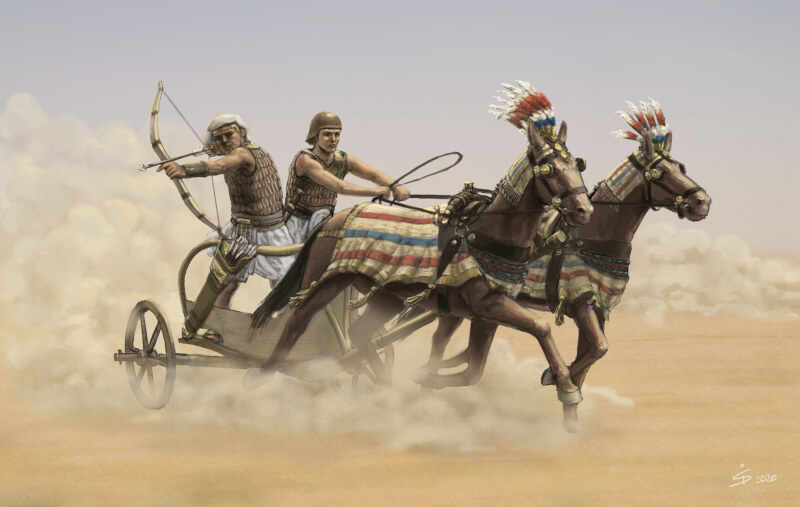
An illustration of an Egyptian war chariot from the Early New Kingdom period (16th and 11th century BC), based on historical wall paintings, armour and the chariot found in Tutankhamun’s tomb. [Angus McBride/World History Encyclopedia]
Ancient warfare was once conducted almost exclusively on foot, with infantry packed into tight fighting formations. The lightweight chariot, which emerged first in Asia around 1800 BC, introduced rapid movement to the battlefield, with a two-man team—a driver and archer—drawn by horses.
Speeding chariots posed a serious challenge to foot soldiers, running them over or peppering them with arrows. The wealthiest states of the ancient world, including Greece and Rome, built thousands of chariots for their armies.
“Chariots were the superweapons of their age,” said Alex Roland, a military historian at Duke University. “They trumped everything else and became the decider of warfare.”
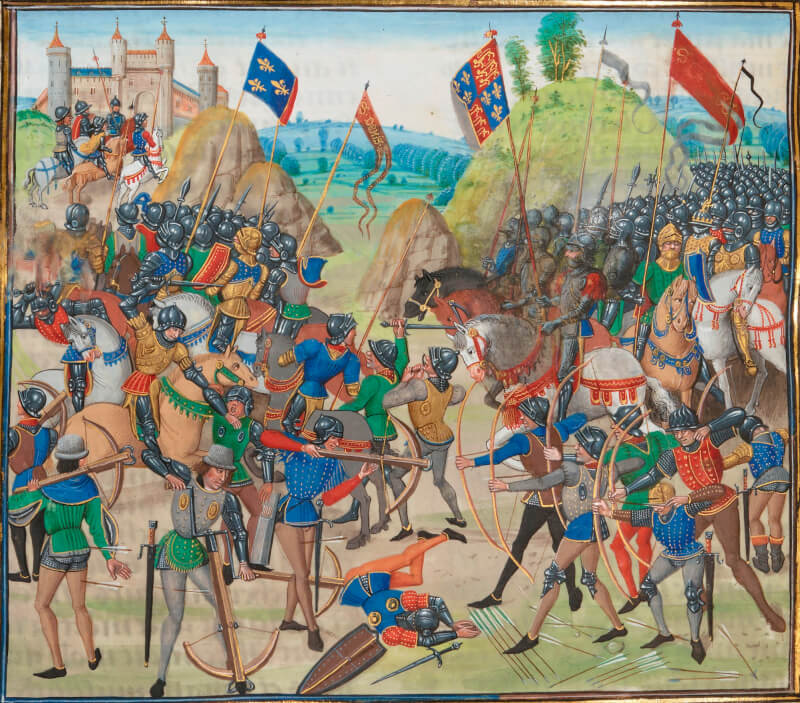
A late 15th-century illustration of the Battle of Crécy depicts English longbowmen (foreground, right) driving away Italian mercenary crossbowmen. [Gallica Digital Library/ btv1b84386043/f354]
The English longbow revolutionized warfare in the Middle Ages.
A single piece of carved wood about the height of a man, the longbow was a heavy weapon requiring considerable strength and years of training. In the hands of a skilled archer, it could rain death from the sky.
The longbow had a faster rate of fire and greater range than the crossbow. It could also pierce chainmail and some basic armour.
During the Hundred Years’ War, English longbow archers defeated thousands of elite, heavily armed French knights massed at the 1346 Battle of Crécy. In 1415, the longbow was also an important factor in the English victory over a much larger force of French cavalry and crossbow archers at Agincourt, one of the most famous battles in British history.

A U.S. Military Telegraph battery wagon is stationed at a Union Army headquarters in Petersburg, Va., in June 1864. [Library of Congress/LC-DIG-cwpb-04330]
Private telegraph companies had been operating in the U.S. since the 1840s, but it wasn’t until the Civil War in 1861 that that the telegraph became a transformative instrument of war.
Telegraph lines allowed almost instant communications between staff headquarters and the front lines. For example, orders to rapidly concentrate forces to counter sudden Union advances contributed to the Confederate victory at the First Battle of Bull Run.
The telegraph also revolutionized the relationship between the military and the executive branch of government, empowering political leaders to issue strategic advice and commands to field generals.
“[President Abraham Lincoln] used the telegraph to put starch in the spine of his often all-too timid generals and to propel his leadership vision to the front,” wrote Tom Wheeler, author of Mr. Lincoln’s T-Mails: How Abraham Lincoln Used the Telegraph to Win the Civil War.

Some 55,000 Mauser rifles were among the most modern weapons available to the Boer armed forces at the beginning of the 1899-1902 war. [IWM/FIR 7246]
Smokeless gunpowder paired with the bolt-action repeating rifle heralded the age of modern warfare.
The adoption of smokeless powder in the late 19th century meant that a rifle shot was no longer accompanied by a cloud of black smoke, keeping the shooter’s position a secret and their vision clear. More importantly, the gases produced by the new powder, when ignited, expanded at a faster rate, propelling the bullet from the rifle’s muzzle at higher velocity. This in turn allowed for the use of smaller calibre bullets, increasing range and accuracy—and when coupled with a bolt-action magazine rifle, a much higher rate of fire.
The deadly effectiveness of these innovations was first witnessed on a large scale in the Boer War of 1899-1902, when Boer commandos, armed with smokeless ammunition and German Mauser repeating rifles, gave the British “no end of a lesson,” as Rudyard Kipling famously put it.
More than 30 Canadian soldiers died at the Battle of Paardeberg in 1900 because of accurate enemy fire from distant trenches.
“The central tactical lesson of the Boer War,” wrote Thomas Pakenham in his definitive history, The Boer War, “was that the smokeless, long-range, high velocity, small-bore magazine bullet from rifle or machine gun—plus the trench—had decisively tilted the balance against attack and in favour of defence.”

A Canadian sentry in a front-line trench, possibly photographed in August 1916 in the Ypres salient. [W.I. Castle/DND/LAC/PA-000568]
If the key lesson of the Boer War had been fully grasped by European war planners, perhaps Germany might never have foolishly sent its army marching through Belgium and France 12 years later. What followed was four years of slaughter and static stalemate along a vast network of trenches stretching some 700 kilometres from the North Sea to the Alps at the Swiss border.
Entrenchment was the only obvious solution to the fury of modern rifle and machine-gun fire. And though the trenches of the First World War had their horrors, they were also a marvel: intricately laid out behind lines of barbed wire and layered with multiple rows of reserve trenches, they also included sandbagged bunkers housing staff headquarters, ammunition storage and deep dugouts to protect troops against punishing artillery bombardments.
The quandary of how to overcome the defensive riddle of the trenches eluded both Allied and German generals for years. Then, starting in 1917, a series of other innovations—the combined arms approach of closely co-ordinated infantry and artillery attacks, the appearance of tanks, and the empowerment of decision-making down to junior officers at the platoon level—moved the pendulum back in favour of offensive action, and eventually, to the war’s end.

Three Sikorsky helicopters on Canadian aircraft carrier HMCS Bonaventure in 1957. (DND/LAC/4951209]
The aircraft carrier
Aircraft carriers first entered the fleets of the world’s naval powers in the 1910s and 1920s, along with the rise of military aviation. In the Second World War, carrier-based dive bombers and torpedo-armed aircraft made once-feared battleships obsolete. The war in the Pacific, particularly the Japanese bombing of Pearl Harbor and the subsequent battles of the Coral Sea and Midway, proved that aircraft carriers allowed countries to project sea and air power across oceans.
Although the modern aircraft carrier still rules the waves, long-range submarines, hypersonic missiles—and drones—may soon test the limits of its effectiveness.
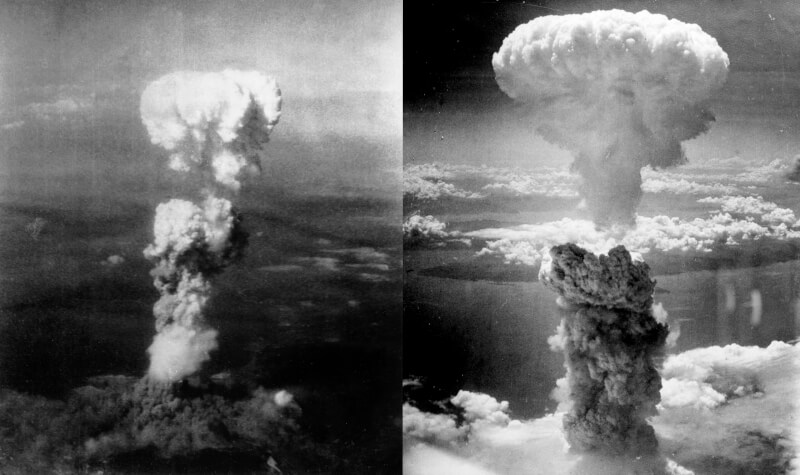
Atomic bomb mushroom clouds over Hiroshima (left) and Nagasaki (right. [George R. Caron / Charles Levy/Wikimedia]
Only twice have atomic weapons been used in war: the U.S. bombings of Hiroshima and Nagasaki on Aug. 6 and 9, 1945. The results, while decisive, were so horrifying that nuclear weapons were deemed too terrible to ever use again.
This may be the only military technology whose power comes not from its actual use, but from deterrence—a concept chillingly captured by the threat, and promise, of mutually assured destruction.
Read “The Drone Age (Part 2): A deadly kill zone unlike anything warfare has ever seen” on July 15.
Advertisement