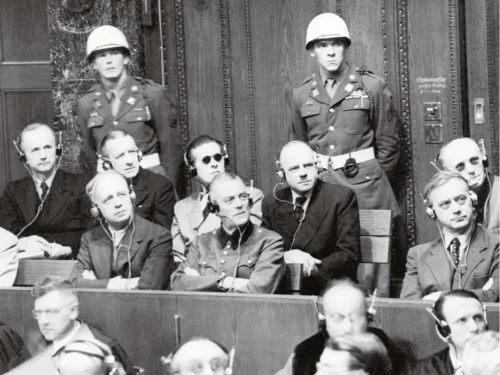



Top Nazi leaders faced war crimes trials after the Second World War but many others who took part in the Holocaust went unpunished. Some may have settled in Canada. [Courtesy U.S. National Archives]
Yet somehow, it took more 70 years for Canadians to learn the truth about how Nazi war criminals and collaborators were later provided safe haven in this country.
The story of how the Canadian government allowed dozens of Nazis and their enablers to settle in Canada in the 1950s—including how Canadian officials were duped and pressured by American agents into accepting those who otherwise would have failed security checks—has finally been revealed with the release of a once-classified report.
In September, after a years-long legal battle by the Jewish advocacy organization B’nai Brith Canada, the Federal Court ordered Ottawa to remove almost all redactions in a 618-page report titled “Nazi War Criminals in Canada: The Historical and Policy Setting From the 1940s to the Present.”
Better known as the Rodal report, the document was written by historian Alti Rodal on behalf of the 1985-86 Commission of Inquiry on War Criminals in Canada, led by former Quebec judge Jules Deschênes. The report lays out in comprehensive detail the findings of the commission’s investigation of how Canada became a haven for Nazi criminals and collaborators.
While much of the report has been public for years, Ottawa kept the most sensitive parts redacted on the grounds that their release might harm Canada’s international relations, including those with allied countries.
Rodal and her commission colleagues had always intended for their report to be fully public, but as recently as 2023, much of it was still hidden.
Some redactions were dropped in 2024 as B’nai Brith began pressing Library and Archives Canada for more disclosure. However, a key section detailing a U.S. program to settle Nazis in Canada remained redacted until last month, when the court—against the wishes of the federal cabinet—said the public had the right to know the full details of this history.
The government did not appeal the decision.
“This is a historic outcome,” said B’nai Brith CEO Simon Wolle in a statement earlier this month. “We are pleased this information has been made available to historians, survivors of the Holocaust and their descendants, and the public. The time has finally come to obtain justice for the Jewish people, for Canadians to learn from the past, as well as to pursue truth and accountability in Canada.”

In September, after a years-long legal battle by the Jewish advocacy organization B’nai Brith Canada, the Federal Court ordered Ottawa to remove almost all redactions in a 618-page report titled “Nazi War Criminals in Canada: The Historical and Policy Setting From the 1940s to the Present.” [Courtesy B’nai Brith Canada]
In return for their co-operation, Nazi collaborators from Germany, Ukraine, the Baltic states and across eastern Europe were offered safe haven in North America, South America and elsewhere via the Research and Resettlement Branch of the U.S. Army Europe (USAREUR).
According to the recently unredacted sections of the Rodal report, that organization was a cover for the Central Intelligence Agency (CIA) and other branches of U.S. intelligence, which undertook an “active and organized program” to resettle informants in Canada and other western countries.
Among the Rodal report’s other recently revealed findings:
- Some in the U.S. resettlement scheme were convicted criminals, including some with crimes of “moral turpitude”—the category under which Nazi collaborators were prosecuted.
- The U.S. tried to deceive Canada by creating fake backgrounds and identities, along with false documents, for informants in the resettlement program to pass Canadian immigration security checks.
- One U.S. intelligence official—who would later serve as the CIA’s representative in Ottawa—“requested that Canadian security screening personnel accept upon recommendation by U.S. authorities certain immigrants to Canada without checking their background.”
- Some Canadian immigration officials based in Europe were aware of the falsified documents of Nazi collaborators but provided security clearances anyway.
- Others were less willing. In 1954, the RCMP rejected 52 U.S.-sponsored applicants on security grounds, while also reporting to Ottawa that 35 similar immigrants had already settled in Canada with U.S. assistance. Said the Rodal report: “The RCMP for its part was convinced in 1954 that larger numbers than those actually detected had been pushed through the Canadian immigration stream with false documentation arranged by USAREUR.”
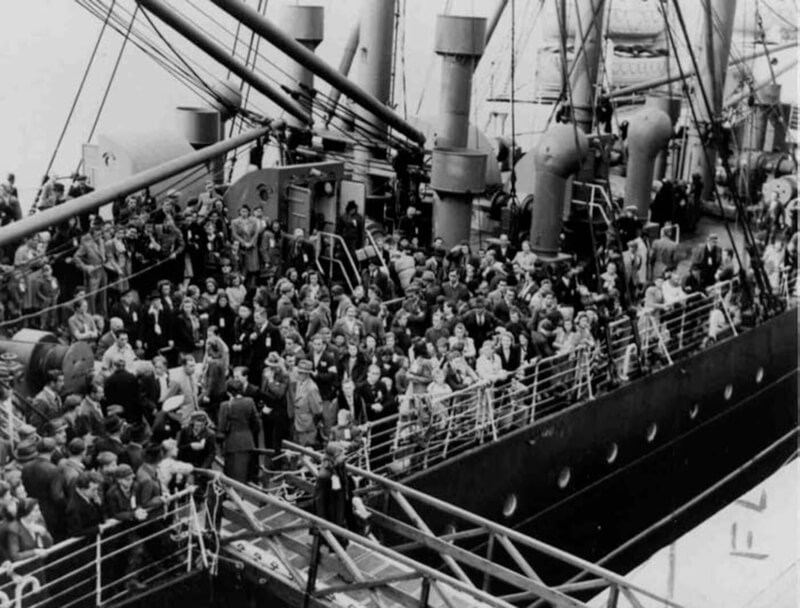
Immigrants disembark S.S. Beaverbrae in Quebec. The former German navy supply ship was given to the Canadian government as war reparations. Re-fitted in 1947, it made 52 crossings every 28 days between Germany and Canada from 1948 to 1954. [CPR/LAC]
Canada had just fought an all-out war to defeat Nazi aggression and ideology. At the very least, weren’t the million-plus Canadians who served in uniform, including the more than 43,000 who lost their lives, owed the respect of a more vigilant stance against Nazi refuge in Canada?
The Rodal report says that “a relationship of trust and a sense of common cause would have made Canada vulnerable to possible abuse by American and British government agencies.”
Certainly, the focus of the early 1950s had shifted to the Cold War. Fascism was no longer a threat, while communism was the new bogeyman. But amid the Korean War and the anti-communist zeitgeist, could antisemitism have also played a part? Even as the world was then coming to grips with the full scope of Nazi horrors in the Holocaust, Canada continued to deny entry to most Jewish refugees from Europe.
“It is a scandal that, during a time when Canada maintained severe restrictions on Jewish immigration to this country, it facilitated the entry of perpetrators of Nazi crimes,” B’nai Brith’s Simon Wolle has said.
Finally, why is Ottawa still not releasing Part II of the report of the Deschênes Commission, believed to contain the list of actual names of several hundred Nazi collaborators admitted into Canada and identified by its investigation?
Most, if not all, of those people are now likely dead. Pulling the veil off that report remains an objective of B’nai Brith.
“Canadians,” said Wolle, “have a right to know more about the circumstances surrounding the resettlement of Nazi war criminals in this country.”
Advertisement