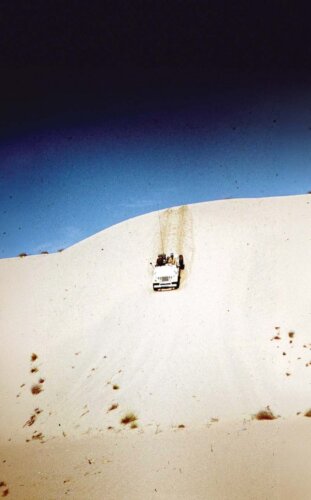



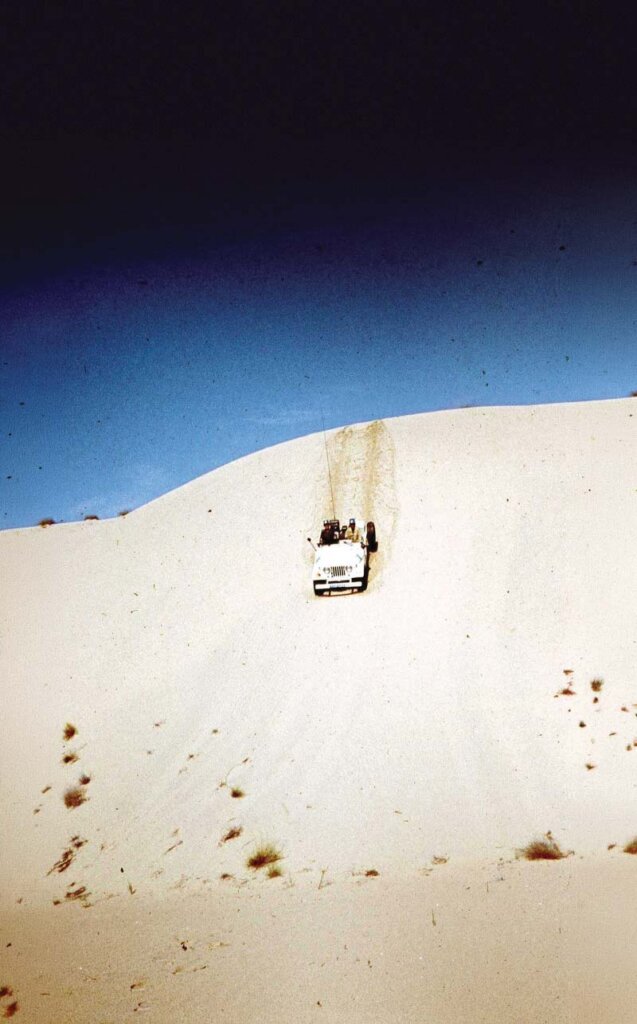
A United Nations Emergency Force patrol. [Courtesy Jack Dangerfield]
Captain Norman Trower of the Royal Canadian Engineers was sitting in his Ottawa home at 11:30 p.m. on a Saturday in November 1956, when he received a call from the army’s chief engineer, Colonel Ted Webb. It was short and to the point.
“Get down to headquarters,” Webb told Trower.
He promptly put on his uniform and went, as Trower recalled in a 2001 interview for the Canadian War Museum. On arrival, Webb told him, “The QMG [quarter master general] wants to see you.”
Trower and a few officers representing other corps filed into the office of the QMG, Major-General Geoffrey Walsh, a fellow engineer. Walsh looked the group over and said: “You’re a recce party and you’re going to Suez.” He then turned to Trower with added guidance: “You’re a sapper. You know what to do in a recce. Get to it.”
With that direction, the small group left Walsh’s office. Canada’s first peacekeeping mission had just begun.
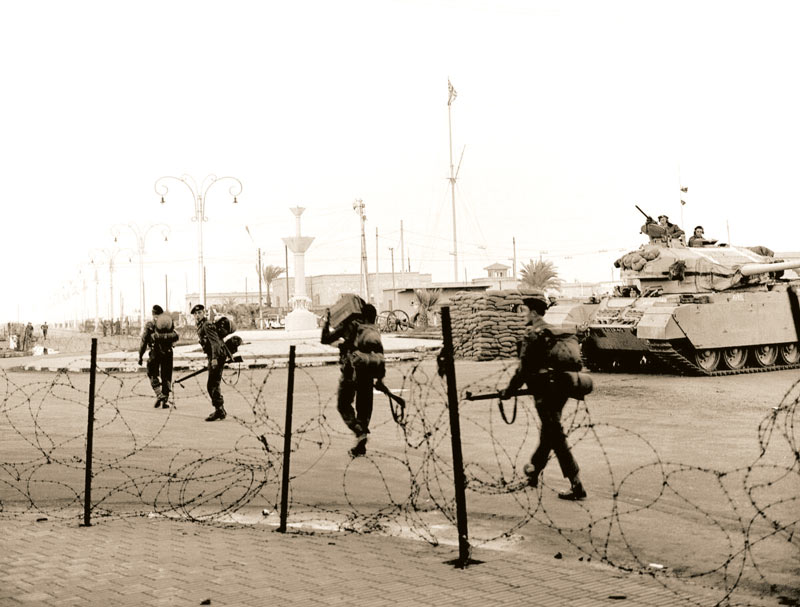
Anglo-French forces complete their evacuation of Port Said, Egypt, in December 1956. [UN Photo/UN7724726]
Trower’s move to the Middle East was the result of collusion between Israel, Britain and France to invade the Suez Canal Zone in late 1956, after Egyptian leader Colonel Gamal Abdul Nasser had nationalized the waterway in July. The channel had previously been under Anglo-French control and neither country’s NATO allies had been informed of the planned attack. The allies were furious.

At the time, Canada’s secretary of state for external affairs was Lester B. Pearson, who headed the country’s United Nations delegation. Pearson had spent the summer and fall of 1956 trying to find a diplomatic solution to the Suez Crisis. When the Israelis attacked on Oct. 29 and the British and French began bombing two days later, Pearson changed tack and developed an entirely new concept.
In the late 1940s, the UN had deployed unarmed military observers in Kashmir and the Middle East to monitor ceasefire agreements. Pearson’s idea, which would earn him the 1957 Nobel Peace Prize, was largley new: the creation of a large-scale peacekeeping force of lightly armed military personnel to interpose itself between the warring parties. The United Nations Emergency Force (UNEF) would supervise the cessation of hostilities, ensure the withdrawal of French, British and Israeli forces from Egyptian territory and act as a buffer between the Egyptians and Israelis.
At emergency meetings of the UN General Assembly on Nov. 4-5, 57 countries voted for the idea, with 19 abstentions. But Britain and France chose to ignore the resolution and, on Nov. 5-6, began landing their forces in the Canal Zone.
On Nov. 12, the first soldiers to arrive for UNEF were from the UN Truce Supervision Organization (UNTSO), which had been monitoring armistice agreements between Israel and its immediate neighbours since the 1948 Arab-Israeli War. UNTSO’s chief of staff, Canadian Major-General Eedson L.M. (Tommy) Burns, was appointed commander of UNEF.
UNEF did not have complete freedom of movement. Israel refused to allow any UNEF forces on its territory and Egypt only agreed to UNEF’s presence on its soil on the condition that it could revoke its permission at any time. Additionally, UNEF troops had no authority over Egyptian territory or citizens. These conditions restricted UNEF forces to the Gaza Strip and the Sinai Peninsula.
Infantry contingents from Colombia, Brazil, India, Sweden, Finland, Indonesia and Yugoslavia, as well as a joint one from Denmark and Norway, soon arrived. As Indonesia, Finland and Colombia had only agreed to short-term commitments, they withdrew their contingents in 1957 and 1958.
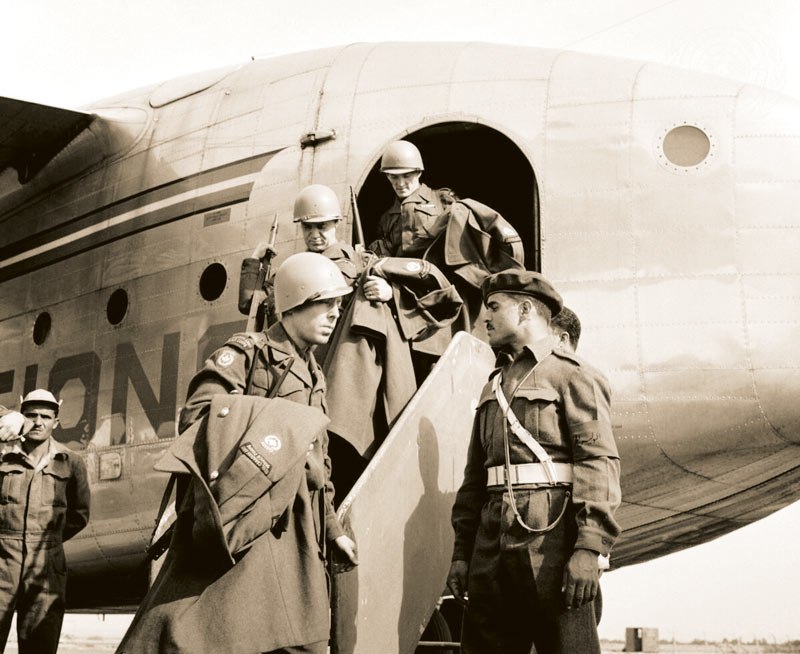
A Canadian contingent of the UNEF arrives at Abu Suweir transit camp near Ismailia, Egypt, in December 1956. [UN Photo]
The Canadian infantry contribution, meanwhile, ran into a snag. 1st Battalion, The Queen’s Own Rifles of Canada was selected, with the soldiers flying on Royal Canadian Air Force transport aircraft and their vehicles and heavy equipment following on the Royal Canadian Navy aircraft carrier Magnificent. But Egyptian authorities objected. Canadian soldiers wore uniforms similiar to those of the British, who had just attacked them, their flag contained the Union Jack and the unit’s name sounded British. Negotiations followed, during which Burns was able to save face for Canada by stating an urgent need for Canadian administrative, air and—later—reconnaissance units.
As a result, 56 Signal Squadron, 56 Transport Company and 56 Infantry Workshop were established, numbered for the year of their creation. Subsequently, the army formed 56 Recce Squadron, initially based on The Royal Canadian Dragoons and Lord Strathcona’s Horse (Royal Canadians), mounted in Ferret scout cars taken from the militia. The RCAF contributed 115 Communications Flight, later renamed 115 Air Transport Unit. During its existence, it flew Dakotas, Otters and Caribous.
That Burns
Royal Canadian Engineer Eedson Louis Millard Burns picked up the nickname Tommy at the Royal Military College after the famed Canadian world heavyweight boxing champion of the time. Burns was a veteran of both the First and Second world wars and, during the latter, rose to command I (Canadian) Corps in Italy.
Despite the successes of his corps, Burns was relieved of command, largely because he could not win the confidence of his subordinates.
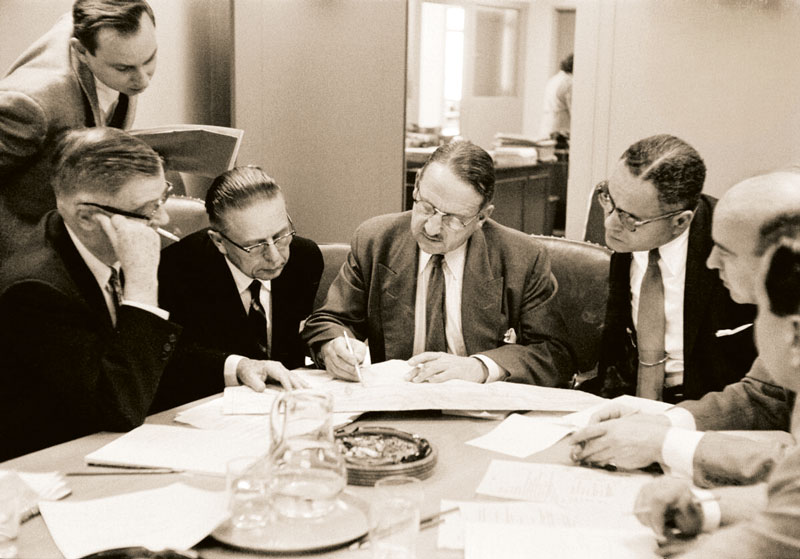
Major-General Eedson L.M. (Tommy) Burns, commander of UNEF, consults with military advisors at the UN headquarters in New York on Nov. 16, 1956. [UN7717732]
He retired from the army postwar and became a senior public servant. On loan to the UN, Burns became chief of staff of UNTSO in 1954 and was nearby when the Suez Crisis broke out, leading to his being named UNEF’s first commander.
After Norman Trower—now a major—arrived in Egypt he discovered he would be remaining there even after the recce was completed. The officer designated to command the engineer detachment had a compassionate problem, so Trower replaced him. Near the end of the year, General Burns appointed Trower force engineer.
Trower noted that language differences in the region sometimes caused issues. When the Canadians ordered a large number of rat-tail springs for screen doors to help keep the flies out, they received rat traps instead.
Meanwhile, the three occupying forces were moving out. In December 1956, UNEF oversaw the evacuation of British and French troops from the Canal Zone, while Israeli forces withdrew from the Sinai in March 1957.
Major Bill Treasure of the Royal Canadian Army Service Corps received his notice of a posting to UNEF differently from Trower. In a 2001 interview with the Canadian War Museum, he remembered working at his desk in Ottawa one day in May 1958.
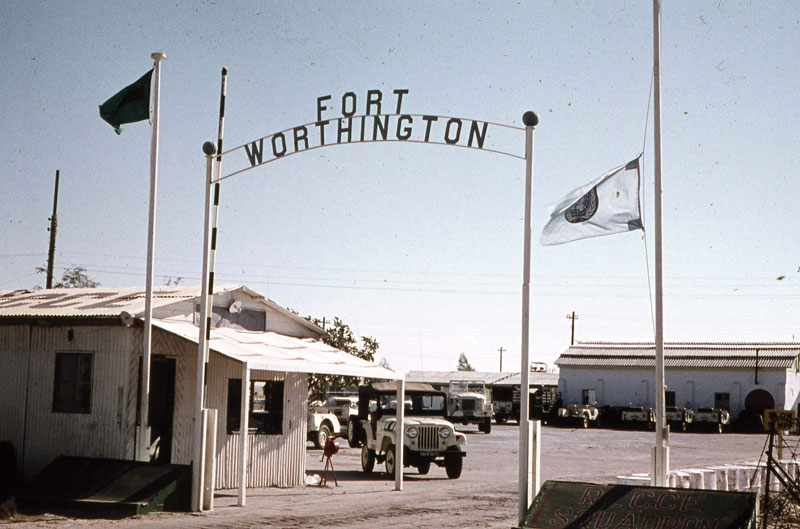
Fort Worthington near Rafah in the Gaza Strip. [Courtesy Jack Dangerfield]
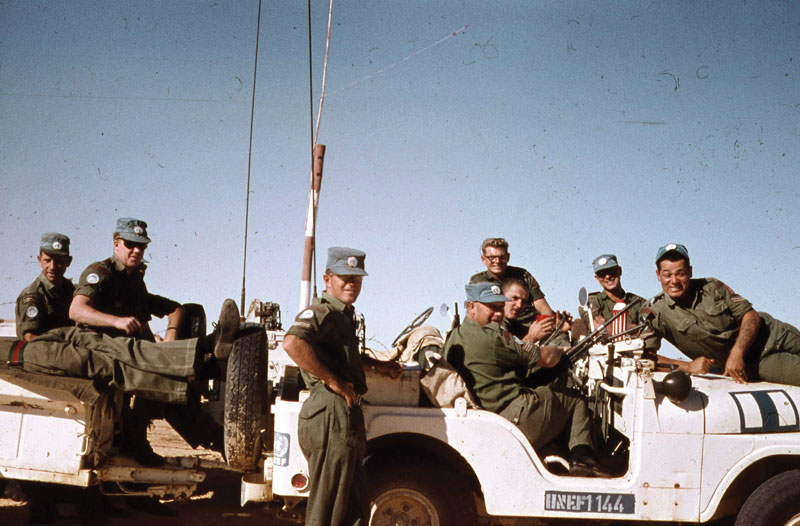
Second Lieutenant Jack Dangerfield’s troop was stationed at Fort Worthington near Rafah in the Gaza Strip. [Courtesy Jack Dangerfield]
“The fort was mainly a tented area with some corrugated tin shelters. It was guarded by Brazilian soldiers who often kept us awake at night with their constant shooting.”
“The orderly room sergeant came in to inform me that I was to report the next morning to the medical section for my preliminary medical appointment for service in the Middle East,” said Treasure. “That was my first notification that I was going to UNEF.”
Treasure “stormed around for a while,” complaining of an organization “where you learn from the bottom up instead of being told from the top down.” He proceeded to UNEF in October to command 56 Transport Company. As he landed at the El Arish air base, Treasure “could see nothing but sand everywhere,” which he noted was “a rather impressive sight, when you see lots of nothing.”
Engineer Lieutenant-Colonel Bill Lye arrived in Egypt in the summer of 1957 as deputy commander of Canadian Base Units Middle East (CBUME). CBUME had been established to co-ordinate the Canadian Army’s communications and logistics units’ support to UNEF. As Lye noted later, he was astonished by Egyptian security arrangements when he arrived.
“The Egyptians seemed to believe in disbelieving everybody else by making sure they had frequent checkpoints,” said Lye. “At every checkpoint, there would be a barrier across the road and armed guards to examine your credentials and your identities. As I was travelling in a UNEF car, which was painted UNEF blue, and had UNEF license plates on it, it was pretty obvious and there was not an awful lot in the way of delay. But it struck me as rather strange. I thought we were travelling in the same country.”
After a year, 56 Recce Squadron was replaced by the first of eight reconnaissance squadrons from all four regular armoured regiments. Midway through the next rotation, provided by 8th Canadian Hussars (Princess Louise’s), quarter-ton jeeps replaced the Ferrets as they were more suitable for desert conditions.
Second Lieutenant Jack Dangerfield was posted to UNEF in June 1961 to replace a fellow officer in Lord Strathcona’s Horse (Royal Canadians) recce squadron who was medically evacuated home. In a recent email, he recounted with Legion Magazine his experiences after arriving at Fort Worthington near Rafah in the Gaza Strip.
“The fort,” noted Dangerfield, “was mainly a tented area with some corrugated tin shelters. It was within a barbed wire enclosure and guarded by observation towers manned, at that time, by Brazilian soldiers—who often kept us awake at night with their constant shooting at whatever.”
“Living 24 hours a day for weeks on end with the same couple of dozen great soldiers teaches one a lot about human behaviour.”
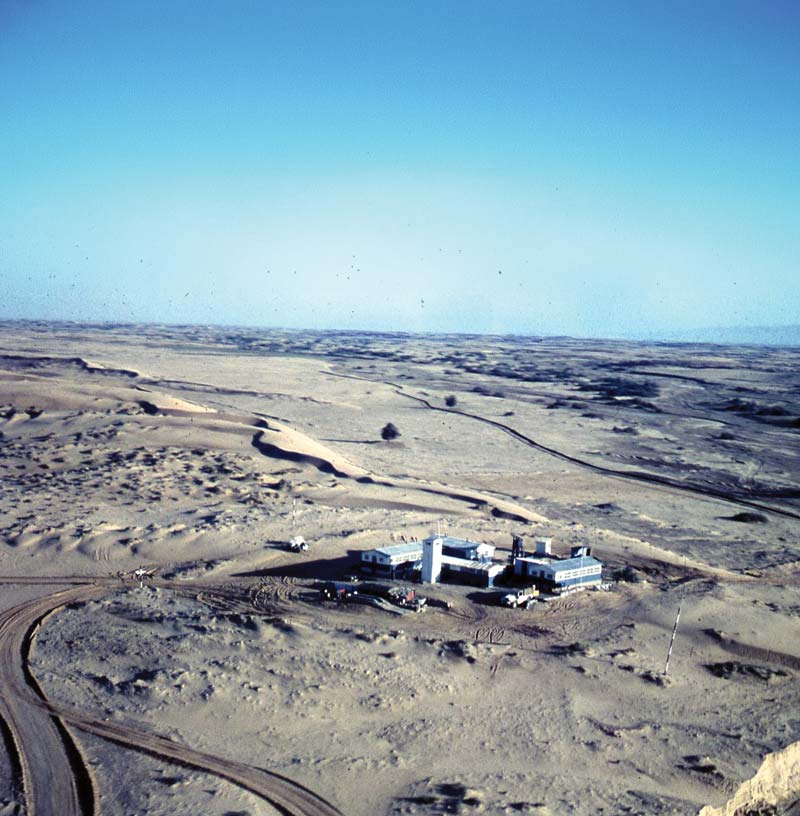
UNEF outpost. [Courtesy Jack Dangerfield]
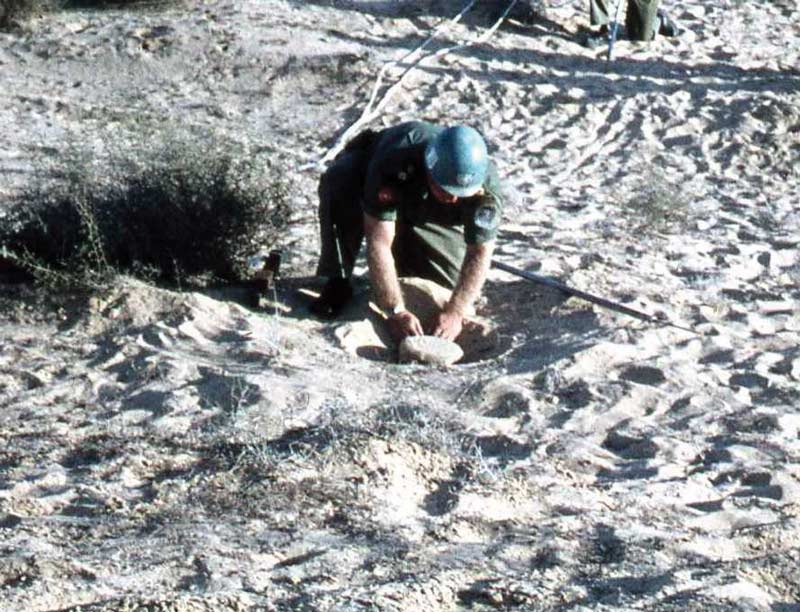
UNEF mine clearing operations. [Courtesy Jack Dangerfield]
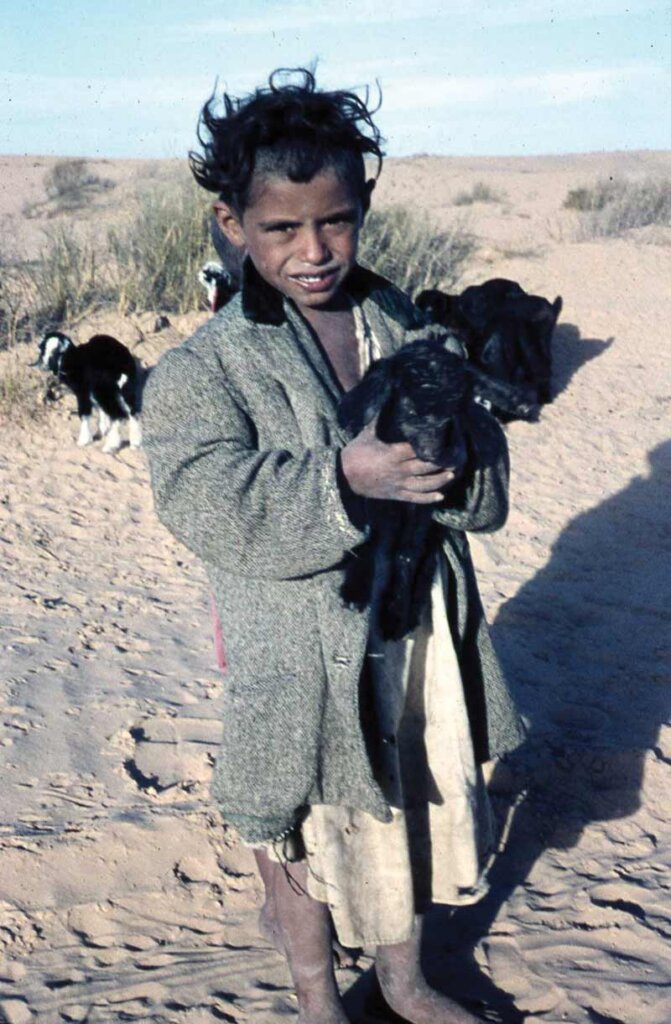
A young Bedouin. [Courtesy Jack Dangerfield]
The fort was home to squadron headquarters, an administration troop and two recce troops, one on standby while the other provided administrative duties. The third and fourth recce troops were stationed in desert outposts. All four rotated between outposts and main camp about once a month. Each troop had seven jeeps, all of which “had a Bren Gun mounted at the windshield level and a very old short-range radio,” recalled Dangerfield.
At the outposts, the recce troops’ main jobs were mobile patrols, which included looking for and disarming any land mines they found. They also tried to detect and prevent any crossings of the international frontier between Egypt and Israel, usually by numerous nomadic Bedouins in the area. Dangerfield believes one of the peacekeepers’ major contributions was not even in their mandate: “We also helped hundreds of Bedouin stay safe and reasonably healthy.”
Dangerfield has fond memories of his time in UNEF. “Personally, it was one of the best experiences of my life,” he wrote. “Living 24 hours a day for weeks on end with the same couple of dozen great soldiers teaches one a lot about human behaviour. I cherished my time with them. I learned from every one of them.”
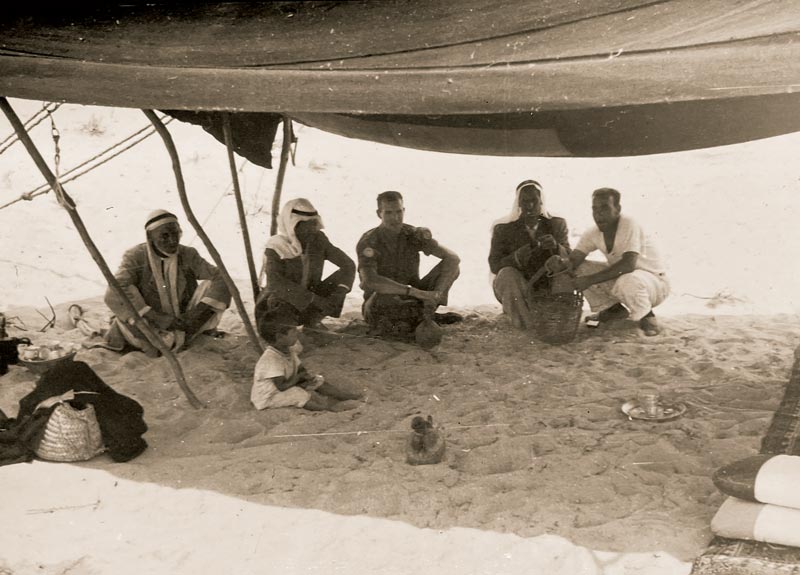
2nd Lieutenant Darrell Dean with the baby locals asked him to care for. [Courtesy Darrell Dean]
Like Jack Dangerfield, 2nd Lieutenant Darrell Dean was a troop leader in a Lord Strathcona’s Horse (Royal Canadians) recce squadron in 1963. As he noted in a recent email, “One morning a man on a white camel appeared at the front gate of my outpost with a small baby in his arms, asking if we could take it to the UN hospital,” as “a clear fluid was seeping from both the baby girl’s ears.” The hospital in Rafah was contacted, gave approval and Dean took the baby to the hospital.
UNEF II
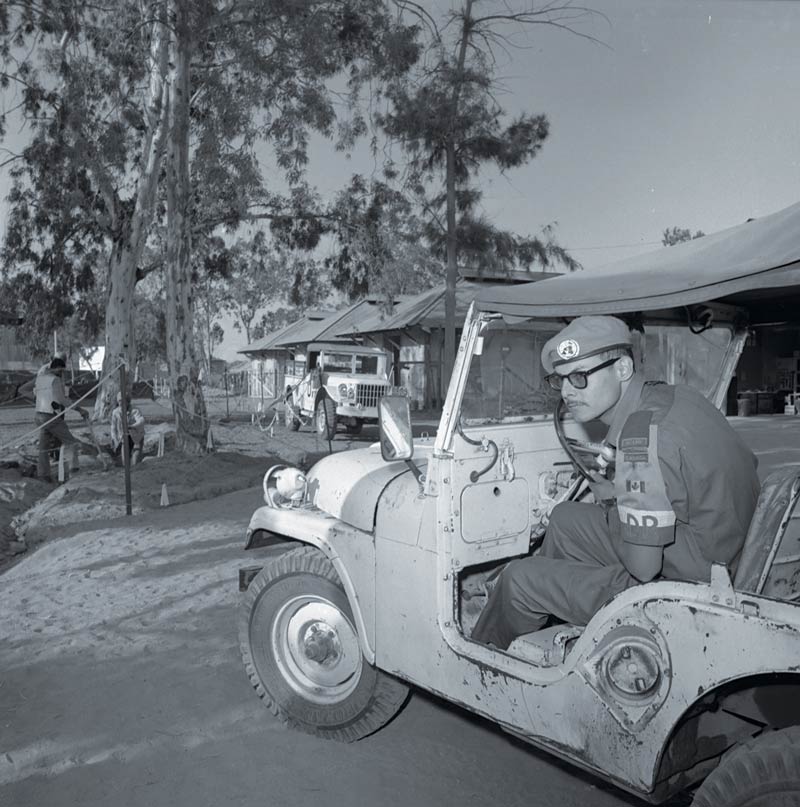
Corporal Carl Svensson of the Canadian contingent of UNEF II prepares for a trip from Ismailia to the Suez Canal in 1975. [DND]
UNEF kept the peace for 10 years, until it was ordered out of Egypt by President Gamal Abdul Nasser on May 16, 1967, amid growing tensions in the area. Three weeks later, the Six-Day War broke out. In response, the UN established a 7,000-person peacekeeping force known as United Nations Emergency Force Middle East (UNEFME), but popularly called UNEF II. Canada provided the largest contingent, up to 1,100 personnel.
“Can you imagine the trust the father displayed in handing over his baby daughter to a complete stranger,” Dean marvelled. “The only real recognition I had of him was that he was riding a white camel. My greatest fear was that the baby would pass away en route or in hospital and then what? Happily, the baby was treated and three weeks later I was called to pick it up and return it to its family.”
At that point, Dean commenced a search for a white camel. With help from Bedouins, he eventually found the family and returned their baby, who by now “looked like a Canadian child as it was wearing clothing donated by the wives of the regiment.
“There was much joy,” he noted of the reunion, “which was followed by coffee, then lunch where I was given one of the sheep’s eyes to eat as the guest of honour. The dad ate the other.”
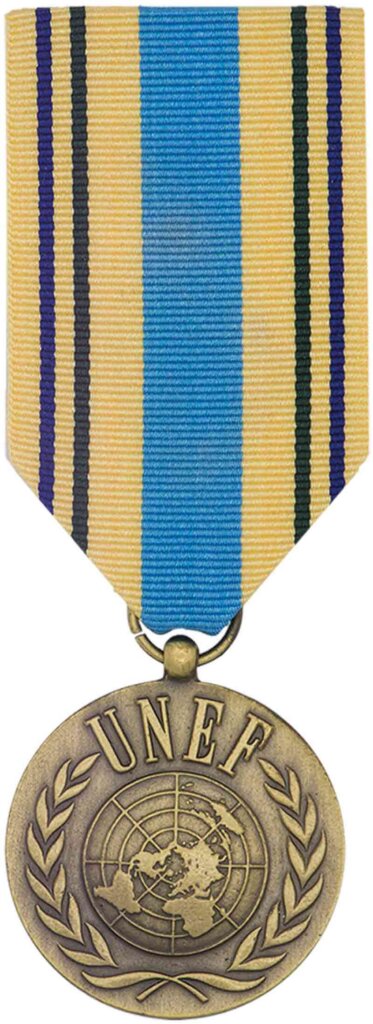
The UNEF Medal. [DND/LAC/5039390]
The UN created the UNEF Medal for 90 days consecutive service between Nov. 7, 1956, and June 17, 1967. Canadians received 9,963 of these medals, the only UN one to bear the name of the mission. Thirty-one Canadians died while on UNEF service.
Advertisement