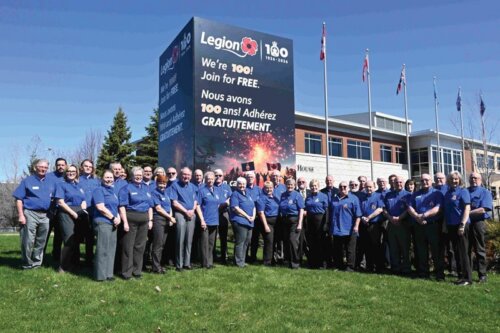


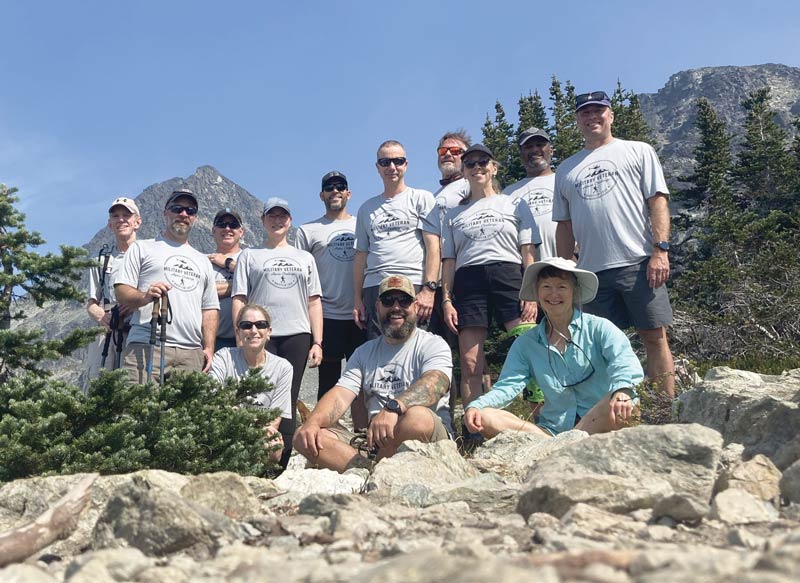
Participants of the centre’s fourth annual Military Veteran Alpine Challenge pose after successfully completing their hike in Whistler, B.C. [Chronic Pain Centre of Excellence for Canadian Veterans]
RCMP veteran Cameron Kowalski continues to feel the weight on his shoulders. It is, he recognizes, from the physical burden of service, the literal load he carried for much of his 34-year career. The repercussions of donning a “16- or 18-pound duty belt and a vest and all that equipment, 12 hours a day, four days a week,” he said, “that wears on your body.”
Kowalski describes a mission-before-self mentality, of pushing through the pain until that pain becomes chronic.
“It doesn’t matter how I feel,” he explained of the mindset he once adopted. “I’ve got to support my team. I’ve got to get from here to there, whatever that mission says I need to do.” Moreover, the now-retired Mountie noted, “you’re doing it for country, and that’s such a profound notion. That’s an extraordinarily huge burden to carry.”
For Kowalski and many others—in the RCMP and the Canadian Armed Forces—such responsibilities come at a hefty cost. Statistics from Veterans Affairs Canada underscore the scale of the issue: 41 per cent of former personnel currently live with chronic pain (double the general population). For women veterans, the figure stands at approximately 50 per cent.
Those individuals, acknowledged Kowalski, are “looked after by the medical teams that are within the Canadian Armed Forces when they’re in [the military].” Not so when the uniform comes off, he said, when veterans find themselves entering an overburdened civilian health-care system that requires them to “jump in a queue for [a] family doctor, which is difficult.”
Even among those lucky enough to be next in line, hurdles often persist. “Veterans are extremely complicated patients to take on,” said Kowalski, “because of chronic pain, mental health, because of the way that they get broken, so to speak, through training and equipment and wear and tear.”
Kowalski himself doesn’t pretend to have all the answers, but he strives to ask the right questions. It is why he found a new outlet for service at the Chronic Pain Centre of Excellence for Canadian Veterans.
Officially established in 2020, the homegrown not-for-profit combines scientific research and first-hand experience to improve the well-being of veterans and their families living with chronic pain.
In just over five years, the centre has funded more than 60 research projects on a variety of topics, from demographic differences to post-orthopedic surgery interventions to medical cannabis, yoga and more. The process of choosing these investigatory avenues is “the uniqueness of the organization,” said Kowalski, who has since retired from the centre. “We have an advisory council of veterans, which is 15 former members of the Canadian Armed Forces. They are the ones who guide us. Everything we do is veteran-informed and evidence-based.”
It’s these veterans, not lab-coated researchers (or at least not exclusively), who decide what matters most to those living with chronic pain. And the collaboration doesn’t end there.
“The researcher has to have a veteran partner so that when they’re doing the research, they’re having that person with lived experience working with them as a co-principal investigator, so to speak,” noted Kowalski.
Equally imperative is that the findings must be understood by academics and laypeople alike. This, described Kowalski, “is something that consolidates the research into a tangible, digestible item—whether it be a paper, a trifold document, a video, or something else—that the veteran community can absorb better than having to read [a] 180-page dissertation.”
Empowerment by communication extends to the centre’s own initiative, “The Most Painful Podcast,” where veteran-turned-host Tom Hoppe interviews various guests—scientists, clinicians, policy-makers and others—who “have a story to tell related to chronic pain.” Exploring a multitude of topics, episodes offer insights into what successful pain management can look like.

Members of the centre’s team, along with veteran advisors Ray McInnis and Hélène Le Scelleur, visit The Pepper Pod in Chelsea, Que. [Chronic Pain Centre of Excellence for Canadian Veterans]
“You’re doing it for country, and that’s such a profound notion…. That’s an extraordinarily huge burden to carry.”
What the centre, funded entirely by VAC, isn’t in the business of, however, is delivering false hope. The institution promises no fix-all solutions.
“Nothing that we research will say, ‘this is the magic bullet—this will take away your chronic pain,’” said Kowalski, “but it will help you live with it and manage it.”
As the centre continues to grow, Kowalski hopes that other groups, namely those responsible for service members, grow with it.
“My vision,” he said, “is to get organizations such as the CAF and the RCMP to understand the implications of chronic pain within the veteran community and do something to manage that while they’re still in and while they’re still performing their duties.”
For those already navigating life with chronic pain, the centre’s executive has a simple message: You’re not alone.
“We need to find those folks who may be hopeless,” confirmed Kowalski, “because that’s a big thing. When you get into that chronic pain hamster wheel, you have hopelessness, and you think that nobody’s looking after you, nobody’s understanding what you’re going through.
“The more people we get to, and the more people that understand what we do, and the more research that’s done,” said Kowalski, “I think the better off the whole veteran community is going to be.”
Advertisement