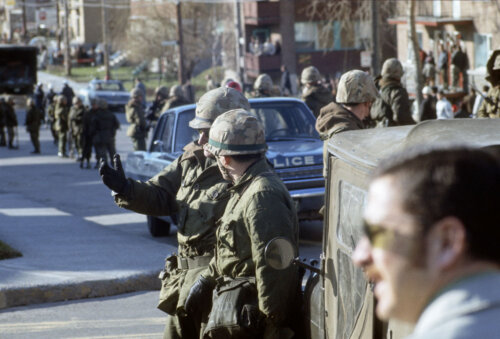



Canadian soldiers are dispatched to Montreal during the 1970 October Crisis. [Frank Prazak/LAC/4118269]
“The governments of Canada and of Quebec have been told by groups of self-styled revolutionaries,” said Pierre Trudeau with icy reserve, “that they intend to murder in cold blood two innocent men unless their demands are met.”
A week earlier, British Trade Commissioner James Cross, and Quebec cabinet minister Pierre Laporte had been abducted by the Front de Libération du Quebec (FLQ), a group of anti-anglophone militants who, for years, had been terrorizing Quebecers with bombings and robberies. Now the FLQ was vowing to execute two high-profile hostages unless its demands—including the release of dozens of FLQ members from prison—were met.
At the request of the Quebec government, Trudeau invoked the controversial War Measures Act, suspending civil liberties in the province, ushering in mass arrests by the police and sending the army into the streets of both Montreal and Ottawa.
It’s worth remembering the October Crisis because, 56 years later, Canada is once again beset by serious threats to unity, sovereignty and security.
Thankfully, none of today’s troubles bring with them the violence and fear that shook the country in 1970.
Even so, the current anxieties—a new separatist Péquiste government about to take power in Quebec; the Oct. 19 separation referendum in Alberta and its uncertain aftermath; plus, the menacing posture toward Canada by U.S. President Donald Trump and his underlings—together represent a real and present danger to national integrity and safety at a level not seen in more than half a century.
As the events of 1970 remind us, Canada has been here before, with domestic extremists sowing disruption, and mendacious foreign leaders interfering with the country’s unity.
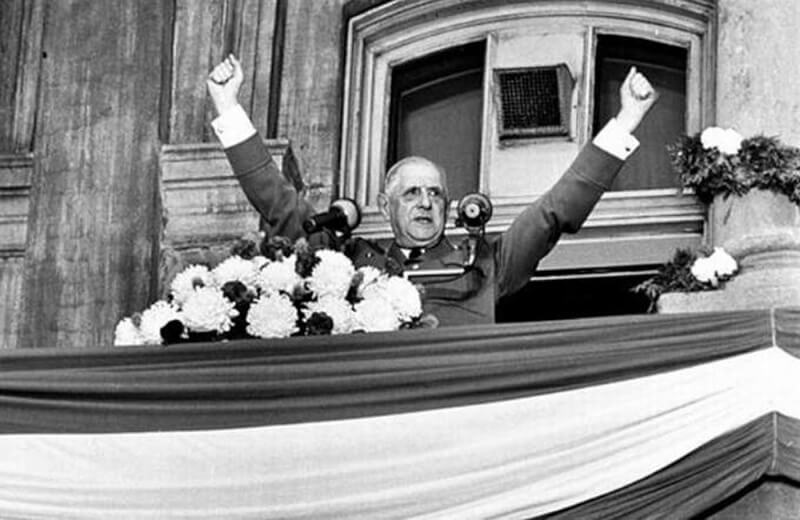
French President Charles de Gaulle during his now infamous speech at Montreal City Hall in 1967. [Wikimedia]
de Gaulle—whose own country had been liberated from fascism, in part, by the sacrifices of Canadian soldiers—was promptly rebuked by Prime Minister Lester B. Pearson, who called the comments “unacceptable to the Canadian people and its government.”
Referendums and the debates that accompany them are entirely legitimate exercises in any democratic society. What’s not legitimate is interference by foreign governments in Canadian affairs. Nor is it legitimate—or possibly even lawful—for separatists to conspire with outside powers or foreign political actors to undermine Canada.
As The Globe and Mail revealed last week, Alberta separatists have held talks in Washington, D.C., with Republican party strategists—including meetings that took place inside the headquarters of the U.S. State Department—where the separatists offered to send Alberta oil revenue and water to the U.S. in return for American government support for an independent Alberta.
As compensation for U.S. political and financial backing in helping Alberta’s transition to an independent country, the separatists also offered to share Alberta’s agriculture, forestry and precious metals resources, as well as cede actual land to the U.S. for a railway to Alaska.
Alberta separatist leader Jeffrey Rath, who arranged the State Department meetings, “believes the Albertans’ overtures to Washington garnered attention at the highest levels of the U.S. administration,” the Globe said.
The paper’s investigation also found that Republican strategists from Michigan travelled to Calgary earlier this year to share advice and tactics about how to sway the referendum outcome.
Globe editor Tyler Dawson expressed his thoughts in an opinion piece published alongside the revelations:
“It should come, perhaps, as no surprise that some in Alberta’s separatist movement are happy to sell out the province, swapping the authority of the Canadian government for domination by MAGA overlords in the United States. They do, after all, have no loyalty to Canada. But you’d think, in an ideal world, they’d have some loyalty to Alberta—and Albertans. If you’re going to fight for an independent Alberta you ought, at least, to fight for independence, and not for vassalage to one’s neighbour.”
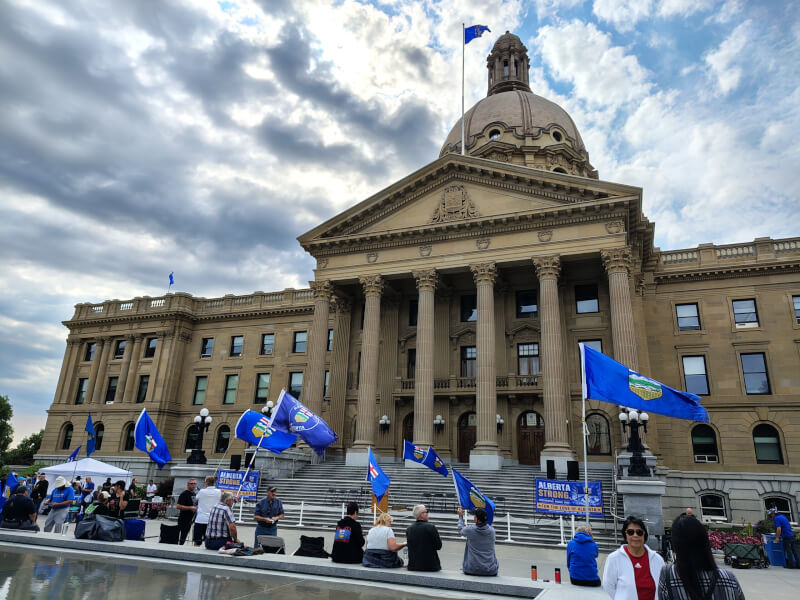
Alberta separatists prepare for a rally at the Legislative Assembly of Alberta on Aug. 29, 2026. [Yuet Man Lee/Wikimedia]
For the first time in a century, the Canadian Armed Forces have modelled a hypothetical U.S. military invasion of Canada and planned out a response based largely on tactics used by Ukraine’s military against Russia. In an interview with the New York Times last month, Prime Minister Mark Carney acknowledged the fact that Canada has drawn up plans for the possibility that Trump might order U.S. military action against its northern NATO partner.
Perhaps it’s wise to be prepared. But the risk is not that the U.S. will one day send tanks rolling across the Gordie Howe International Bridge in Windsor, Ont., or drop paratroopers on Parliament Hill. Instead, the real threat will come from the inside—with this country’s own citizens quietly working with predatory external forces, American or otherwise, eager to assist in destroying Canada for their own purposes.
That’s already the case with Alberta separatists. It may soon be the case in Quebec, where the Trump administration could take an interest in fueling separatist fires and promoting, through online propaganda, contempt for federal laws and institutions in that province. It could happen anywhere in Canada where division and discord present an opportunity for exploitation.
Earlier this year, the Defense Analyses and Research Corporation (DARC), an American organization that calls itself “a new kind of think tank,” published an essay titled “The Centrifugal Strategy,” which advocated American domination of Canada not through annexation or outright invasion, but by weakening this country via the stoking of internal tensions—among separatists and between white Canadians and Indigenous Peoples as well as immigrants.
“Canada today is more splintered than it has been in decades,” read the essay. “The United States should exploit the soon-to-arrive fragmentary moment in Canada as an opportunity to drastically reshape the North American environment into one more amenable to U.S. interests.”
“It should come, perhaps, as no surprise that some in Alberta’s separatist movement are happy to sell out the province, swapping the authority of the Canadian government for domination by MAGA overlords in the United States.”
The point is: most of the countries and societies that fall apart—or worse, dissolve into violence—do so from the inside first. External forces only provide the final push. That’s a lesson of history dating back to ancient Rome.
The October Crisis of 1970 showed that even a peaceful and prosperous democratic society can be turned upside down by domestic radicals pursuing their goals at the expense of the broader population. In that case, Quebec Labour Minister Pierre Laporte was the ultimate victim, strangled to death by his captors, his body discarded in the trunk of an abandoned car.
As Pierre Trudeau reminded Canadians in his televised speech in 1970, it takes constant care and effort by citizens to keep a country free and whole:
“It has now been demonstrated to us by a few misguided persons just how fragile a democratic society can be if democracy is not prepared to defend itself—and just how vulnerable to blackmail are tolerant, compassionate people,” he said.
“I’m confident that those persons who unleashed this tragic sequence of events, with the aim of destroying our society and dividing our country, will find that the opposite will occur—the result of their acts will be a stronger society in a unified country. Those who would have divided us, will have united us.”
Advertisement