

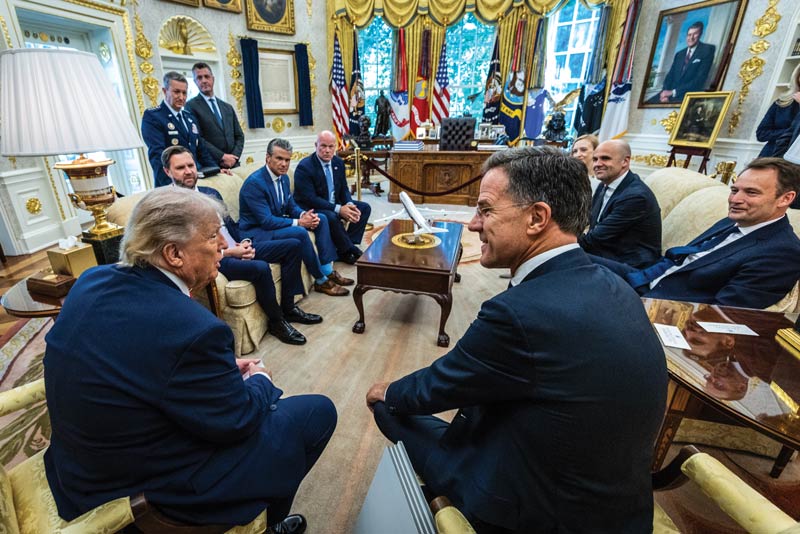
U.S. President Donald Trump and senior members of his administration meet with NATO Secretary General Mark Rutte at the White House in June 2026. [NATO]
Canada played a substantial part in the creation of the North Atlantic Treaty Organization. Signed on April 4, 1949, the agreement bound together North America and western Europe in an alliance to unite the democracies against threats posed by Soviet aggression. With the end of the Cold War and the fall of the U.S.S.R. in 1991, the alliance expanded to include most of the countries of eastern Europe, and latterly of Nordic and Baltic nations. Now more than 75 years old, NATO has been the most successful military alliance in history. But with Donald Trump president of the United States, NATO faces its worst crisis—and from, of all places, Washington, D.C.
Trump has had some genuine grievances with NATO members. After the Soviet Union collapsed, most NATO countries reduced defence spending, and the U.S. assumed the burden—which Trump harped on during his first term (2017-2021). But after Russia annexed Ukraine’s Crimean peninsula and then staged a full-blown invasion eight years later in 2022, all NATO members—including Canada, belatedly—increased military investment, with some nations exceeding an alliance target of two per cent of gross domestic product (GDP), and all now aiming for a revised goal of five per cent by 2035. Trump’s original NATO criticism is no longer valid, though the U.S. nuclear deterrent and its military power remain central to the defence of the democracies.
But Trump’s administration, in his second term, has other concerns. As the 2025 U.S. National Security Strategy (NSS) put it: “it is more than plausible that within a few decades at the latest, certain NATO members will become majority non-European. As such, it is an open question whether they will view their place in the world, or their alliance with the United States, in the same way as those who signed the NATO charter.”
The NSS further highlights European immigration policies that “are transforming the continent and creating strife” and several other issues that are leading to “loss of national identities.” And if, in Trump’s view, Europe is allowing itself to decay, why should the U.S. protect it? The Trump administration believes it’s all the fault of the European Union and its “focus on regulatory suffocation.”
The refusal of NATO members to join the U.S. and Israel in their spring 2026 attacks on Iran also demonstrated, in Trump’s opinion, that they were “cowards.” Hard to envision either side seeing much of an alliance with such comments.
Trump seems to admire right-wing European politicians, such as former Hungarian prime minister Viktor Orbán (swept from office this past April) who project values and policies like his own. The president also appears to have a particular fascination with Russian President Vladimir Putin and Belarus President Alexander Lukashenko, two dictators. Can a U.S. government that views authoritarians as better models than democratic leaders continue to be comfortable in a military alliance with western Europe and Canada?
The U.S. security strategy also made clear that Washington viewed the Western Hemisphere as under its purview. “The United States must be preeminent in the Western Hemisphere as a condition of our security and prosperity,” it states. At the same time, many experts believe the strategy’s positions on other regions of the world effectively concedes influence over them to Russia or China. In effect, Washington is washing its hands of Ukraine, the Baltic states and eastern Europe, essentially gutting the North Atlantic alliance. An opinion poll conducted in early 2026 in six major western European countries (Denmark, France, Germany, Italy, Spain and the U.K.) indicated a sharp decline in the popularity of the U.S. during the preceding year.
Of course, the Western Hemisphere over which the U.S. indicated it must be preeminent includes Greenland and Canada. After Trump began musing about purchasing or seizing the former, an autonomous territory of Denmark, in early 2025, the Danes moved troops to the island, other European Union members did the same and Canada opened a consulate there.
Similarly, Trump launched a trade war with Canada by imposing a series of tariffs and repeatedly proclaimed interest in annexing the country and making it the 51st state. For a NATO member to directly threaten the sovereignty of an alliance ally—let alone two—would have seemed inconceivable two years ago. If such a move was to come to pass, it would almost certainly destroy NATO.
Could the U.S. simply leave the alliance? In 2023, Congress passed a law outlining rules governing a withdrawal from NATO—requiring either an act of Congress or the approval of two-thirds of the Senate. Neither is likely.
Trump, however, still has some cards to play: he can pull U.S. troops out of NATO, abandoning American deployments in Europe; he could fail to honour defence obligations to an alliance member; or he could state that the U.S. nuclear deterrent wouldn’t be available to meet an attack on a NATO country.
The refusal of NATO members to join the U.S. and Israel in their spring 2026 attacks on Iran also demonstrated, in Trump’s opinion, that they were “cowards.”
So, while Trump might not be able to unilaterally exit NATO, he could seriously impact its potential effectiveness.
That has led Germany, France, Britain, Poland and other members to work to bolster their defences. Canada, too, where a September 2025 Ipsos poll reported that 60 per cent of people say they no longer trust the U.S., has moved to strengthen its armed forces. Prime Minister Mark Carney, recognizing the threats to his country and NATO, has invested heavily in defence since his April 2025 election. Canada was spending two per cent of GDP on its military by March 2026 and has pledged to reach five per cent within a decade.
The Carney government has also worked to strengthen ties with Nordic members of NATO, placing contracts for icebreakers with Finland, firming up submarine purchases from Germany, and intends to build Swedish surveillance planes.
Meanwhile, the deployment of some 2,600 Canadian troops to NATO’s Multinational Brigade in Latvia has been confirmed until 2031 and their equipment is rapidly being upgraded. Canada has clearly demonstrated that it has no intention of exiting NATO, no matter what the U.S. might do. Canada’s national interests demand no less.
Advertisement