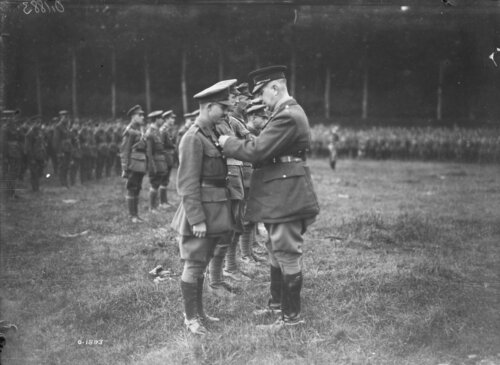






Prime Minister Arthur Meighen at the memorial event at Vimy Ridge honouring Canadian war dead on July 3, 1921. [Public domain]
Canada Day feels like a fitting moment to remember Arthur Meighen, one of Canada’s finest statesmen, whose insight and eloquence helped guide the country through the darkest days of the First World War.
As Eugene Forsey, the renowned former senator and constitutional scholar once wrote: “[Meighen] was incomparably the greatest parliamentarian and orator of my time, probably the greatest Canada had ever had, and from the first time, I listened enthralled … The speeches were masterpieces.”
Meighen delivered one of those masterpieces on July 3, 1921—105 years ago on Friday—atop the scarred landscape of Vimy Ridge. Having become prime minister the previous year, Meighen was attending a ceremony to dedicate a Cross of Sacrifice erected on the site, years before the creation of the full monument that stands today.
“The Great War is past; the war that tried through and through every quality and mystery of the human mind and the might of the human spirit,” Meighen said in a eulogy to the more than 60,000 Canadians who had died during the war.
“We live among the ruins and echoes of Armageddon. Its shadow receding slowly backward into history. At this time, the proper occupation of the living is, first, to honour our heroic dead; next, to repair the havoc, human and material, which surrounds us; and, lastly, to learn aright and apply with courage the lessons of the war.”
Meighen did not declare that those lessons had been, or would be, learned. Perhaps he understood enough about human nature and politics to know that new generations would forever have to “repair the havoc which surrounds us”—a process that continues around the world today.
“At this time, the proper occupation of the living is, first, to honour our heroic dead; next, to repair the havoc, human and material, which surrounds us; and, lastly, to learn aright and apply with courage the lessons of the war.”
Meighen first rose to national prominence in 1908 when he was elected Conservative member of Parliament from Manitoba (having won his riding by a slim margin of 250 votes). His early speeches and debating skills in the House of Commons turned heads, including that of Prime Minister Wilfrid Laurier. Once, while Meighen was speaking, Laurier whispered to a colleague that Robert Borden, the Opposition leader, “has found a man at last.”
Forsey wrote that Meighen never used notes while speaking, and that “every name, every date, every quotation [was] impeccable.” Meighen was “never at a loss [and] was invincible with interrupters and hecklers.”
By 1913, Borden’s Conservatives were in power and Meighen would soon be in the cabinet. Four years later, with the war raging in Europe, Meighen drafted the legislation for the government’s highly divisive Military Service Act, allowing Canadian men aged 20 to 45 to be conscripted for the war effort.
Conscription was passionately opposed by French Canadians in Quebec and by much of the farming community in the West. Laurier—then leading the Opposition—wanted a national referendum on conscription. Meighen responded to Laurier’s proposal with another vigorous speech in the Commons in June 1917. As quoted in the 2004 compilation Great Canadian Speeches:
“I regard the forwarding of troops to the front on the scale now being undertaken as an all-essential, as something we cannot shirk,” he told Parliament.
“No one has seriously argued in this House, and in solemn truth no one seriously believes that we can dispatch, as we have done, 350,000 men overseas, commissioned by us to stand between our country and destruction, pledge them the undying fidelity of a grateful people, watch them through harrowing years of suffering, bathe ourselves in the reflected glory of their gallantry and devotion, and then leave them to be decimated and destroyed….
“If there was ever a time for a referendum, which I deny, it was in August 1914; it is not now. We have committed ourselves as a nation, we have signed the bond, it is for us to discharge the obligation. The prosecution of this war by every effective and honourable means is now a matter only of good faith: 300,000 living men and 20,000 dead are over there, hostages of our good faith. All that remains for us is a choice between fidelity and desertion, between courage and poltroonery, between honour and everlasting shame.”

Arthur Meighen, in an undated photograph, became an unpopular prime minister in part due to his stance on conscription. [Public domain]

A poster explaining the terms of the Military Service Act, 1916. [LAC/3666501]
Arthur Milnes, the editor of a published collection of Meighen’s speeches and a past speechwriter for former prime minister Stephen Harper, wrote in the National Post that Meighen’s words are especially worth recalling at a time when “Canadian politics have sunk to lows of blind partisanship and anger that bring no credit to any party in Ottawa.”
In Meighen’s speeches, said Milnes, “we find love of country, respect for Parliament and all our ancient institutions, a belief in public service, and a celebration, not denigration, of past prime ministers and Canadian history itself.”
Unlike Borden, whom he succeeded as prime minister, Meighen was not a successful national leader. He served as prime minister only briefly, from 1920 to 1921 and again in 1926 for just three months. His political ambitions were partly undone by his close association with conscription and its lingering resentment in Quebec. Perhaps he was also unlucky in having to compete with the political juggernaut of then-emerging Liberal leader William Lyon Mackenzie King.
But whatever Meighen’s failings in high office were, no one could hold a candle to his incisive, unmatched oratory. As he said of Canada’s war dead in the eulogy on Vimy Ridge:
“Their resting places have been dedicated to their memory forever by the kindly grateful heart of France, and will be tended and cared for by us in the measure of the love we bear them.
“Above them are being planted the maples of Canada, in the thought that her sons will rest the better in the shade of trees they knew so well in life. Across the leagues of the Atlantic the heartstrings of our Canadian nation will reach through all time to these graves in France; we shall never let pass away the spirit bequeathed to us by those who fell; their name liveth evermore.”
Advertisement