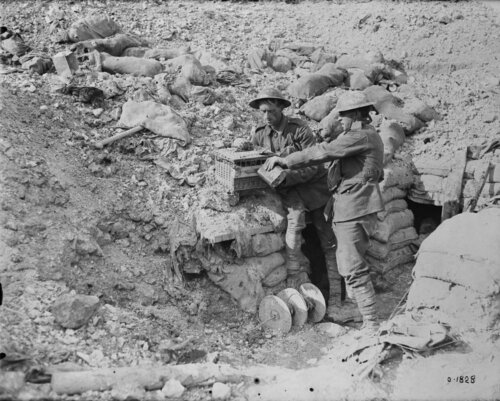



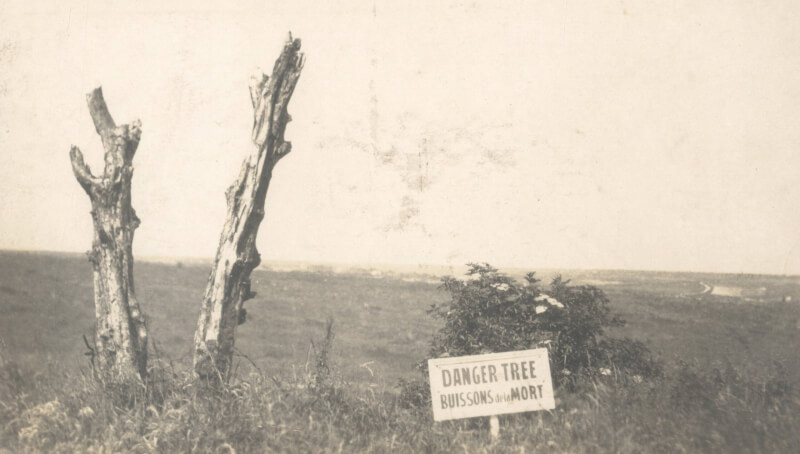
A photograph of the original Danger Tree at the Beaumont-Hamel battle site, taken circa 1920 by Lieutenant-Colonel Thomas Nangle, chaplain of the Newfoundland Regiment. [Memorial University Archives]
It is perhaps Newfoundland and Labrador’s most famous wartime icon. Certainly, it’s a symbol of profound sorrow among a people well-acquainted with loss and hardship.
For more than a century, the Danger Tree, or a version of it, has stood amid the green expanse of the Beaumont-Hamel battlefield in northern France as a stark reminder of precisely where so many Newfoundlanders died.
Next month, on the eve of the 110th anniversary of the Battle of Beaumont-Hamel, a new version of the Danger Tree will be unveiled at the site. This one, crafted with attention to historical detail at Memorial University in St. John’s, is intended to provide a permanent battlefield replica of the original tree.
When Britain, and automatically Canada, went to war against Germany in August 1914, Newfoundland, then a separate British dominion, had no army or militia. More than 500 volunteers were hastily trained, outfitted and sent overseas as part of the fledgling Newfoundland Regiment. The Newfoundlanders fought first at Gallipoli in 1915, then transferred to France.
On July 1, 1916, British and French forces launched the Somme offensive, aimed at breaking the stalemate in the muddy trenches of the Western Front. The fighting on the Somme would grind on for almost five months. But its deadliest day was July 1—the bloodiest in British military history.
That morning, about 800 troops of the Newfoundland Regiment were waiting for their turn to join the assault from a support trench known as St. John’s Road, behind the front line.
Already the attack was going badly. The Allies had lost the element of surprise, and hours of British shellfire had neither destroyed the rows of barbed wire protecting German trenches nor killed the men sheltering in deep dugouts beneath.
When the Newfoundlanders reached the front line, the area was still laden in barbed wire and clogged with dead or wounded soldiers from initial waves of the attack. As they attempted to cross no man’s land, they too were cut down by German machine-gun fire. And nowhere was the fire as intense as at the prominent remnants of a shattered tree, nicknamed the Danger Tree.
The attack was devastating to the regiment: only 68 of the 800 Newfoundlanders answered rollcall the following morning. The Newfoundland Regiment was effectively wiped out, its 710 dead, missing or wounded soldiers among the more than 57,000 overall British casualties on July 1.
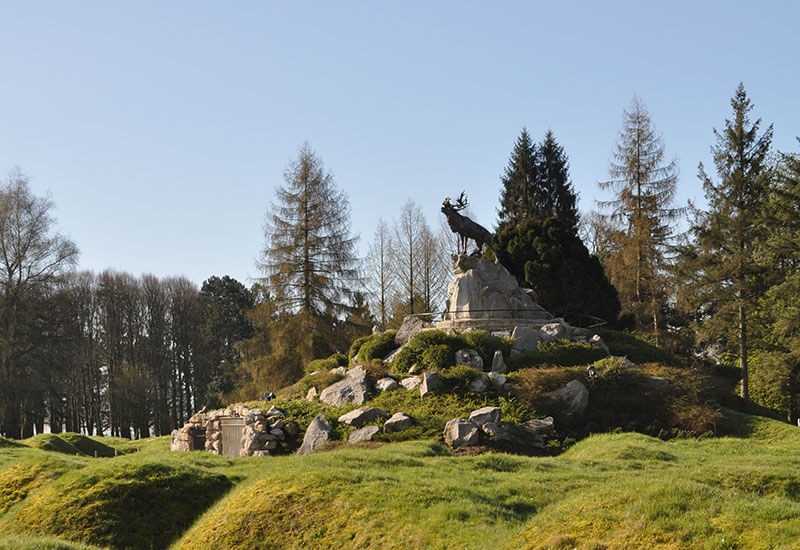
The Beaumont-Hamel Newfoundland Memorial. [Veterans Affairs Canada]
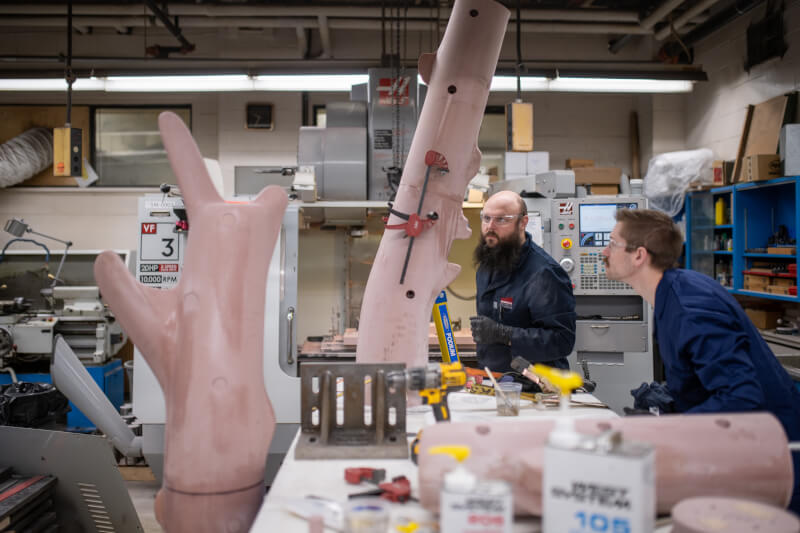
Memorial University machinists Chris Ryan and Simon Ernst creating the replica of the Danger Tree at the university’s technical services workshop. [Rich Blenkinsopp/Memorial University]
Incredibly, the regiment was reconstituted with additional Newfoundland volunteers and would go on to fight in France and Belgium throughout the war. After the Armistice, it fell to Lieutenant-Colonel Thomas Nangle, the regiment’s chaplain, to identify the graves of Newfoundland soldiers and commemorate their sacrifice.
As the Newfoundland government’s director of war graves, registration, enquiries and exploit memorials, Nangle was determined to honour the memory of those he served with. He was instrumental in acquiring and planning what is now called the Beaumont-Hamel Newfoundland Memorial.
It’s arguably one of the most evocative battle sites in Europe: the original trench lines are well preserved, and the site is dominated by an impressive caribou statue—above plaques listing the names of the dead—symbolizing Newfoundland’s sacrifice. And amid the now verdant killing field stands the Danger Tree.
The original battle-worn tree, believed to have been an old apple tree, decayed long ago and was replaced over the decades by various replicas, none of which stood the test of time. This year, Veterans Affairs Canada will install a permanent artificial replacement.
In building a new replica, the department found an eager partner in Memorial University, originally founded as a living commemoration to Newfoundland’s wartime sacrifices. There, the task was taken up by the school’s department of technical services.
“When my supervisor first mentioned this project to me, I said, ‘Oh man, I want to be a part of that for sure,’” said machinist Chris Ryan, who typically spends his days creating parts for oil and gas research or other engineering projects.
Ryan and fellow machinist Simon Ernst relied on an old, black-and-white photograph of the original Danger Tree found in the university’s archives. The picture was taken by Lieutenant-Colonel Nangle in the early 1920s during a memorial-planning visit to Beaumont-Hamel.
Using Nangle’s image, Ryan and Ernst created a 3D computer model of the tree to guide their construction of the replica out of high density, polyurethane particle board.
St. John’s artist Brittany Mitchell painted the new tree with battle-scarred markings, before it was finished in fibreglass and sealed with a UV-resistant clear coat to withstand the elements of northern France.
“It’s a pretty robust design,” Ryan told Legion Magazine. “They should get a good life out of it.”
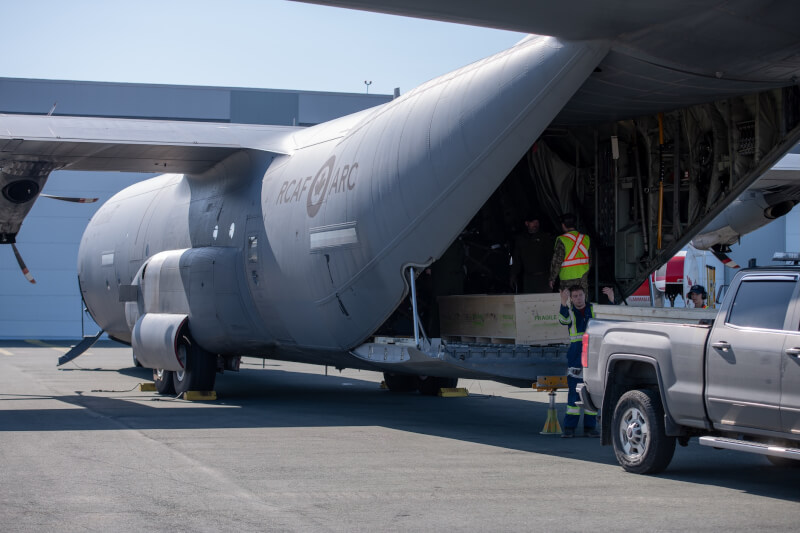
The replica Danger Tree is loaded onto an RCAF CC-130 transport in St. John’s in early May, at the start of its journey to France. [Rich Blenkinsopp/Memorial University]
Ryan said he was “honoured” to have played a small role in a revered part of his province’s history. His great-grandfather served in the First World War, signing up with the Newfoundland Regiment after the fighting at Beaumont-Hamel.
Ryan’s grandfather Bernard Long was president of The Royal Canadian Legion’s Pleasantville Branch in St. John’s and his grandmother Nita still volunteers there today.
“They really instilled in me the importance of remembrance,” said Ryan. “They brought me to all the remembrance parades. And I’ve always been a history buff. For my undergraduate degree I did a double major in history and German literature and culture.”
A few weeks ago, the new Danger Tree was loaded onto a Royal Canadian Air Force transport in St. John’s and flown to France. VAC will unveil it in a ceremony at Beaumont-Hamel on June 30.
“It’s a pretty amazing thing to have been a part of,” said Ryan. “That tree was as far as the regiment got on that particular day. The loss of life—and the wider significance of that day—resound strongly in the hearts of Newfoundlanders.”
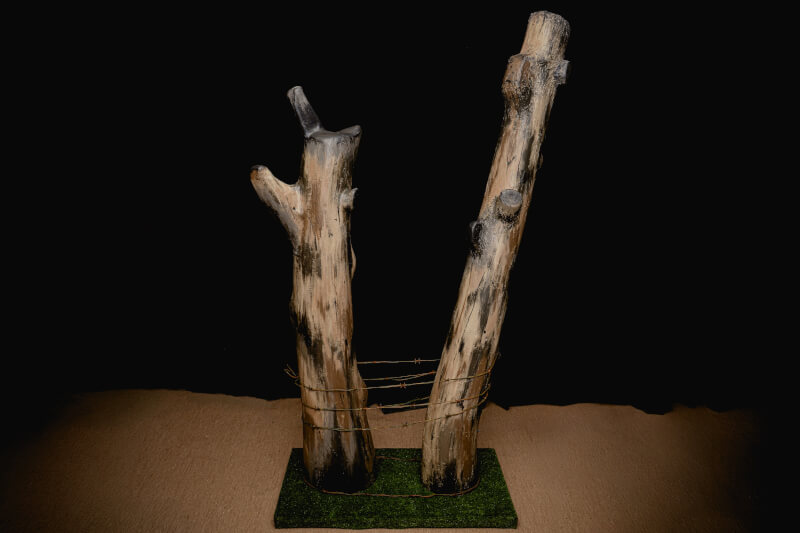
The finished replica of the Danger Tree. [Rich Blenkinsopp/Memorial University]
Advertisement