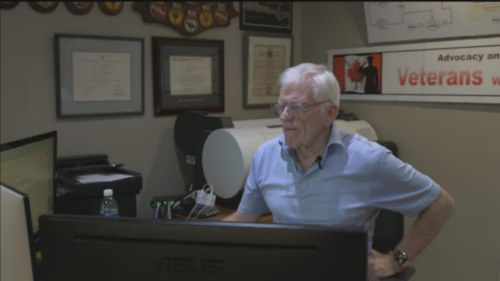



Former military medic Jessica Miller resigned from the Women Veterans Council in early January 2026. [Courtesy Jessica Miller]
Retired sergeant Jessica Miller believed in the cause, believed in the potential of the Women Veterans Council when it was launched on Jan. 29, 2025.
The body, explained the former military medic, was “based off one of the 42 recommendations in the Invisible No More report” from the previous year, a study undertaken by the standing committee on veterans affairs of the experiences, challenges and systemic barriers faced by women—past and present—in the Canadian Armed Forces. Miller had faith that change could finally be possible, and that serving on the council could help deliver it.
Not so, the now-ex-member says.
“We were gaslit every which way,” reported the Sweets Corner, N.S., resident who, in early 2026, resigned alongside four others, all of whom cited a failure of “institutional conditions required to enable meaningful, impactful work.” A sixth member also resigned.
In dealing with numerous hurdles, Miller found that the originally 12-person council’s principal objective, to advise Veterans Affairs Canada on implementing reforms and ensuring that women veterans had a direct voice in policy discussions, was greatly undermined—not by fellow members, she insisted, but by departmental red tape. She now argues that the Invisible No More report hasn’t been taken seriously enough and that far too many of its recommendations have been dismissed.
Here, in a Legion Magazine exclusive, Miller reflects on her tenure on the council and her disappointments with VAC.
On being a member of the Women Veterans Council
We were officially acknowledged as a council in January 2025, but we had started unofficially in November 2024. It was pretty clear from the beginning that it was very much going to be a top-down approach.
As opposed to us as a council advising the minister, VAC was dictating all the agendas for the meetings.
My whole approach to serving and helping women is transparency, honesty, communication and acknowledgement—all those things that make somebody feel heard, recognized and not brushed off like the government can sometimes make women feel. All the things I believed in were suddenly things I couldn’t use.
For example, another member and I wanted to set up a way to communicate with other women veterans, but Veterans Affairs shut that down. We couldn’t have our own email address for people to connect with us, but Veterans Affairs had an email address in the council’s name. It was completely misleading because you’d send a message to the council and it said that it would go to us for advice or guidance. We never saw a single email. And I couldn’t tell anybody why we weren’t responding because we were gagged.
Here we were, sitting on this council thinking we would be doing great things for women veterans across the country and we were then told that we weren’t allowed to speak to them. It went against everything that I believed in.
That’s just a small part of everything that went on.
On her departure from the council
There were a bunch of us on council who met in person at the January 2026 meeting with the minister. We actually didn’t even know if she would show up because VAC had tried to postpone the meeting.
By that stage, there were two out of five of us who knew they were leaving for sure. The three of us who were sitting on the fence said we would give the minister one last opportunity to answer our questions and get a clear statement from her as to what things were going to look like moving forward.
When we were in that meeting, it was worse than anticipated. I asked the minister specifically about the top-down approach. And her words were, “It’s coming from the top down. When we need you, we’ll call you.”
It was an emotional day, because it felt—once again—like women didn’t matter.
Resigning was probably one of the most powerful moments I’ve had. Having that position meant nothing if I couldn’t advocate or at least speak for veterans or engage with veterans outside the council, so I had to leave.
On her hopes for the future
I hope the council is given more responsibility and acknowledgement. They’re very special women of professional backgrounds on there, so I hope VAC will recognize that much of the corporate knowledge they brought in has been lost.
And I hope the minister will take back what she said about the top-down approach. I hope she understands that veterans are a group of people who have dedicated much of their lives to serving the country. I hope she learns that we have a strong voice.
This interview has been edited for brevity and clarity.
Advertisement