





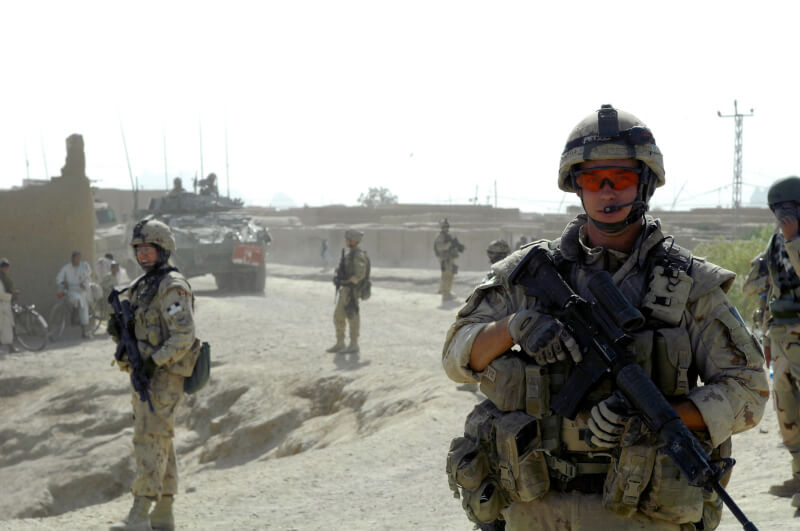
Canadian Master Bombardier Clint Godsoe (right) of the Kandahar Provincial Reconstruction Team patrols the province on Aug. 26, 2008, on the way to deliver donated school supplies to a local school. [ISAF Headquarters Public Affairs Office/Wikipedia]
Rowswell had spent the previous two years serving at the highest civilian levels of Canada’s mission in Afghanistan, first as deputy ambassador in Kabul, then as the Representative of Canada in Kandahar (known as the RoCK), overseeing a NATO Provincial Reconstruction Team, from 2009 onward.
He led a team of about 80 civilians building infrastructure, such as schools and irrigation projects, and providing other support, including training for security and governance, to the people and local authorities of Kandahar province. Their work, alongside the combat and security efforts of the Canadian battle group, was the cornerstone of Canada’s mission to “stabilize” the Kandahar region and win the counter-insurgency war there.
Yet, despite years of effort, billions of dollars spent and many lives lost, Rowswell says he knew even then that Canada was facing defeat.
Sixteen years later, one of Canada’s most senior diplomats in the war in Afghanistan is going public with his thoughts: namely, that Canada suffered a largely unspoken defeat that has for years weakened the country’s resolve to engage in other global conflicts and hot spots. He says it’s important for Canada to learn the lessons from Afghanistan to find the will to re-engage with the world.
More than 40,000 Canadian Armed Forces members served in Afghanistan from 2001 to 2014. The war killed 165 Canadians, including 158 soldiers. Many more were wounded in mind and body—injuries that continue to affect thousands of families today.
Rowswell’s comments take nothing away from the courage and professionalism of Canadian soldiers, particularly those who battled the Taliban during some of the bloodiest fighting around Kandahar. Rowswell worked closely with then-brigadier-general Jonathan Vance, the commander of Task Force Kandahar, whose troops, he says, succeeded in the specific, tactical mission assigned to them.
“But the overall mission—whether you take that as the broader military mission in Afghanistan, or the Harper government’s attempt at a military-civilian stabilization mission in Kandahar [from 2009 to 2011, when Canadian combat operations ended]—both of those missions failed,” he told Legion Magazine.

From 2008-2010, Ben Rowswell served as deputy ambassador in Kabul and as the Representative of Canada in Kandahar, overseeing a NATO Provincial Reconstruction Team. [National Site Search Forum]
In 2008, he was posted to Afghanistan to support and then lead Canada’s renewed effort to stabilize Kandahar province, following the findings of a high-profile report by former Liberal cabinet minister John Manley. Amid a steady stream of Canadian casualties in Kandahar, Prime Minister Stephen Harper had commissioned Manley to recommend a way forward for Canada in Afghanistan.
Rowswell said Harper was “extremely frustrated with the military mission and felt that the top, political level of government wasn’t sufficiently informed or on top of what was happening on the ground.”
The Harper government accepted the Manley report’s conclusion that the military effort wouldn’t succeed without a renewed, serious attempt at training Afghan security forces, building civilian infrastructure projects, and supporting local governance to improve the lives of ordinary Afghans. That effort unfolded in earnest from 2009-2011, at the end of which Canada handed over its responsibilities in Kandahar to the U.S.
Rowswell discussed this and Canada’s overall experience in Afghanistan in an interview last week. It’s a sobering assessment of Canada’s largest foreign conflict since Korea, by someone who was often in the room when decisions were made at the highest levels in the final years of the combat mission in Kandahar.
“The overall mission—whether you take that as the broader military mission in Afghanistan, or the Harper government’s attempt at a military-civilian stabilization mission in Kandahar—both of those missions failed.”
Two of Rowswell’s most revealing insights are his claims that the political leaders who sent Canadians to fight in Afghanistan for 14 years did so with only a modicum of confidence that the mission would succeed. And that for successive governments, Canada’s contributions were less about making the world safe from terrorism or rebuilding Afghanistan, than a plain political exercise in meeting international obligations.
“The overarching strategic imperative for Canada to get involved in Afghanistan was alliance integrity,” says Rowswell. “Canada’s fundamental security in the world was based on its alliance to the United States and to NATO, and we had to renew our contributions to that alliance not just in spending targets, but in blood and treasure.”
He says that prime ministers and their cabinets almost never made decisions about Afghanistan where the centre of gravity was the long-term outcome on the ground. Decision makers were rarely guided by questions such as, how can we help win the war, or even, are Canada’s sacrifices making a lasting difference?
Rather, Rowswell says Canadian leaders were motivated by the need to prove to the Americans that Canada was a reliable partner and NATO ally that would step up in Afghanistan, no matter the outcome. By the time the Harper Conservatives were in power, that impulse had morphed into how Canada could extricate itself from the minefield of bad options that Afghanistan had become.
“What I know from talking with some of the senior politicians at the time is that at no point did Canada ever think more than two or three years ahead,” says Rowswell.
He says Bill Graham, Liberal defence minister when the Kandahar mission was initiated, told him that every time a decision about Afghanistan was made in cabinet, the thinking was, “‘We’ll just do this next thing for 12 months and then we’ll call it quits and we’ll say that we’ve paid our debts, we’ve made our contribution.’
“When the Kandahar mission came up, the [Paul] Martin government thought, ‘We’ll have to do this for two or three years and then we’ll move on.’ And then the Harper government comes in and says, ‘We’re going to wrap this up in a few years.’
“That’s why they sometimes say that Afghanistan was 20 one-year wars, as opposed to one 20-year war. I think that’s the way the politicians managed the situation.”
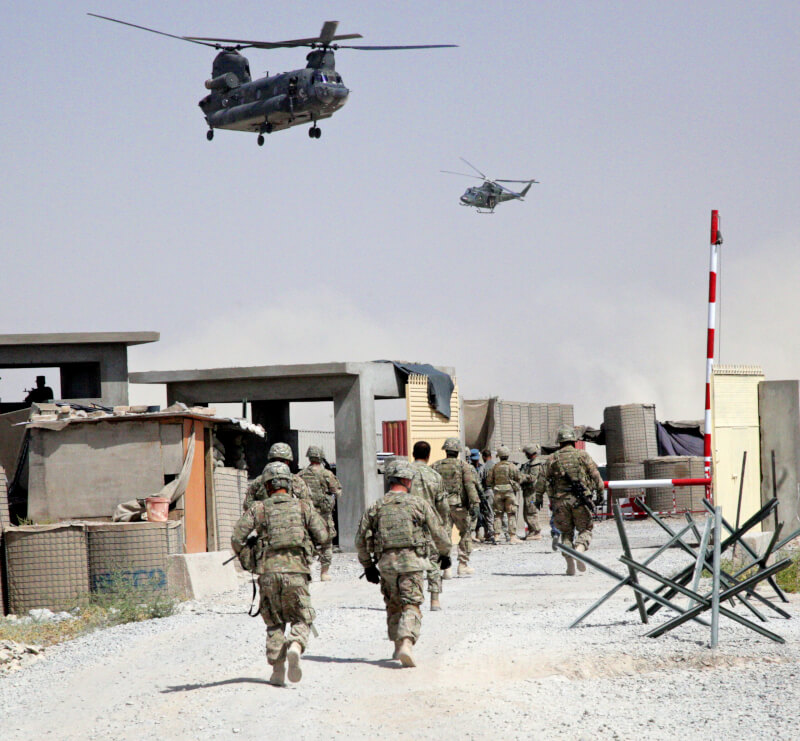
U.S. Army soldiers of Task Force Automatic move out to link up with Canadian troops preparing to meet with the Kandahar officials to celebrate the opening of the new Daman District Center, July 3, 2011. [Staff Sgt. Lorenzo Sam/U.S. Army/Wikipedia]
“The NATO alliance is worth dying for, yes. It’s the foundation of our security. That’s definitely worth sacrifice.”
But now that the war is in the past, he says it’s crucial for Canada to be honest about its defeat and understand what it learned from the experience. For example, he says Afghanistan is today a taboo subject to be avoided within the halls of Global Affairs Canada, rather than a topic of valuable learning and debate.
Rowswell says sweeping those lessons under the carpet won’t help Canadians or the political, defence or diplomatic establishments to find the will and confidence to engage in other global challenges that demand Canada’s attention—including negotiating with self-assurance and purpose to strike a new trade deal with the U.S. or supporting security in Haiti.
“The NATO alliance is worth dying for, yes. It’s the foundation of our security. That’s definitely worth sacrifice.”
“When I look back to where we were as a country with our foreign policy, we are so much less confident and less ambitious than we were in the 2000s,” he says. “That atmosphere of gloom you hear so much about—especially pre-Mark Carney—to me coincides with the end of the Afghanistan mission.
“Our confidence in our ability to fight a war or tackle difficult diplomatic issues is so much lower, and I wonder if we would serve ourselves better as a country to say ‘we lost in Afghanistan, we learned lessons, and now we adjust so that we can take on the next major challenge,’ as opposed to shrinking from it as we seem to have done in the 15 years since.”
For greater context of Rowswell’s comments, read a transcript of the interview below.
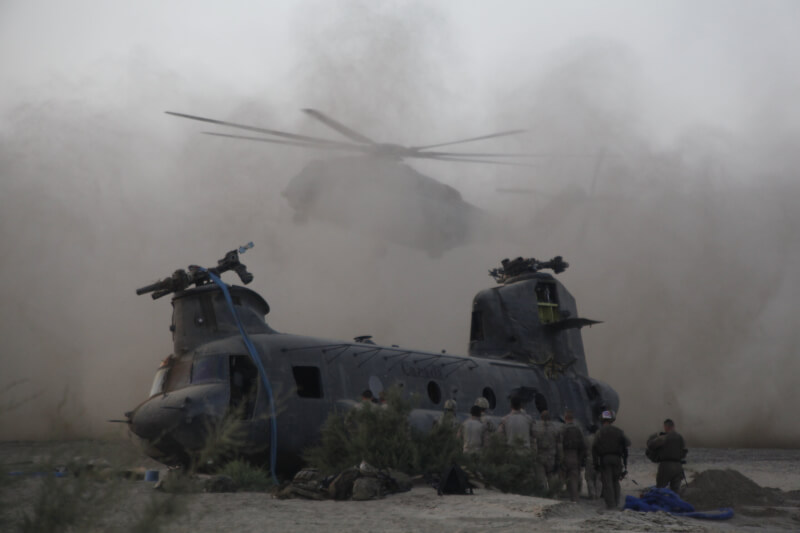
A U.S. CH-53E Super Stallion lands next to a downed Canadian Forces CH-47 Chinook during a tactical recovery of aircraft and personnel in Kandahar on May 17, 2011. [U.S. Department of Defence/Wikipedia]
Rowswell: The context is the John Manley report commissioned by Prime Minister Harper in 2007 to find out what was going wrong in the mission. Inside government—we tried to keep this pretty quiet at the time—the prime minister was extremely frustrated with the military mission and felt that the top, political level of government wasn’t sufficiently informed or on top of what was happening on the ground. So, he brought in [former Liberal cabinet minister] John Manley to lead a commission to study what was happening and do several field trips. The thrust of the report was that the security mission in and of itself would not be sufficient for victory in the conflict because of the nature of asymmetric warfare. There needed to be much more emphasis on governance and development.
LM: Did you have a high sense of confidence that this renewed mission would bring stabilization to Kandahar province?
Rowswell: I think the government itself had only a medium level of confidence. The Harper government hedged its bets by implementing a deadline. This was not part of the Manley recommendations. Manley argued we should stay there as long as it takes to succeed. Whereas the Harper government established a deadline of 2011, three years in the future. That indicted that they wanted to pull out of Afghanistan one way or another. And this was the best of the bad set of options to extricate Canada from the mission. That was the view at the political level.
My own personal views were: I had been in two wars already. What I had taken away from those conflicts is that the local population ultimately determined the long-term prospects for the country. And it was pretty jarring when I first arrived in Kandahar to see how unpopular the Afghan government and the Canadian/ISAF [International Security Assistance Force] mission to support them was. The degree of force protection that was required for even basic mobility was an ominous sign from the beginning. I remember when I first arrived in Kandahar, my first impression is that we would be facing an incredibly uphill battle, given the level of local mistrust and animosity toward the Afghan government and ISAF.
LM: Since Canada’s full withdrawal in 2013-14, there have not been many voices openly saying that we lost the war in Afghanistan. I think the prevailing view is that Canadians performed well, we did our job in tough circumstances, we held the Taliban at bay. But you say we lost—why?
Rowswell: I agree with that conventional wisdom as it applies to the military, but I’m not sure it applies to Canada’s effort as a whole. In tactical and operational terms, the Canadian Forces succeeded in the mission assigned to them.
But the overall mission—whether you take that as the broader military mission in Afghanistan, or the Harper government’s attempt at a military-civilian stabilization mission in Kandahar—both of those missions failed. The ISAF mission obviously failed because the Afghan government didn’t stand on its own when presented with the Taliban advance in 2021. And the Canadian mission of stabilizing this one province can’t be described as a success because there was nothing that would meet the standard of stability, from the perspective of the people of Kandahar.
You mentioned keeping the Taliban at bay—that would not have been the way the mission was articulated. It was not articulated as the Canadian Forces battling the Taliban, it was the Canadian Forces supporting the development of the Afghan National Army [ANA] in its ability to stand up on its own and support the democratically elected government of Afghanistan. And clearly the ANA failed to do that in 2021.
One reason why it’s not that common to hear that Canada was defeated is just a matter of timing. Obviously, the ANA and the Afghan government were still intact in 2011 [when Canada’s combat mission in Kandahar ended] and it would be a whole decade before it fell apart in 2021. That’s why it’s possible to have both of those statements be true.
It was not articulated as the Canadian Forces battling the Taliban, it was the Canadian Forces supporting the development of the Afghan National Army [ANA] in its ability to stand up on its own and support the democratically elected government of Afghanistan. And clearly the ANA failed to do that in 2021.
LM: One of the startling things about the U.S. withdrawal in 2021 was the speed with which the ANA fell. I think the Americans thought it would be a couple of years, at least, that they would be able to hold on, but it was a matter of weeks. It raises the question: if the U.S. had left Kandahar at the same time as Canada in 2011, would the collapse in Kandahar have happened then?
Rowswell: That seems very, very likely. You mention it was only weeks. In fact, the Taliban conquered Afghanistan while NATO was still in the country. NATO just hadn’t fully implemented their withdrawal. So, in one sense, it wasn’t weeks or even days, it was a Taliban victory while Americans were still on the ground.
But the point is, the rapid collapse of the ANA suggests that the structure we left behind was extraordinarily fragile, so it’s a stretch to call that a success.
LM: Could some of this failure not have been foreseen from the start? We knew Afghanistan was the ‘graveyard of empires.’ We knew going in after 9/11 that Pakistan was a duplicitous ally that supported the Taliban. We knew about the challenges of guerrilla warfare from other conflicts throughout history. Were we right to take on a nation-building project there, as opposed to just going in, getting rid of al-Qaida, routing the terrorists and then getting out?
Rowswell: My recollection is that it was widely viewed within the mission that we—NATO, the West—were headed for failure. Those reasons you mentioned—the graveyard of empires—I probably heard references to that every single day I was in Kandahar. The other common one we heard a lot is that Afghanistan was a fundamentally tribal society that never had a consolidated central state, and that building a state was going to be impossible with that situation.
I don’t know what the debates were in 2001 and 2002 when we decided we couldn’t just eliminate al-Qaida and then move on. There was an explicit decision to rebuild within the vacuum that the U.S. intervention had created. Perhaps there was a mistake at that time.
Having been part of the strategic discussions in PCO [Privy Council Office], with DND [Department of National Defence] at the table, and the various government departments debating the transformation of our mission after the Manley report, I don’t think at that point it was seen as viable that you would just eliminate various military targets and then the threat to the West would not just resume once we left. There needed to be something built to prevent the resurgence of the threat that had led to 9/11. The alternatives to nation building are not very appealing. They seem very unlikely to be successful. The choices were a bunch of awful options, once you’ve decapitated a government.
LM: And yet, we ended up in the same place as if we had just left after removing al-Qaida and destroying various military targets.
Rowswell: That’s true.
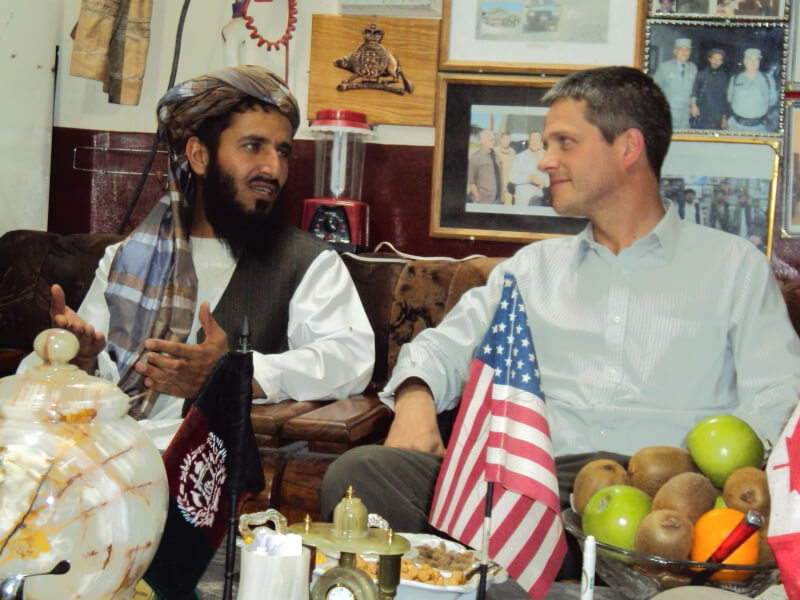
Rowswell meets with the head of police for Kandahar city during his tenure as Representative of Canada in Kandahar (RoCK) in 2009-2010. [Courtesy Ben Rowswell]
Rowswell: I do believe that the overarching strategic imperative for Canada to get involved in Afghanistan was alliance integrity. Canada’s fundamental security in the world was based on its alliance to the United States and to NATO, and we had to renew our contributions to that alliance not just in spending targets, but in blood and treasure. Having not participated in Iraq, this alliance was under strain and there was a requirement for us to demonstrate that we could pull our own weight.
I do think it was very important for us to show that we are net contributors to our collective security. And given how fundamental that is to Canada, it was worth taking on the level of risk that we took in Afghanistan.
What I know from talking with some of the senior politicians at the time is that, at no point did Canada ever think more than two or three years ahead. [Liberal cabinet minister] Bill Graham, who I ended up working closely with—who was minister of defence at the time that the Kandahar mission was set up, and minister of foreign affairs prior to that—told me, ‘We are taking it one year at a time.’ Every time you made a decision in cabinet, the thinking was, ‘We’ll just do this next thing for 12 months and then we’ll call it quits and we’ll say that we’ve paid our debts, we’ve made our contribution.’
When the Kandahar mission came up, the [Paul] Martin government thought, ‘We’ll have to do this for two or three years and then we’ll move on.’ And then the Harper government comes in and says, ‘We’re going to wrap this up in a few years.’ That’s why they sometimes say that Afghanistan was 20 one-year wars, as opposed to one 20-year war. I think that’s the way the politicians managed the situation.
LM: So, given the low level of confidence among the political leadership in Ottawa and among senior bureaucrats on the ground in Afghanistan, was it right for the country to send its soldiers to die in an unwinnable conflict? Is being a good ally to your NATO partners a good enough reason to do that?
Rowswell: I think the decisions are defensible. The NATO alliance is worth dying for, yes. It’s the foundation of our security. That’s definitely worth sacrifice.
If you’re dealing with a situation where you’re being asked by your alliance partners to take on some role that will last between three and four years, is it worth taking on that mission for one to three years given that Afghanistan in that period is by far the most important issue in the alliance—it’s essentially the main effort? Yes, I do think so.
There’s no point in which we looked at a 20-year span of involvement, if you look at the civilian mission, or the 14 years of the full military involvement. There’s no point in which the decision was being asked of a cabinet or prime minister: will Canada make a commitment for 14 years that could cost hundreds of deaths? That would be a much more ambiguous question.
One of the reasons I’ve kept my silence for so long about my sense around why we lost—when we were on the plane flying out of Kandahar in July 2010, I had a profound sense of depression that this was a war we had lost. If I have not felt able or willing to come forward until now, it’s because of the extent of the sacrifice that was made. It’s not a comment that you make lightly.
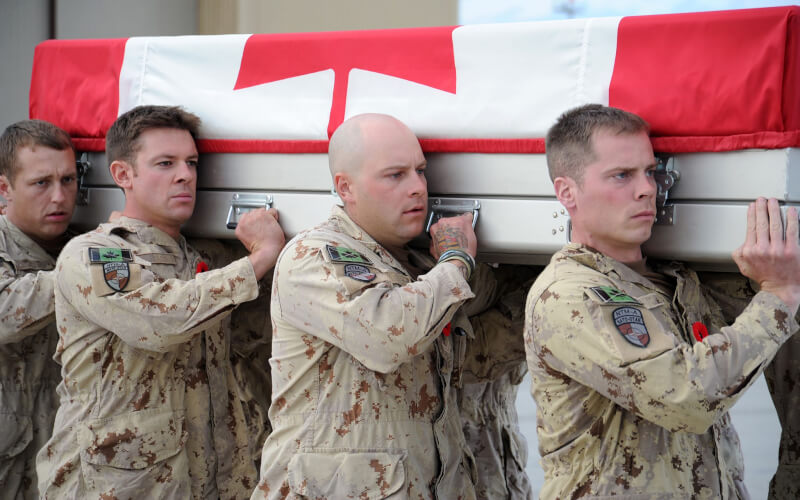
Canadian troops carry the remains of Master Corporal Byron Greff to a waiting aircraft in Kabul, Afghanistan in 2011. [Senior Airman Kat Lynn Justen/US Air Force/Wikimedia]
Rowswell: Two things about the Iran War. The first is that the United States is going to be significantly weakened by this for quite some time, and therefore it’s important for us as an ally of the United States—a country that still depends on the U.S.—to recognize that they’re going to be significantly weaker. And using the word ‘defeat’ helps to crystalize that a little bit more. I’m hoping the Canadian military and the security and diplomatic establishment doesn’t just sit around and wait to see what happens with the Iran War, but that we now factor in the fact that the U.S. has lost, much in the same way I assume Canada did in 1975 when the U.S. suffered a loss in Vietnam. That’s going to have some knock-on effects that I want us to focus on.
The second thing is, when I look back to where we were as a country with our foreign policy, we are so much less confident and less ambitious than we were in the 2000s. I’ve been searching for an explanation. Why is it that we automatically assume that now that Canada is isolated and alone, that we are incapable of negotiating basic bilateral relationships with some of the most powerful countries? That atmosphere of gloom you hear so much about—especially pre-Mark Carney—to me coincides with the end of the Afghanistan mission.
My conclusion is that even though we didn’t use the words ‘defeat’ or ‘loss,’ it’s almost as if subconsciously Canadians have factored that experience in when we think about our ability to solve other conflicts and global problems—‘We got ourselves into this Afghanistan mess, it didn’t do any good, 158 soldiers died and many others injured.’
So now, it’s much more tempting [to say no] when there’s another problem. For example, I was heavily involved in Haiti in 2023. Canada was asked to lead the mission there, and our response was ‘no f-ing way, we’re not going close to that.’ Even though it’s so much closer to Canada and arguably has a much more direct bearing on our interests.
Our confidence in our ability to fight a war or tackle difficult diplomatic issues is so much lower, and I wonder if we would serve ourselves better as a country to say we lost in Afghanistan, we learned lessons, and now we adjust so that we can take on the next major challenge, as opposed to shrinking from it as we seem to have done in the 15 years since.
So that’s why I’m saying this, to make sure we’re able to meet the challenges of today with more confidence than we’ve demonstrated up until now.
I wonder if we would serve ourselves better as a country to say we lost in Afghanistan, we learned lessons, and now we adjust so that we can take on the next major challenge, as opposed to shrinking from it as we seem to have done in the 15 years since.
LM: One way to do that is to have an honest reflection of what Canada did right and what went wrong in Afghanistan. Has there been enough of that analysis in Canada in the years since we left?
Rowswell: No, we definitely haven’t. I think everyone who served in Afghanistan is struck by the silence on it. You don’t read about it anymore—not only current developments in Afghanistan, but you just don’t hear about Canada’s mission. I don’t know what the dynamic is in the military, but at Global Affairs [Canada], the Afghanistan experience is completely irrelevant in today’s diplomatic service.
LM: Just to be clear, you’re saying that inside the department of Global Affairs and in Canada’s diplomatic corps, people are not talking about Afghanistan or thinking about the lessons learned there?
Rowswell: It’s a topic that people just prefer to avoid.
I think it’s a cynicism. The attitude is: ‘Obviously it was a failure, like we knew it was going to be a failure going in, graveyard of empires, etcetera, etcetera.’ So, it’s seen as a 20-year mistake, a 20-year aberration: ‘Let’s all hope that we never, ever do anything like that again because it was just so stupid.’
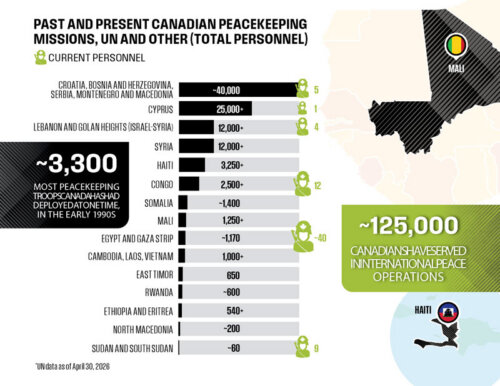
And, of course, when you talk about any other crisis—should we get involved in Lebanon? In Mali? In Haiti? It’s like, ‘Oh, it sounds like we’re going to be stuck in another Afghanistan.’ That’s the worry. The world continues to produce other Afghanistans, and even if it wasn’t a positive experience for us last time, if we’re going to aspire to anything other than being just a junior sidekick under the American shadow, we have to be able to tackle the next major challenge.
But there’s been very little public debate. And there hasn’t been an official lessons-learned exercise. I know this because one of the things I volunteered to do when I returned to Ottawa was to convene a lessons-learned exercise with all the previous commanders of Task Force Kandahar and the previous RoCKs [Representatives of Canada in Kandahar]—the four senior civilians and the four and five one-star generals who served as commanders. We had a half-day booked in Ottawa. It was a complete waste of time because each of us just re-litigated all the internal debates we were having at the time: about whether we got the balance right between military and civilian areas, whether we were focused enough on governance and development or all security. It was a shit-show. It showed to me that we weren’t institutionally capable of doing a lessons-learned. At that time, I thought it was because it was too fresh and maybe we needed to wait a few years. But two or three years passed and there was no other attempt to do a lessons-learned. We just got into, ‘lets forget about Afghanistan’ mode.
It showed me that there’s no consensus that just magically appears after a major failure like that. If we had succeeded, maybe we would have all agreed about what went well. Success has many parents and failure is an orphan.
LM: What criteria should Canada weigh for participation in future wars? Should the likelihood of success be a requirement?
Rowswell: The first condition should be the level of threat to international peace and security. In the Second World War, I can’t imagine we thought it was going to be easy to beat the Germans when we lined up in 1939. But it was very clearly a crisis we could not avoid or not participate in.
The second condition has to be Canada’s long-term connection to the country or region where the conflict is happening. Afghanistan is not a country we had any kind of connection to beforehand. And now that it has slipped back into tyranny and repression, we’re not really affected in our daily lives by what happens in Afghanistan. Haiti, for example, should be a higher priority because we have all kinds of ties to Haiti that are going to last no matter how bad things get there.
A third criteria is, is there an alliance structure available for us to contribute under? We’re never going to fight any of these wars on our own, but given NATO’s role in Canadian defence, if NATO goes to war, it’s much more likely for us to join. Our security really depends ultimately on our alliances as much as any of our own specific capabilities that we bring.
With Afghanistan, if that theoretical conversation about whether we should be there for 20 years and sacrifice 158 people had ever come up, the answer probably would have been no. But that’s not how the structures of decision-making operate in international security.
LM: Thank you.
This transcript has been edited for length and clarity.
Advertisement




I think we lost many good soldiers there and many came back in bad shape, but I think we had to be there as North Americans. 24 Canadians were attacked and died on 911. To me, a kind of an end was ‘Osama Bin Laden death day’ (as I call it in my own mind). Achieving that was a victory for me. It was a pity the Americans were divided in their efforts – Afghanistan and Iraq. Canada did well to stay out of Iraq immediately after 911. We were focused on the more significant area of operations. Unfortunately I was unable to help there. My barrack box made it to the sandbox and back, but I was cut from a tour at the last minute due to a thyroid condition. Afghanistan is their country and I do not believe it is any longer a threat. We held the line strong and true until it no longer needed to be held.