



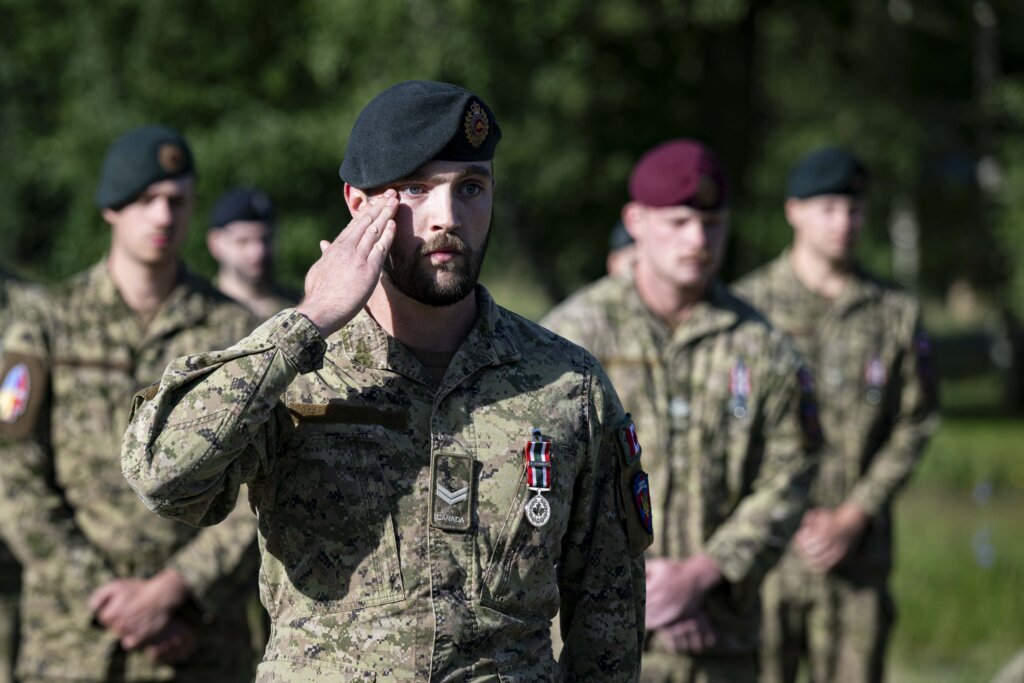
Members of the CAF engineering training element as part of Operation UNIFIER in Poland on June 30, 2025. [Canadian Armed Forces Imagery Technician]
Amid this ominous milieu, should Canada adopt mandatory national service?
Numerous countries—including several NATO members in Scandinavia and the Baltic, as well as Greece and Turkey—require citizens to undertake a period of national service, often with a military component.
Finland, living under Russia’s shadow, requires every man to serve at least 165 days in the military. Finnish women can apply for voluntary service. Likewise, Estonia conscripts all men into the military for 12 months, with the option of civilian public service for those with objections.
South Korea requires all men aged 18-35 to provide 18 months of military service. Even the popular singers of the chart-topping K-pop band BTS had no choice but to swap their microphones for uniforms starting in 2023.
Retired general Stanley McChrystal, the venerated American commander who led U.S. and NATO forces in Afghanistan, recently said he believes the U.S. should adopt mandatory national service for all American men and women—with both military and civilian service options, such as teaching in low-income communities—as a means of healing the country’s deep social and political divides.
“It would be a great leveler in American society,” McChrystal told The New York Times last month. “It would be something that every American had to do. And when they got together later in life … they’d start the conversation, ‘Well, where did you serve?’
“‘I taught in New Orleans,’ ‘I did X’ or whatever. It would be a way to bridge divides. All of us could use a period in our lives when we’re doing something that’s inconvenient or maybe unpleasant. We come out better for it.”
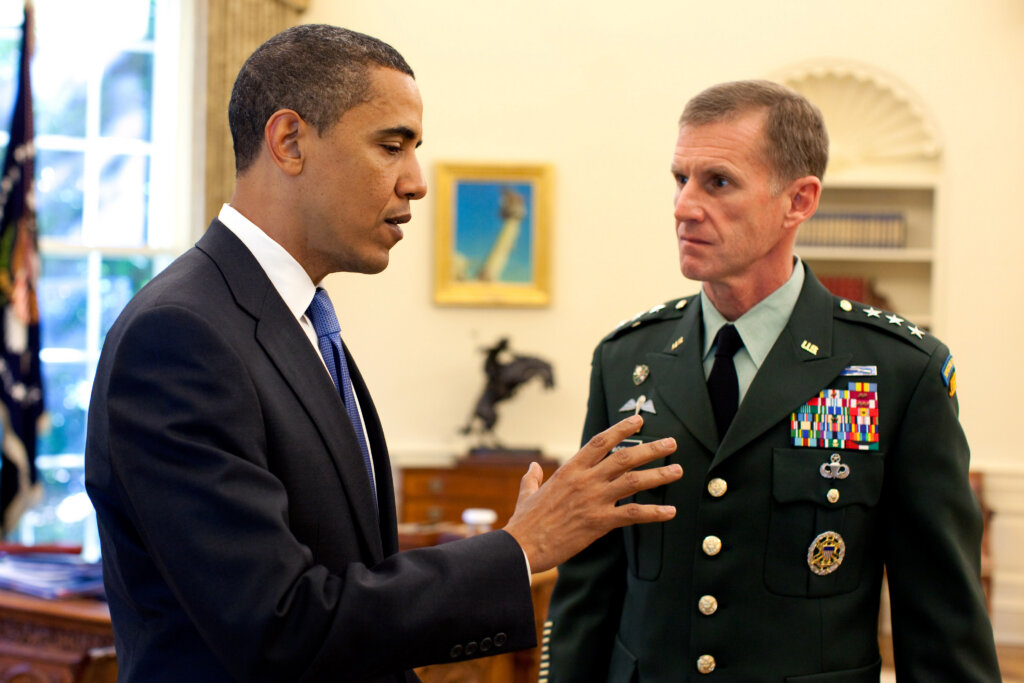
President Barack Obama meets with Lieutenant-General Stanley McChrystal, the new U.S. Commander for Afghanistan at the time, in the Oval Office on May 19, 2009. [Pete Souza]
In early March, Nanos Research asked 1,058 adult Canadians if they “would be willing to personally serve in the Armed Forces if Canada were involved in a major conflict.” One quarter (24 per cent) agreed they would be willing to do so as a full-time job—more than double the amount that agreed to the same question in November 2025. (Fifty per cent did not agree to full-time military service in the latest survey, while 12 per cent were neutral).
In addition, 32 per cent of respondents agreed they’d be willing to serve on part-time duty in the CAF Reserve, up from 19 per cent in 2025.
A separate survey, conducted in June 2025 by the Angus Reid Institute, found overwhelming support among Canadians for a year of mandatory civilian service for people under 30. At least 70 per cent supported mandatory national service carried out in the areas of public health, environmental support, youth services and civil protection.
In contrast, 43 per cent supported the idea of mandatory military service—about the same share (44 per cent) that opposed it.
When young Canadians aged 18-29 were asked what form of service they would prefer if Canada instituted mandatory national service, 60 per cent chose civilian service while 15 per cent chose military service. Notably, only 14 per cent of young people said “neither.”
“All of us could use a period in our lives when we’re doing something that’s inconvenient or maybe unpleasant. We come out better for it.”
Canada has an unhappy history with mandatory military service in wartime. Profound divisions over conscription in the First and Second World War, including strong opposition among French Canadians and Western farmers, triggered political crises and produced riots in Quebec in 1918, nearly rupturing the country.
Few if any Canadians alive today remember those experiences. And the encouraging findings of recent opinion polls suggest the time may now be ripe for mandatory national service. They key to success would be the creation of a well-organized, well-funded and meaningful civilian program requiring people to spend a year of paid service in support of conservation, disaster relief, the health system, at-risk populations or communities in need.
Meanwhile, even the minority of Canadians who would choose a year of military over civilian service would go a long way in supporting recruitment efforts currently underway to replenish the CAF’s depleted ranks.

Participants take part in the RCN’s Naval Experience Program. [Government of Canada]
Retired lieutenant-general Michel Maisonneuve, who joined the forces out of high school, attending the Royal Military College of Canada because his family couldn’t afford tuition at a civilian university, has argued persuasively for mandatory national service with both military and civilian options.
“I envision national service as a paying job, which would make it more attractive to young people,” Maisonneuve wrote last year in Maclean’s. “And there could be other incentives for them to join—financial support for university, for instance, or guaranteed employment after service. Permanent residents could get a faster path to citizenship.”
Canada faces a series of unprecedented security threats. A weakened NATO with scaled back or even withdrawn U.S. forces could put pressure on Canada to re-establish an army brigade or air squadrons stationed permanently in Europe.
“I envision national service as a paying job, which would make it more attractive to young people.”
A scramble for Arctic supremacy could impose heavy demands on Canada’s military, intelligence and other security institutions.
Soon, it may even be necessary to commit significant military resources along the U.S. border. Meanwhile, domestic climate-related disasters, such as floods and wildfires, will also tax military and civilian responders.
Even if such scenarios never arise, Maisonneuve and McChrystal both understand that mandatory national service, military or civilian, would help rebuild societal trust in national institutions and between citizens themselves.
Most importantly, it would re-acquaint people with the old-fashioned notion of personal sacrifice, of giving something of yourself to your community and country.
“Citizenship in this incredible country comes with benefits, but also responsibilities,” said Maisonneuve. “Once every young Canadian has worn a maple leaf on their shoulder, I think they’ll feel pride for their country—something that can unite us all and help Canada achieve its fullest potential.”
Advertisement







I agree with bringing back some form of national service especially for youths that that are having difficulty finding/out ofwork, it may just teach them discipline and respect two things that seem to be lacking these days.