


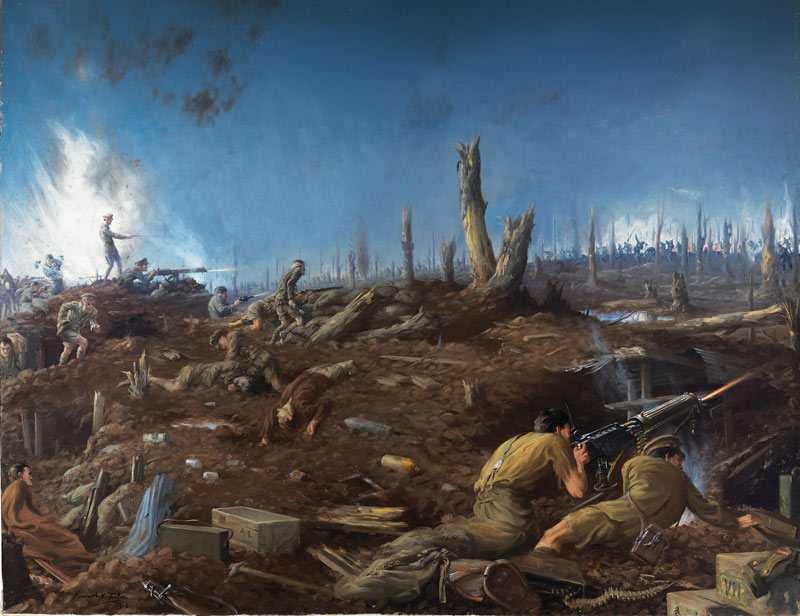
Artist Kenneth Forbes depicts Princess Patricia’s Canadian Light Infantry fiercely defending its position amidst the carnage of the 1916 battle.[Kenneth Forbes/CWM/19880266-001/Wikimedia]
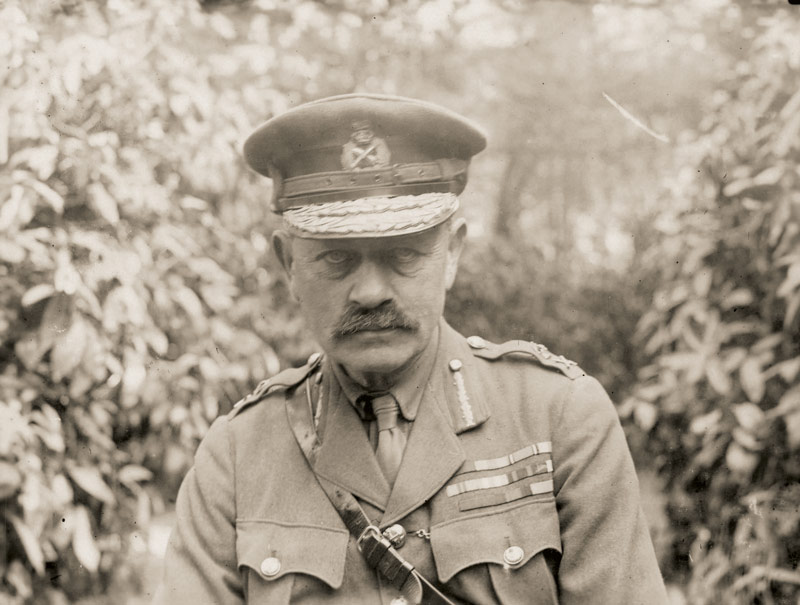
Lieutenant-General Julian Byng, commander of the Canadian Corps.[DND/LAC/3213526]
ON June 2, 1916, the Canadian Corps was still recovering from a disastrous April defeat at the St. Eloi Craters. There, British sappers had detonated underground charges near the Ypres salient’s St. Eloi village, creating seven massive craters. The following attack by 3rd British Division on March 27 had started out promising and then unravelled in the face of determined German counterattacks. When 2nd Canadian Division was sent in on the night of April 3-4 to hold the ground that had been won, it was mauled and forced to retreat. This allowed the Germans to recover all the territory they had lost. At the battle’s end on April 16, the Canadians had suffered 1,373 casualties, the Germans 483.
In the aftermath, corps commander Lieutenant-General Edwin Alderson was replaced on May 28 by fellow Brit Lieutenant-General Julian Byng. Having just returned from service at Gallipoli, Byng wasn’t thrilled by being assigned to colonials. And being new to the unit meant he needed time to assess the Canadians’ strengths and weaknesses, as well as those of their divisional and brigade commanders. Fortunately, the salient seemed relatively quiet. British attention was focused on amassing troops, artillery and munitions for a planned July 1 offensive in the Somme, and the Germans seemed content to let current lines stand. Of course, for soldiers on the ground, the salient was never quiet. An ongoing artillery duel claimed about 2,000 Canadian casualties in May alone.
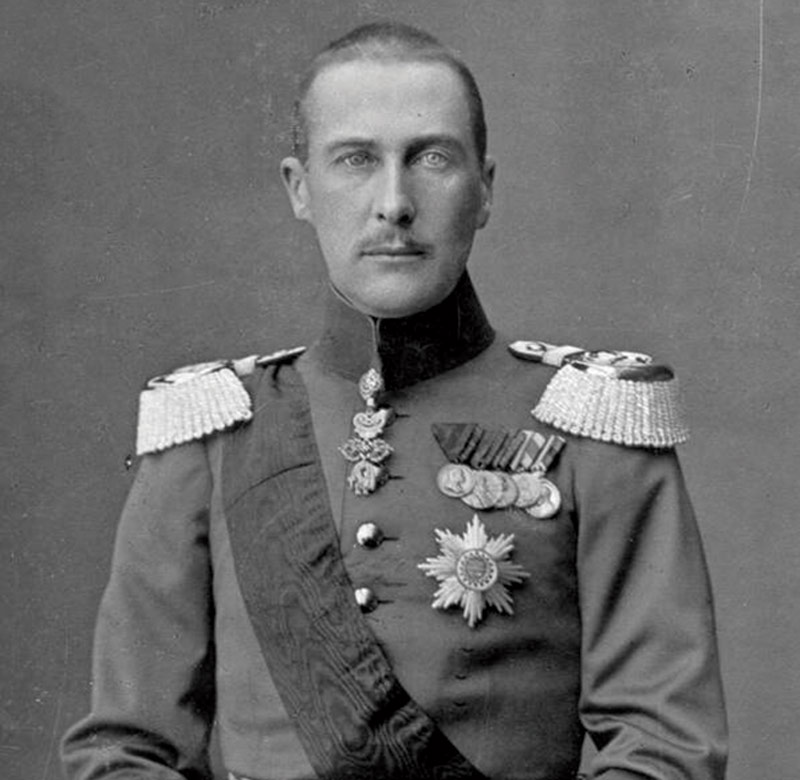
German 4th Army commander Generaloberst Albrecht. [akg-images/Alamy/B5M774]
Spring’s unseasonable cold and rainy weather clogged trenches with mud. Soaked soldiers on both sides were miserable. Perhaps it reflected Canadian inexperience or shaky morale at corps command following the messy shakeup around Alderson’s relief, but the Canadians failed to monitor what the Germans in front of them were doing. Nor did they improve defences, prepare artillery fire zones or create a reaction reserve to break up enemy attacks.
The front defended by the Canadians was both the salient’s most vulnerable and strategically important. Forming the easternmost thrust into German territory, it was the only remaining stretch of Observatory Ridge in Allied hands. Extending from about 1,000 metres east of Zwarteleen beside Hill 60, it passed over the flat knoll of Mount Sorrel and two slightly higher points—Hill 61 and Hill 62, the latter named Tor Top. North of it, the ground fell to Menin Road, while to its west Observatory Ridge extended 1,000 metres from Armagh Wood to Sanctuary Wood.
“The whole enemy position was a cloud of dust and dirt, into which timber, tree trunks, weapons, and equipment were continuously hurled up.”
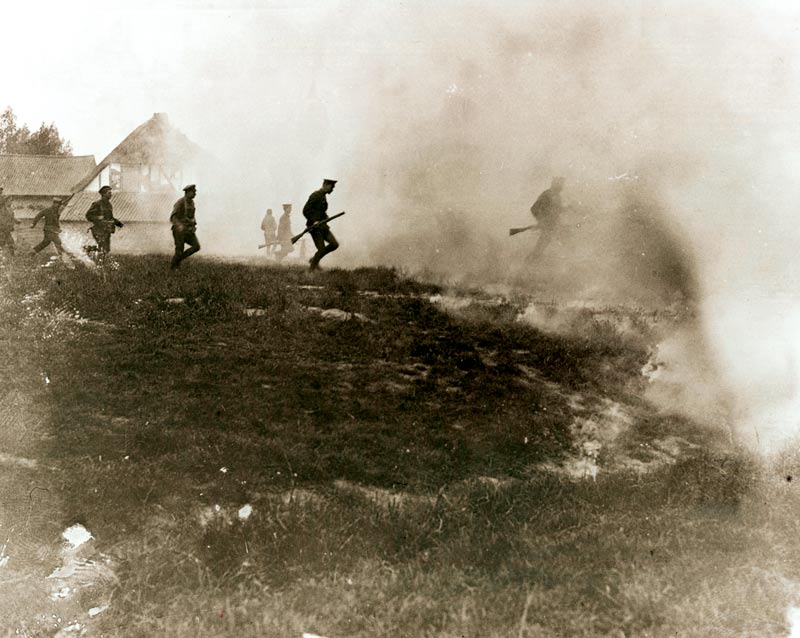
Troops attack through smoke at the Battle of Mount Sorrel. [Henry Edward Knobel/DND/LAC/PA-000169]
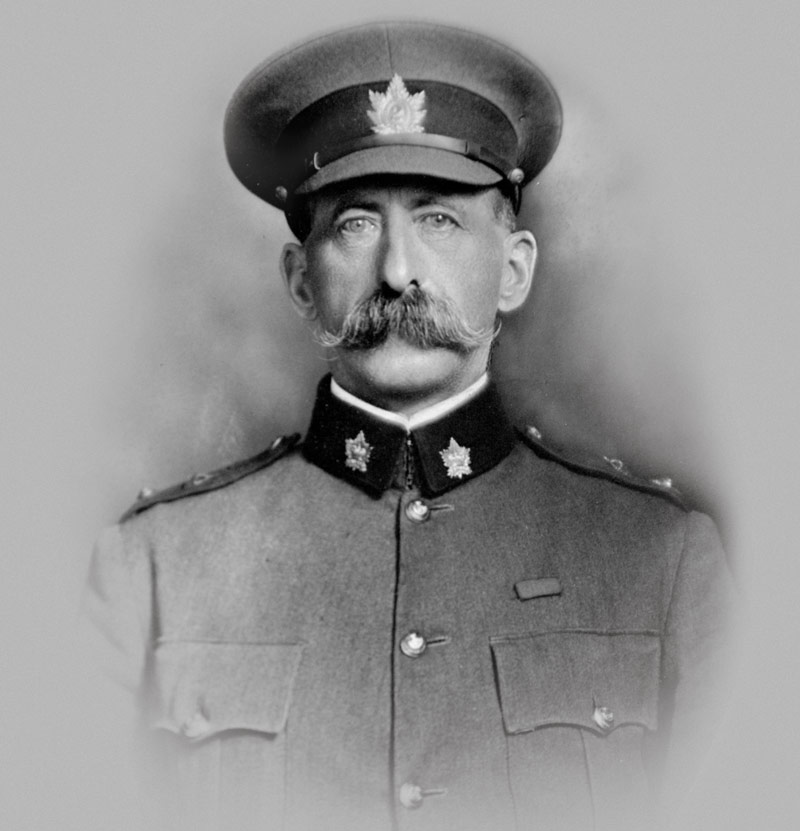
Major-General Malcolm Mercer, commander of 3th Division [The Queen’s Own Rifles of Canada Regimental Museum and Archives]
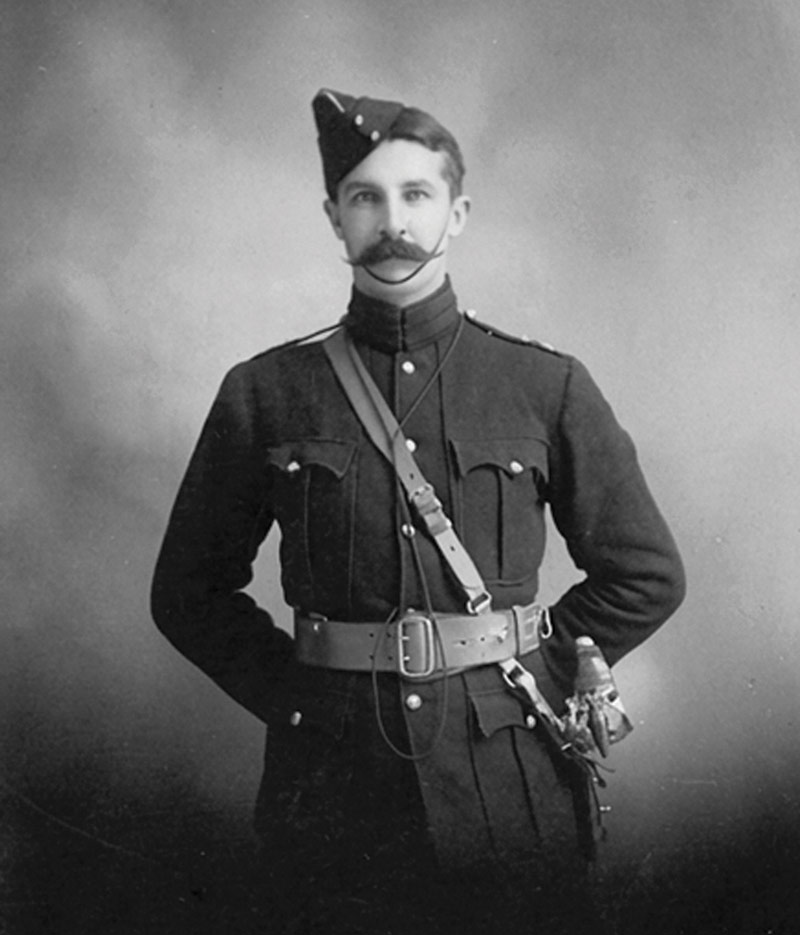
Brigadier-General Victor Williams [British Library/HS85-10-11346/Wikimedia]
German 4th Army commander Generaloberst Albrecht was determined to win this high ground. If he could take it—particularly Observatory Ridge—the Allies might have to cede the salient. At worst, losing these heights might require the Allies to “fetter as strong a force as possible to the Ypres Salient,” as the Germans stated, and thereby reduce British ability to undertake a major offensive elsewhere.
Albrecht, heir apparent to the Kingdom of Württemberg’s throne, was a highly regarded professional soldier. His 4th Army’s 13th Württemberg Corps
was top-notch and its 26th and 27th infantry divisions had been preparing an attack for six weeks. Engineers had extended saps on either side of Tor Top.
Although this work was detected by the Allies and subjected to artillery and machine-gun harassment, German engineers worked on. By the end of May, the heads of these saps—now no more than roughly 50 metres from the Canadian front lines—were linked by a lateral trench. Similar works were identified south of Mount Sorrel.
Meanwhile, Allied aerial observation reported what appeared to be dummy fortifications near Menin Road that closely resembled the Canadian defences at Tor Top, which could be serving as a training site for a future attack. There was also evidence that large-calibre trench mortars and other artillery assets, normally associated with offensive operations, were gathering before the Canadians. With the weather making observation difficult and no signs of major infantry concentrations underway, however, these telltale signs were dismissed.
In the early morning hours of June 2, the Canadians roused to address their defensive weaknesses—not aware it was already too late. At 6 a.m., 3rd Division’s Major-General Malcolm Mercer and Brigadier-General Victor Williams arrived at Mount Sorrel to observe the front lines of 4th Canadian Mounted Rifles (CMR). The battalion’s 8 a.m. diary entry reported a “calm, beautiful and noticeably quiet morning.”
At 8:30 a.m., all that changed as a massive avalanche of artillery shells rained down on a 1,000-metre frontage with 4th CMR caught in the middle. What followed was one of the most intense bombardments to date in the war. For four-and-a-half-hours, the artillery storm raged. Canadian gunners tried to respond but the weight of enemy fire overwhelmed them. Caught in the maw, Mercer was killed while Williams was badly wounded and taken prisoner. Mercer would be the highest ranking Canadian officer to die in the war and Williams the highest ranking prisoner of war.
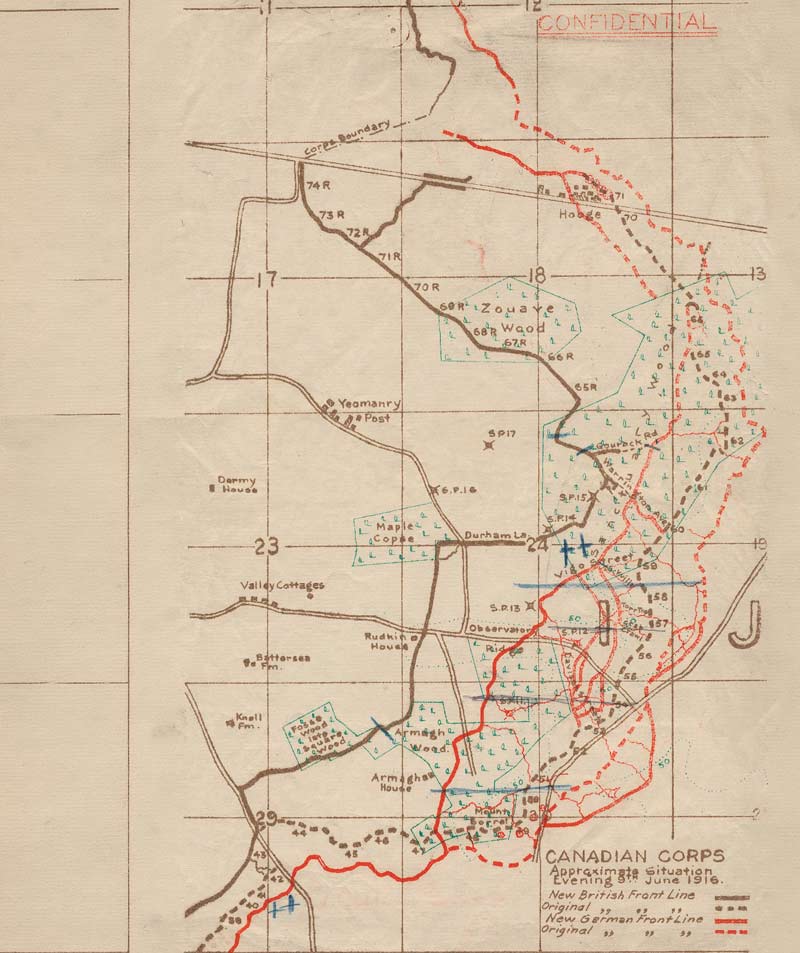
This map illustrates the British/Canadian positions (brown) and the German lines (red) on June 4, 1916. [CWM/19870027-018/Wikimedia]
To the rear of 4th CMR, Private George Yule of 5th CMR hunkered in Maple Copse, a small wood near Hill 62. He was caught in the maelstrom. “All those beautiful trees in Maple Copse, by afternoon there wasn’t a stump left higher than a foot and a half. That’s how devastating the barrage was. I was sent back to find B Company…HQ had been blown to smithereens…everything was destroyed.”
Until now, much of this section of the salient had been spared full-scale destruction. The barrage finished that. The trees of Maple Copse, Armagh Wood and Sanctuary Wood were shredded, nothing left but craters and jagged stumps. Deadly slivers of wood sliced into flesh, adding to the carnage. Few soldiers caught in the barrage survived. Many simply disappeared, engulfed by fire or buried beyond recovery by showers of dirt and debris.
“The whole enemy position was a cloud of dust and dirt, into which timber, tree trunks, weapons, and equipment were continuously hurled up, and occasionally human bodies,” wrote a German witness.
At 1 p.m., the barrage lifted, and four mines emplaced in undetected tunnels under the Canadian front exploded, continuing the slaughter. Then, six Württemberg assault battalions, followed by five more in close support and another six waiting in reserve, struck the four Canadian battalions blocking their path.
As the Germans flooded through the shattered trenches along Mount Sorrel and Hill 62, the isolated bands of survivors from 1st and 4th CMR tried to hold on. Men fought hand to hand with bayonets and grenades. Whenever a Canadian pocket seemed like it might stand, the Württembergs burned them out with flame-throwers. On the left and right flanks, Princess Patricia’s Canadian Light Infantry (PPCLI) and 5th Battalion from 1st Division ripped the Germans with machine guns. Directly facing the Germans, 5th CMR blazed away with rapid and accurate rifle fire from isolated positions on the edges of Maple Copse, somewhat checking the enemy’s advance. Flooding onto Observatory Ridge, the Germans were met with deadly artillery fire from gunners of 5th Battery, Canadian Field Artillery, shooting over open sights. Despite inflicting heavy casualties, however, the battery was overrun.
“It is fitting to stress that here too the Canadians did not surrender,” one German regimental historian wrote, “but at their guns defended themselves with revolvers to the last man.”
By mid-afternoon, a 1,200-metre gap had been created between Mount Sorrel and Sanctuary Wood. Hills 61 and 62 had fallen, along with the eastern portion of Observatory Ridge. But the battle-tested PPCLI—the first Canadian unit to have joined the British Expeditionary Force—refused to budge despite the death of its commander, Lieutenant-Colonel Herbert Buller, and the loss of more than 400 men, including 150 killed.
Then, with the road to Ypres open, the Württembergs—obeying preset orders—dug in 600 to 700 metres from their start line. It was a pause they would regret, for it gave the Canadians desperately needed time to regroup. The losses suffered by the battalions in the direct line of attack were devastating. 4th CMR suffered 89 per cent casualties—only 76 of 702 men were unharmed. Of 1st CMR, just 135 men out of 692 reached the rear.
Determined to reverse the debacle, shortly after 5 p.m. Lieutenant-General Byng ordered that “all ground lost today will be retaken tonight.” A counterattack was critical to prevent the Germans from using their newly won gains as a launch pad for a renewed assault that could threaten the entire salient. With 3rd Division badly mauled, the counterattack needed reinforcement by 1st Division’s 7th and 9th brigades. This pushed the planned 2 a.m. start to past 7 a.m. on June 3 to ensure battalions reached their jumping-off points. Six green rockets meant to signal the four-battalion advance suffered random failures, and required firing a total of 14. Even then, at least two battalions saw no rockets.
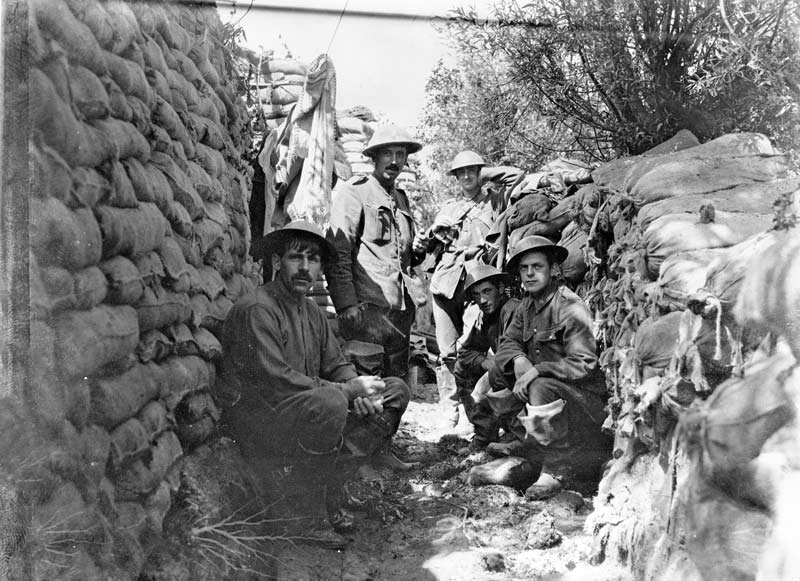
Canadian troops rest in reserve trenches in June 1916. [DND/LAC/PA-000165]
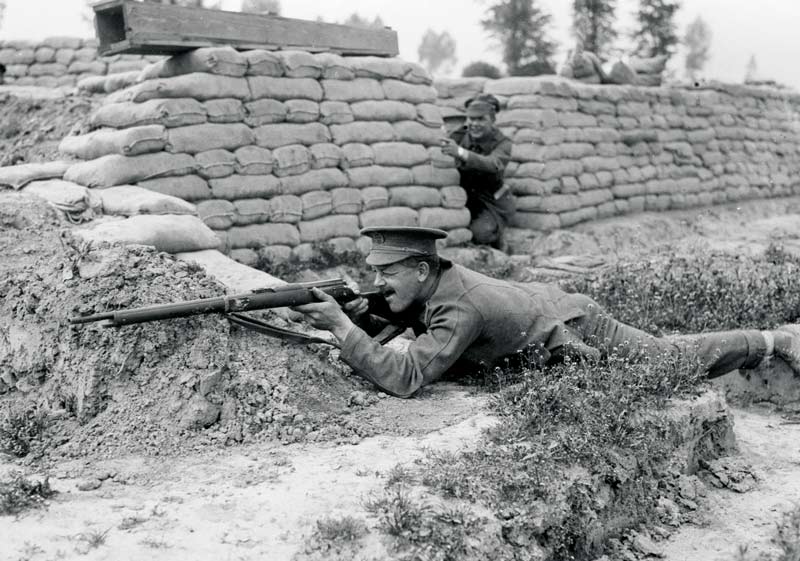
A prone infantryman wields a Ross rifle. [ DND/LAC/PA-3520927]
The misfires resulted in the battalions attacking separately, allowing the Germans to concentrate their fire to shred each in turn. Adding to an already confused situation, the Canadians wore primitive gas masks through which they struggled to breathe normally. The largest attack Canada had mounted to date failed disastrously.
During the advance, Private A.Y. Jackson—known later as a Group of Seven artist—saw a soldier beside him stare “in dismay at a great spurt of blood coming from his arm, which was only hanging by a few shreds of flesh.” Struck in the shoulder, back and neck by shrapnel, Jackson also fell wounded.
“It is fitting to stress that here too the Canadians did not surrender, but at their guns defended themselves with revolvers to the last man.”
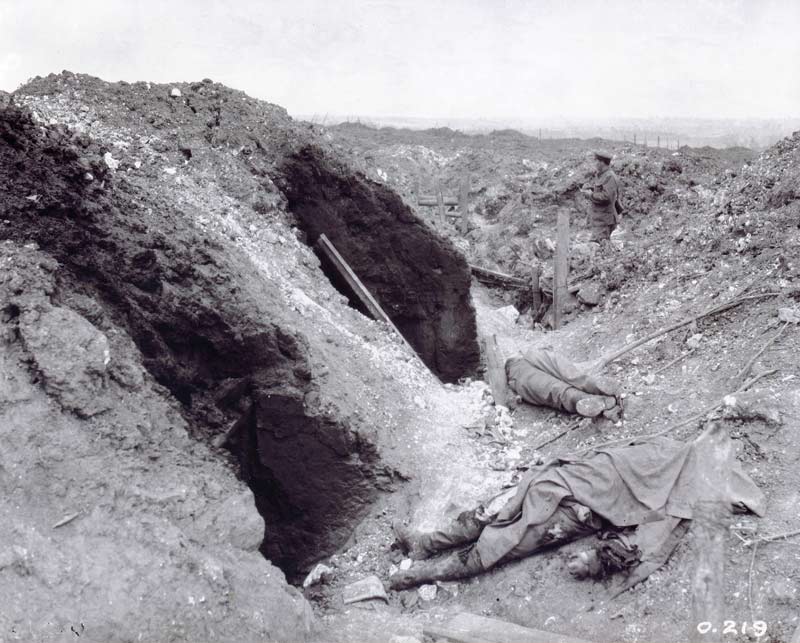
German trenches in the aftermath of a Canadian artillery barrage. [DND/LAC/PA-3194768]
Regaining the lost ground clearly required a more deliberate effort. Byng gave the task to Major-General Arthur Currie’s 1st Division. Currie’s plan was a first taste of what would become the trademark Canadian Corps approach—meticulous attention to detail and heavy use of artillery throughout all operational phases. During the failed June 3 counterattack, artillery forward observation officers had been too far back to effectively direct fire. This time, Currie integrated them into infantry battalion headquarters to ensure close co-operation. Finally, Currie decided on an uncommon night attack.
Between June 9-12, the German lines were pounded by four massive bombardments. Each time the guns stilled, Württemberg troops rushed to front-line positions through the last falling shells to meet an attack that never came, suffering casualties. The final 10-hour barrage on the last night was devastating. One German lieutenant called it a “catastrophe” and wrote: “The trenches are quite destroyed…one shell hole joins the next…the dreadful spectacle of the many dead and the number of missing, depresses everyone.”
At 1:30 a.m. on June 13, four battalions—3rd, 16th, 13th and 58th, from right to left—charged over the top in a rainstorm and advanced through a morass and countless craters. The creeping barrage that would soon become standard had not yet been devised, so troops raced to close with the stunned Germans emerging and lurching in disorganization toward fighting positions.
“We were on top of them before they knew it,” 3rd Battalion’s Lieutenant H.R. Alley wrote. “There was some pretty bloody bayoneting.”
In places, the Württembergs resisted with heavy machine-gun and rifle fire. Instead of fighting it out with these positions, 16th Battalion’s soldiers infiltrated around their flanks and kept advancing. The attack dissolved into a melee with junior officers and non-commissioned officers controlling small groups of soldiers in engaging the enemy at point-blank range and hand to hand. By 2:30 a.m., the Canadians had won back virtually all ground lost on June 2. Exhausted, they waited for a counterattack that never came.
Instead, the Germans lashed back with a massive artillery barrage that killed many wounded on both sides who lay helpless on the mud-drenched battleground. Fitful but failed counterattacks followed for two days. When the fighting sputtered out, no man’s land was a churned-up cauldron just 150 metres wide.
The two-week battle ended with both sides where they had begun. Canadian casualties numbered more than 8,700—including about 1,000 dead and 1,900 missing. Most of the missing were presumed dead. The Germans counted 5,765 killed, wounded or missing.
The Canadian Corps emerged from the battle not only victorious, but having proved its ability to withstand the worst the Germans could throw at them, and to bounce back to victory with a well-planned and executed counterattack. It marked the Canadians coming of age as a fighting formation and presaged what would come in the summer at the Somme.
Advertisement