

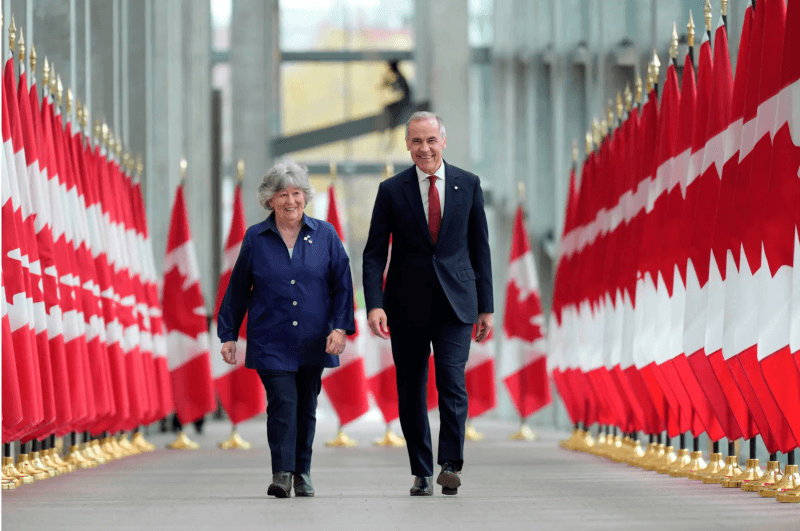
Prime Minister Mark Carney announces Canada’s next governor general, Louise Arbour, in Ottawa on May 5, 2026. [Adrian Wyld/The Canadian Press]
More than a half-century later, the idea that the conduct of governments and armies should be subject to international law arguably reached its high point with the 1999 indictment of Yugoslav President Slobodan Milošević—the first time a sitting head of state had ever been indicted for war crimes by an international tribunal.
The lawyer behind that historic indictment was Canadian Louise Arbour, then chief prosecutor for the United Nations International War Crimes Tribunals for the former Yugoslavia and Rwanda.
As Canadians learned last week, Arbour’s latest undertaking will be serving as Canada’s 31st governor general.
It’s tempting to dismiss the individuals installed at Rideau Hall every five years or so as inconsequential: while they may be accomplished people, they exercise mostly ceremonial posts seemingly without real power or influence. And yet behind the pomp and the polite ribbon-cutting, governors general are entrusted with constitutional authority as the guardians of Canada’s parliamentary democracy.
There’s no better example of this than Julian Byng, the great general who led Canadians to victory at Vimy Ridge. After commanding the Canadian Corps through much of the First World War, Byng became governor general in 1921 and—on constitutional principle—famously withstood pressure from Prime Minister Mackenzie King to dissolve parliament and call an election in 1926.
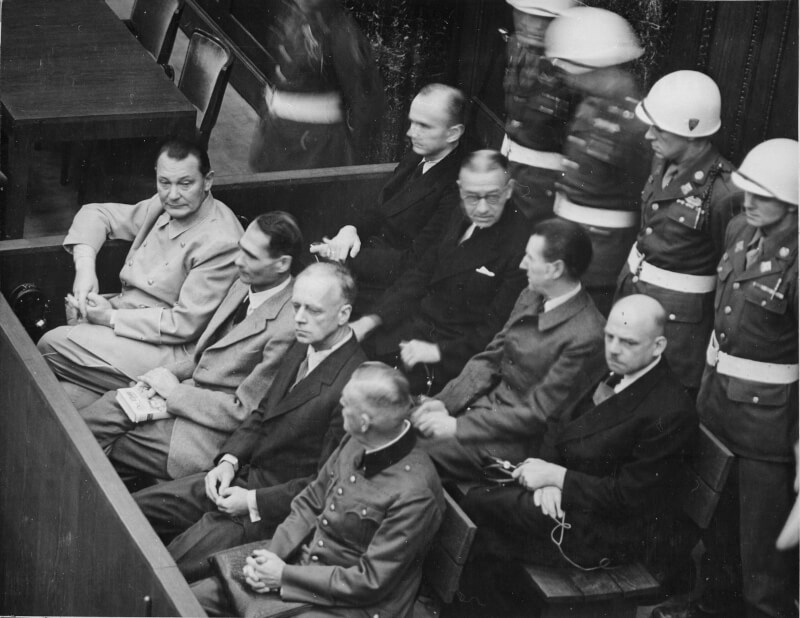
A group of defendants at the Nuremberg trials. [Office of the U.S. Chief of Counsel for the Prosecution of Axis Criminality/Wikimedia]
Arbour spent four years immersed in the aftermath of the hostilities that consumed much of the Canadian Armed Forces’ energy and attention throughout that decade. Amid the violent breakup of the former Yugoslavia, Canadian soldiers played a vital role in the United Nations Protection Force (UNPROFOR) in Croatia and Bosnia and Herzegovina. In the spring of 1992 under the leadership of Major-General Lewis MacKenzie, Canadians and other so-called “peacekeeping” troops came under frequent fire in maintaining the flow of humanitarian aid through the beleaguered Sarajevo airport.
Behind the pomp and the polite ribbon-cutting, governors general are entrusted with constitutional authority as the guardians of Canada’s parliamentary democracy.
The following year, four members of Princess Patricia’s Canadian Light Infantry were wounded in the Battle of Medak Pocket as they tried to intervene during the genocide of Serb civilians by Croation forces.
Virtually every Canadian Army unit was engaged in the Balkans, first with UNPROFOR and later with NATO during the fighting in Kosovo. Many who served brought home psychological scars from trying to keep peace where there was none to keep, amid civil wars rife with generational hatred and ethnic cleansing.
Meanwhile, Canadians were front and centre in Rwanda, both during and after the explosion of violence that killed more than 800,000 people in the summer of 1994. Major-General Roméo Dallaire was forced to confront the genocide with only a token force of foreign soldiers under his command in the United Nations Assistance Mission for Rwanda (UNAMIR).
Following the genocide, a second UNAMIR mission, substantially operated and commanded by Canadians, returned to Rwanda to restore a semblance of order, as well as bring medical attention and other needs to the shattered country.
Into the wake of these awful tragedies stepped Arbour and her band of war crimes prosecutors. With far fewer resources than were available to the Nuremberg prosecutors, Arbour’s team notched some notable successes, indicting and, in some cases, convicting key figures behind the violence in both the Balkans and Rwanda.
(Milošević—charged with genocide, crimes against humanity and other war crimes—was arrested by the Yugoslav government and turned over to Arbour’s tribunal in 2001. He died in his prison cell in 2006 while his trial was underway.)
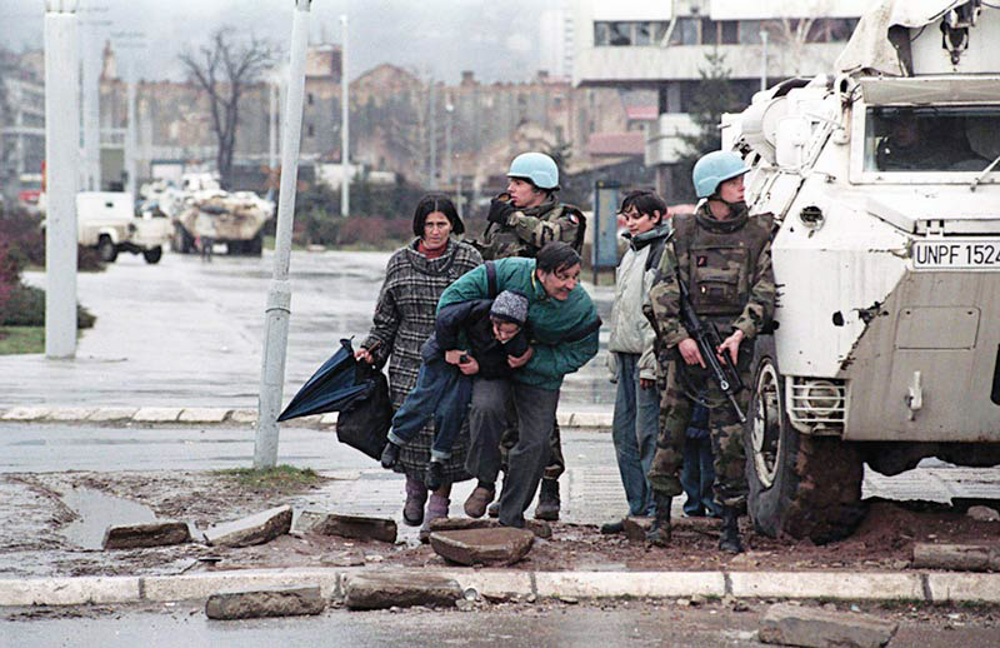
Residents of Sarajevo take cover from sniper fire behind an UNPROFOR armoured vehicle in 1993.
[Danilo Krstanovic/Reuters/Alamy/2D1GJ50]
After all, Nuremberg—and the larger projects of reintegrating Germany and Japan into the community of nations—were a result of the painful mistakes of the Treaty of Versailles after the First World War. The onerous terms imposed by the victors on a defeated Germany in a spirit of retribution in the 1920s contributed to German resentment, propelling the rise of Nazism and another war.
At Nuremberg, as with the tribunals for Yugoslavia and Rwanda, the goal was not revenge but justice, for the purpose of showing survivors on both sides of the conflicts that those who orchestrate mass violence should be seen not as populist heroes who embody the spirit of their people, but as criminals accountable under the law.
“That’s what justice does, you see, it sheds light on the reality of a situation,” Arbour said in an interview with PBS Frontline, while still a war crimes prosecutor.
Not only does justice show victims that their suffering has been recognized and accounted for, but it also enlightens those who supported leaders convicted of war crimes.
“If we are successful, we will assist a people in letting go of what it believes to be its war heroes, by exposing them as criminals. This is critically important, I think, for the long-term establishment of peace, on both sides,” said Arbour. “There’s no need to pass on to the next generation their need for revenge.”
“If we are successful, we will assist a people in letting go of what it believes to be its war heroes, by exposing them as criminals.”
One can take issue with some aspects of Louise Arbour’s long record in public life. As chief prosecutor at the tribunals, she can fairly be criticized for selective judgment in choosing which leaders to pursue—for example, prosecuting those of one ethnic group over another when, in fact, crimes were committed on all sides.
One can find fault in her subsequent decisions as a justice of the Supreme Court of Canada from 1999-2004, or disagree with some of the recommendations of her inquiry into sexual misconduct and culture of the Canadian Armed Forces in 2021-2022.
Yet, it’s surely significant that someone bound for Canada’s highest constitutional office is appointed at a moment when the rules-based international order she so clearly embodies lies in tatters.
The previous global trade system has been discarded; great powers are unilaterally going to war without the approval of the UN, the endorsement of NATO or other international bodies; freedom of navigation on the high seas is becoming a distant memory.
Into this, Prime Minister Mark Carney has chosen to send a signal via Arbour that Canada, for its part, still believes in the rule of law, the legitimacy of institutions and the importance of global co-operation.
As Carney said when announcing the incoming governor general: “The strength of this country resides in stable institutions managed with wisdom.” Arbour will represent Canada as “a beacon to a world lost at sea.”
Advertisement





Good article. Did not know her background in legal work regarding war crimes.
While I find Richard Foot’s article balanced I believe that Ms Arbour’s approach to investigating a concern, such as sexual harassment in our service colleges, is not with an open mind but with a predetermined outlook to be supported by whatever evidence she can produce.
I think that an editorial in one of the national newspapers had it right when it proposed that a member, serving or retired, of Canada’s armed forces would be the ideal candidate to uphold the values of the office of Governor General.