

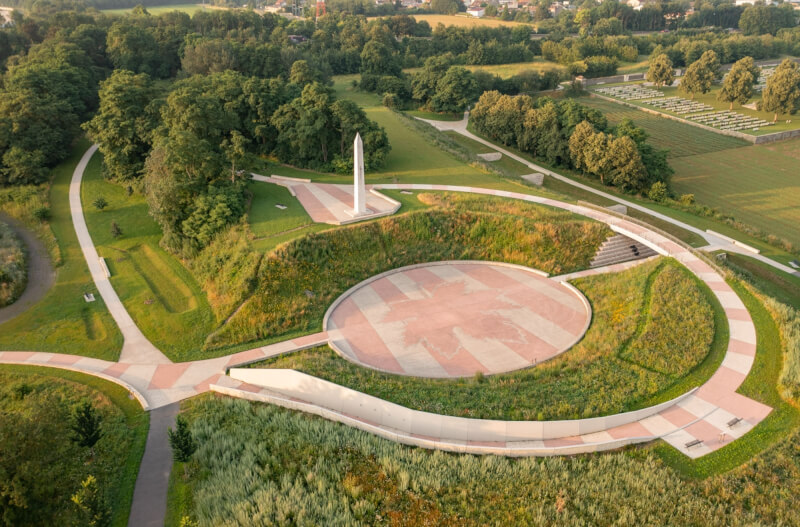
The limestone obelisk and revamped ampitheatre at Hill 70 Memorial Park in Loos-en-Gohelle, France. [hill70.ca]
In startling contrast to the stunning memorial and grounds he had seen at Vimy Ridge, there was nothing to mark one of Canada’s most significant actions of the war except a nearby cemetery holding the graves of some of the 1,877 troops who died capturing Hill 70 in 1917.
“We went straight up the hill, and I stopped and said, ‘Hill 70, this is the highest feature—this must be it,’” recalled Hutchings. “And there was nothing there.”
That evening over a beer, Hutchings and his brother John resolved to build a memorial at Hill 70 to commemorate Canada’s sacrifice and educate visitors about the little-known battle that for generations has been overshadowed by Vimy Ridge.
“We decided we’ve got to do something, we’ve got to put something there,” said Hutchings. “My brother was doing little sketches on the place mat in the French pub where we were sitting—those were the first sketches of what we built.”
A retired army colonel who spent 20 years serving in Canada’s armoured regiments, Hutchings returned home to Kingston, Ont., and poured his energy into a 10-year, $10-million, private effort to create Hill 70 Memorial Park, outside Lens, France. The memorial opened in 2017, just in time for the 100th anniversary of the battle.
This week, Hutchings returned to the site with dignitaries from Canada and France to inaugurate the project’s final stage: an open-air visitor information pavilion explaining the history of the battle. The pavilion has been dedicated to the memory of Brigadier-General Raymond Brutinel, a French-born, Canadian officer and military innovator who founded the Canadian Motor Machine Gun Brigade, one of the first mechanized army units.
“We went straight up the hill, and I stopped and said, ‘Hill 70, this is the highest feature—this must be it,’” recalled Hutchings. “And there was nothing there.”
In the summer of 1917, following its successful assault on Vimy Ridge, the Canadian Corps—previously led and largely staffed by senior British officers—was placed under the leadership of Lieutenant-General Arthur Currie, its first ever Canadian commander. To divert German resources away from the Allied offensive then underway at Passchendaele, the Canadians were ordered to seize what was left of Lens from the Germans. Currie believed a frontal assault on the city would be futile, so he convinced his superiors that capturing Hill 70—a chalky, treeless elevation 70 metres above sea level, from which the Allies could harass and pin down German forces inside Lens—would be of greater tactical value.
After weeks of careful planning, Currie’s troops launched their attack on German lines on Aug. 15, 1917. Despite stiff resistance, they were atop Hill 70 by the end of the day. The Canadians withstood 21 German counterattacks, eventually declaring victory after four days of hard fighting.
The cost was roughly 9,200 Canadians and up to 25,000 Germans killed and wounded. An incredible six Victoria Crosses were awarded to Canadians for their bravery in the battle, mostly in episodes of close combat.
On the heels of Vimy, the victory at Hill 70 again confirmed the skill and fortitude of the Canadian Corps. It would remain under Canadian command, and its four divisions would be kept together as one of the Allies’ most formidable fighting units, through the end of the war.
Yet in the decades that followed, as Vimy’s fame and legend grew in the presence of its great memorial, so the memory of Hill 70 languished, along with the actual site itself. When Mark Hutchings first saw it, the location of one of Canada’s great wartime achievements was only a patch of suburban scrubland holding the remnants of an abandoned amphitheatre overgrown with grass and weeds.
“It was all in pretty rough shape,” he said.
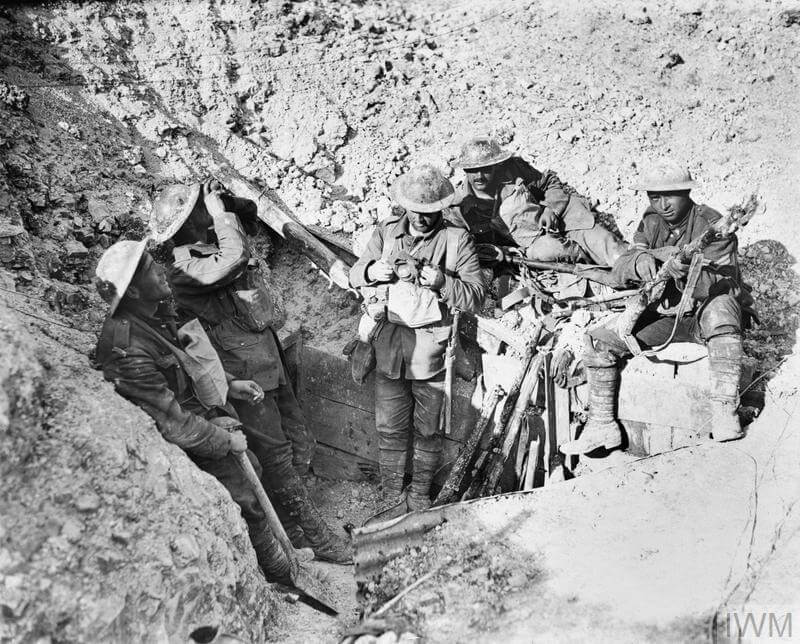
Canadian troops in a captured German trench on Hill 70 in August 1917. [IWM/CO 1782]
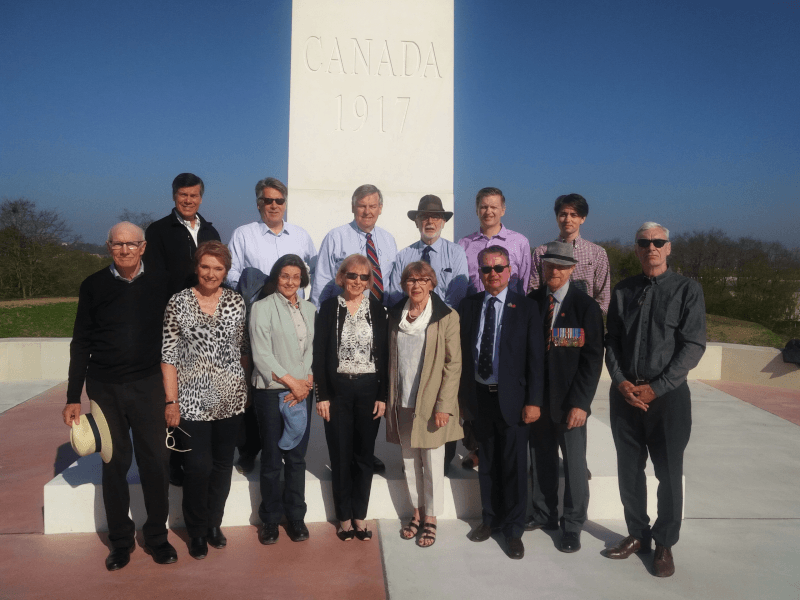
Mark Hutchings (back row, top left) and other volunteers of the Hill 70 Memorial Project team gather in front of the Hill 70 monument. [Courtesy Mark Hutchings]
“We never got any [federal] money, not a cent,” said Hutchings, who serves as the charity’s chairman. “There was simply no political interest.”
Undeterred, the group raised $10 million from businesses, regimental associations and individuals across the country, many of whom had family members who fought at Hill 70. There were four single donations of at least $1 million each, including from the late Toronto businessman Cyril Woods and the late Vancouver philanthropist Robert Ho.
Then-governor general David Johnston also became the project’s official patron.
Yet in the decades that followed, as Vimy’s fame and legend grew in the presence of its great memorial, so the memory of Hill 70 languished, along with the actual site itself.
Hutchings persuaded the town of Loos-en-Gohelle, where Hill 70 is located, to set aside five hectares of vacant land for the project. Although the actual summit of Hill 70 wasn’t available, the project land encompasses the old trench lines and tunnels from where Canadians began their assault on the hill.
“We had to go over all the land to ensure it was clear of mines, unexploded artillery, booby traps and human remains. We did not find any human remains, thankfully,” said Hutchings.
With volunteer design services from a group of Ottawa architects, the team built an impressive commemorative park that includes a renewed amphitheatre, the interpretive pavilion, and a series of six walkways dedicated to each of the battle’s Victoria Cross recipients—all constructed around a tall limestone obelisk rising 70 metres above sea level inscribed with the number “70.”
Throughout the memorial, 1,877 maple leaves inlaid in concrete mark each of the Canadian soldiers who died as a result of the battle.
Hutchings says his hope for the memorial park is that it becomes more than simply a solemn place to remember the sacrifices and achievements of the dead, but an active, joyful venue for the living. His team are promoting the site as a destination for international tourists, particularly the large number of British tourists who travel in France.
He also hopes residents enjoy the memorial as a place to ride bicycles, spend time with their families, attend small outdoor concerts, or simply take in the view.
“We encourage local citizens to use our park,” he said. “It’s a place of great beauty.”
Advertisement