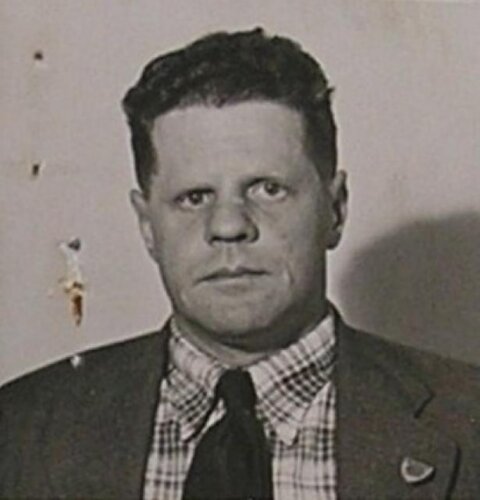



A portrait of Francis (Mike) Kendall from his Special Operations Executive personnel file. [gwulo.com]
Francis (Mike) Kendall was many things: flawed yet formidable, complicated yet courageous and, perhaps most strikingly, forgotten.
A resident of Hong Kong prior to the Dec. 8-25, 1941, battle, the Canadian civilian was nevertheless drawn into a clandestine war against Japan after its forces attacked. There, as the Allied garrison attempted—ultimately in vain—to stem the enemy tide, Kendall helped organize the escape of 75 key people out of the doomed British colony and into unconquered China.
His exploits continued with Operation Oblivion—a secret mission to infiltrate Japanese-occupied Hong Kong alongside a group of Chinese-Canadians. Despite the absence of official military credentials, Kendall found himself at the centre of the British Special Operations Executive (SOE) effort.
It is, asserts biographer Allan Bartley, an extraordinary story that “has not been acknowledged”—until now, that is, with the release of his book Beyond Operation Oblivion: A Canadian Spy Before, During, and After the Fall of Hong Kong, 1941.
Speaking to Legion Magazine, Bartley offered a teaser to the tale.

Author Allan Bartley. [Lorie Root]
On Kendall’s early life and career
Mike Kendall was an intriguing character. Born in Vancouver, he was three or four years old when his father—a doctor—died. His mom eventually remarried, and the family migrated to Los Angeles in the early 1920s, by which point Mike would have been in his teens.
He falls off the official radar for about 10 years, resurfacing in Hong Kong in the early 1930s. It seems that he’d spent most of that prior time working for mining companies in Mexico and Peru, then in the Philippines. When he arrives in Hong Kong, he’s working for an American construction company on a major dam project in the New Territories, presenting himself as a mining engineer.
I can find no evidence that he ever studied mining in university or that he ever attended university, which suggests that he’s not a man who’s frank about his origins or background.
He joins the Hong Kong Volunteer Defence Force as a bombardier in the artillery but resigns within a couple of years because he was going on a long trip to the United Kingdom. During these years, he meets and marries his wife, Beatrice. He then essentially moves into a mining consultant role with a colleague, where they’re involved in a couple of shady activities that are still unclear to me. That’s Mike Kendall until about 1937.
On Kendall in the lead-up to war
That year, a major typhoon hits Hong Kong. There are more than 10,000 fatalities. At the same time, the Japanese have launched attacks on China and are threatening Shanghai. The British government evacuated its nationals from there, bringing them to Hong Kong.
The Hong Kong administration is thus facing a double crisis, both from the after-effects of the typhoon and the influx of refugees. A call goes out for volunteers to help deal with these situations. A citizens’ committee is established, and Mike Kendall steps forward. Quite frankly, he makes a huge impression on the colonial administrators with his efficiency and effectiveness.
It’s at that time that the Hong Kong government and military authorities start taking seriously the prospect that the Japanese may attack Hong Kong itself. So, the military intelligence group in Hong Kong begins setting up what comes to be known as ‘Z’ Force, an organized resistance group in the event of a Japanese conquest.
Kendall is recruited as the leader of the force, and he then recruits about 15 members, largely westerners, to operate as behind-the-line guerrillas. Kendall and his people had also been recruited by the SOE working out of Singapore.
That’s basically what’s going on before we see the actual attack on Hong Kong in December 1941.
On Kendall during the Battle of Hong Kong
The Japanese quickly overrun the New Territories north of Hong Kong. Kendall and two of his colleagues escape from there to the island.
Notably, they were involved in planning for the escape of senior Nationalist Chinese officers who’d been sent to Hong Kong to co-ordinate with the British. That group eventually mushroomed into a party of about 75, which also included senior military intelligence people, spies working for the British government, and key serving army and navy personnel.
For these folks, escape from Hong Kong was imperative to their survival. It was authorized on the day of the fall of Hong Kong—Christmas Day, 1941. Kendall spearheaded efforts to move the group from central Hong Kong to Aberdeen naval station. They were put onto boats and taken away from Hong Kong that night.
Kendall led this mixed group of spies, sailors, soldiers, civilians and senior Chinese officers up through the New Territories—a days-long march through enemy territory—and managed to reach the Nationalist Chinese lines. He then managed to get to Chongqing, where the Nationalist government had fled, and from there, he was able to solidify his relationship with the SOE.
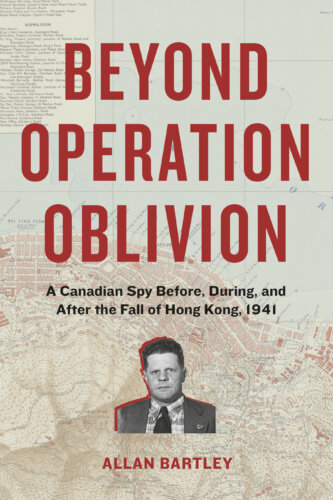
[Courtesy Heritage House Publishing]
About Kendall and Operation Oblivion
He was sent off to India and put in charge of an SOE training camp at Poona [present-day Pune], south of Bombay—now Mumbai. By that stage, Kendall had spent a lot of time thinking about an appropriate response to the Japanese occupation of Hong Kong. He came up with the idea of inserting a much more organized guerrilla force, made up of Cantonese speakers, into the Hong Kong region.
Kendall was sent to London and then Washington to argue that the Americans should take this on as a project and recruit from Chinese-American communities. Unfortunately, the U.S. decided that their diplomatic relationship with the Nationalist Chinese government would be better served with another option.
Regardless, the Brits say, “Okay, let’s do it. We’ve got Chinese-Canadian and other Cantonese speakers from elsewhere who we can call on.” They put Kendall in charge of what they called Operation Oblivion.
Kendall arrives in Canada and does a pretty good job at recruiting 13 Canadians of Chinese origin. He sets up a training camp for them on the east side of Okanagan, B.C.—a place where, as a child, he had spent holidays and knew well. In summer 1944, they get on with the business of training.
Let’s not forget that these recruits were the children of Chinese immigrants to Canada. In 1923, the Canadian government had passed the Chinese Exclusion Act, which had severely restricted Chinese immigration to Canada and curtailed the civil rights of Canadians of Chinese origin. These were now young men who had grown up in circumstances where they had been denied full citizenship rights, who had to fight to get into the Canadian forces. And there they were, ready to serve their country—and expecting full civil rights for doing so.
On the operation’s cancellation
The men all pulled through training and were dispatched to Australia in fall 1944. Kendall was there, although he did not make himself welcome. He told the Australians that he was a lieutenant-colonel when, in fact, he had no military rank at all.
Meanwhile, by early 1945, it’s clear that the war in Europe is going to come to an end soon. The war in China and the Pacific, on the other hand, is still raging. The British and Americans are also engaged in a diplomatic set-to about who would control the Asia-Pacific region after the war, with Hong Kong becoming a particular point of contention.
Kendall and his 13 operatives are still waiting to be inserted into the Hong Kong area at that time, and the only way they could make that trip was by submarine. But, the only submarines that might be available are American—and the American commander says no. Operation Oblivion couldn’t proceed.
On how Kendall should be remembered
Kendall’s life was more than it appeared because most people knew nothing about his wartime and pre-wartime activities—and indeed, what he accomplished during those years was major. It was also less than what it appeared in the sense that—to be blunt—the man was a bit of a prevaricator. He was not a mining engineer, for example—he was a mining foreman at best. He was well-spoken and wrote well, but he did not present himself well. I wouldn’t say he picked fights, but he was also hard to get along with. That said, he did some extraordinary things—and I don’t think he received sufficient credit for them.
This interview has been edited for brevity and clarity.
Advertisement