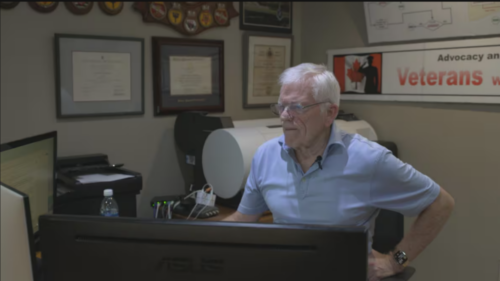



Jim Hutton, co-founder of Veterans with Cancer. [Veterans with Cancer]
Retired commander Jim Hutton recalls the mess deck where he relaxed aboard HMCS Assiniboine. Then an ordinary seaman serving in the Royal Canadian Navy during the Cold War, he was well prepared for peril—but not for what loomed above his berth.
There, hanging low where he rested off duty, were “steam pipes covered with lagging. The lagging was all asbestos.”
It was an era before FaceTime, Hutton recounts, when writing letters was still in vogue. “I remember putting my pen and pencils into the lagging to hold them because it was a great place for them to be. You could also throw your webbing over that, and all you could see was dust coming down.”
Hutton’s cancer came not from any one source, he attests, but from a multitude of hazards both at sea and on land. Though he acknowledges that the specific causes can’t be pinpointed with absolute certainty, he believes that most causes share an apparent common thread: “There was no education at that time.”
Increased awareness eventually brought a slew of procedural changes, but for many, those reforms came far too late. Hutton’s diagnosis, for one, required complex treatment that left him with permanent side effects. Now, he questions whether the Veterans Well-being Act—including its benefit-of-the-doubt provisions in certain disability claims—goes far enough in practical application for those affected.
“The onus,” Hutton argues, “is still on the veteran to actually bring the evidence to the table and show that this particular exposure resulted in their current condition. Really, it should be on Veterans Affairs Canada to bring evidence to the contrary.”
Convinced that more could and should be done, the once-and-always sailor has since taken matters into his own hands, co-founding Veterans with Cancer. Dedicated not only to RCN comrades but to all Canadian Armed Forces members who have dealt with the disease, the not-for-profit is working to ensure that experiences such as Hutton’s are heard. Among its mission objectives are raising awareness of the potential links between military service and carcinogenic exposure; providing useful information to veterans and their families; and advocating for systemic change in the disability claims process.
Hutton spoke to Legion Magazine about his group’s work.
On his naval career and exposure to carcinogenic hazards
I joined the Royal Canadian Navy in 1968 as a fire control technician, where I was exposed to a number of different carcinogens.
One thing I had was exposure to polychlorinated biphenyls (PCBs). As a young ordinary seaman, I remember being sent up to the half-deck of HMCS Assiniboine to clean up a blown transformer. When a transformer blows, it just leaks oil all over the place, and at that time, there was no understanding that transformer oil could contain PCBs. With a roll of paper towel, you had to reach underneath to pull all of the oil out.
I can recall that on that particular day, my work dress was all covered in oil. You would just leave it on and work the whole day in it.
Several years later, when I was commissioned and came on board as a combat systems engineer, the process was totally changed. As soon as you had a transformer blow like that, two people in hazmat suits would go in with special absorbent material to clean up the oil. Everything—including the oil itself and the hazmat equipment—was then sealed and quarantined. Finally, it was taken ashore when the ship got back and disposed of by incineration.
On founding Veterans with Cancer
I started doing research after being diagnosed with cancer to find out what caused it. Online, I connected with Don MacPhail and Randy Hladun, who were technicians in the CAF. Like me, they had been exposed to carbon tetrachloride.
Randy, in particular, had been working with research scientists and doctors trying to identify connections between prostate cancer and carbon tetrachloride. Though he eventually got his VAC claim approved, he passed away from his cancer shortly thereafter.
Before he passed away, however, we started trying to get people together. We came up with the idea that we needed to incorporate and get a website where we could deposit all this information. Many veterans go through their cancer diagnosis and die never knowing that the potential origin of their cancer was their service, so one of our missions is to advise people about what’s going on.
The other thing we do is to advocate on behalf of veterans to get the system changed. Canadians have to jump through a lot of hoops and many veterans die before they get their VAC disability claims approved.
On addressing challenges with VAC
One of the biggest problems, and we’ve raised this with VAC, is that some veterans don’t have the ability to express themselves in writing well—particularly if a veteran is undergoing cancer treatment. We’re advocating for VAC to change that.
One of our recent appeals to VAC basically says, “Hey, you guys have got to recognize that you need to talk to veterans—that one of the reasons why so many of your decisions are overturned when they go to the appeal board is because the appeal board gives veterans an opportunity to speak about their condition and its impact on their quality of life.”
What VAC is doing is taking forms and letters and trying to make decisions based on those instead of picking up the phone and talking to the veteran.
If you’re going through cancer, your tolerance is very limited when you’re taking different treatments, and many veterans feel like they’ve basically been set aside. When you go back and look at the contract that veterans sign when they join the army, navy or air force, it shows that they’re willing to put their lives on the line. It’s the government’s responsibility to recognize that and to take care of them when they get hurt. That doesn’t seem to be happening with a process that still needs to be fully transparent and relatively swift—especially when you’re talking about veterans who potentially have terminal illnesses.
VAC doesn’t need to change the legislation per se, but what they do need is to interpret it more liberally in favour of veterans. If they did some critical thinking at the coal face, they would solve many problems.
This interview has been edited for brevity and clarity.
Advertisement