





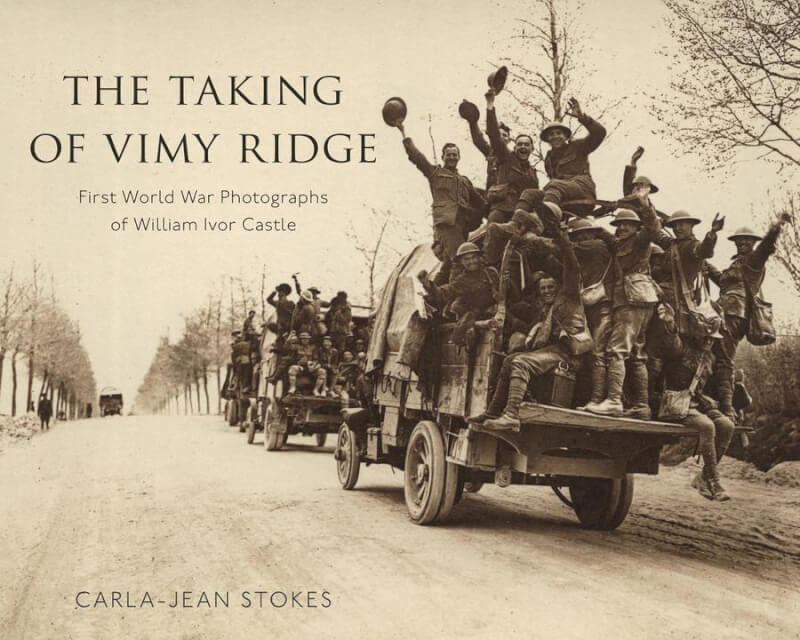
In her new book The Taking of Vimy Ridge, historian Carla-Jean Stokes explores the First World War photography of William Ivor Castle. [Wilfrid Laurier University Press]
The camera never lies, or so the saying goes. The reality, however, is in the eye of the beholder.
In the 1860s, U.S. Civil War photographer Mathew Brady, renowned for capturing scenes of carnage and despair, was hailed—alongside his team—as a pioneer of the medium. Yet some of his depictions were served with a side of deception when battlefield props, and even bodies, were shifted and staged.
With advances in technology came improved methods to manipulate, applied anew following the outbreak of the Great War in 1914. When pictures could speak a thousand words, not to mention win hearts and minds, military authorities weren’t above sanctioning subterfuge in the name of propaganda.
If myths weren’t strictly borne of truth-bending visuals, they played a role at a minimum. The April 1917 Battle of Vimy Ridge, where four Canadian divisions secured a great tactical victory, was no exception. From the ashes of sacrifice, the oft-cited—and disputed—legend suggests, a young nation rose. And one official photographer, William Ivor Castle, was there to document it.
The images that Castle produced were destined to resonate, coming to symbolize the tenacity of Canadian wartime spirit. That spirit was, and is, unquestionable, as is the power of the pictures that came from the four-day struggle, but photographic complexities persist.
B.C.-based historian Carla-Jean Stokes believes nuance is necessary in understanding Castle’s works and, indeed, the man himself. Her new book, The Taking of Vimy Ridge, examines his legacy—both in front of and behind the lens. Here, in a Legion Magazine exclusive, the author offered her own perspective.

Historian Carla-Jean Stokes. [Courtesy Carla-Jean Stokes]
On the role of photography during the Great War
It’s often said that the Great War was the first war in which the vast majority of soldiers knew how to take a photograph. Each might have been photographed professionally once in his life, but they probably understood that there were also amateur-level cameras available to them. These cameras were marketed to the regular infantry, the first war in history where that’s true.
This becomes a huge problem for censorship. Since the beginning of the war, illustrated newspapers had popped up everywhere, and soldiers were invited to send in photos, but then authorities can’t control the flow of images coming from the Western Front.
In Britain and Canada, soldiers were told to send their cameras home—with no film in them. That order came through for Canadian soldiers in March 1915, so essentially, all soldiers were forbidden from having cameras after that point of the war.
It wasn’t until 1916 that England appointed its first official photographers, and Canada received clearance to do so shortly thereafter. Ultimately, Canada had three official photographers between 1916 and 1918, including Ivor Castle.
On Ivor Castle
Ivor Castle is definitely a very challenging person to write a biography about because he’s not very well remembered in a lot of ways. Toward the end of the war, he left his wife and married another woman and had another family. I was able to contact his first family and they helped me with a lot of genealogical information.
His schooltime report cards show that he excelled at art but did less well in more academic pursuits, which probably weren’t very interesting for him. I think he was a very aesthetically minded person early on.
That said, it’s hard to know much about his personality or his character, and I didn’t want to make too many assumptions. In the study of the history of photography, one can produce theories, but I’m more interested in creating understanding.
So, what do we have to work with? His photographs.
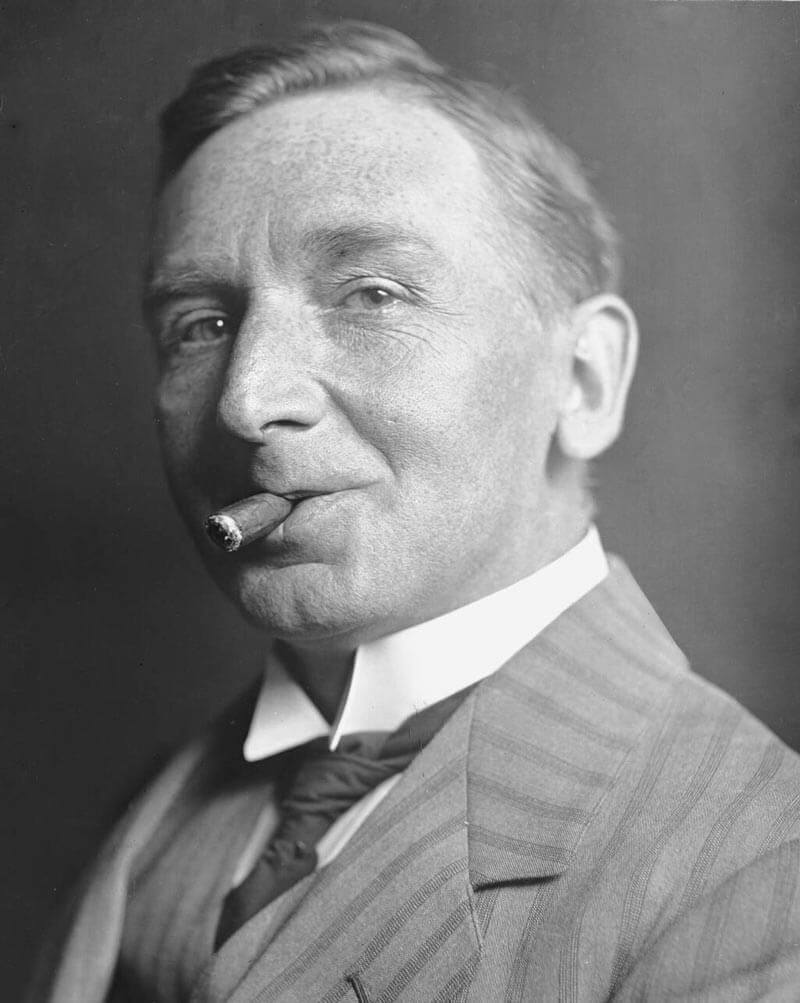
William Ivor Castle. [Wikimedia]
On Ivor Castle, the photographer
By age 20, Castle had taken his first cover photo for an illustrated magazine. To me, that’s quite impressive.
It’s worth noting that during the First World War, all of Canada’s official photographers came from England, including Castle. He had worked for the Daily Mirror and was sent to photograph the Balkan Wars in 1912-1913.
Castle never wrote a memoir, but a lot of his contemporaries did. I read a lot of them to understand the psyche of press photographers at the turn of the century. A lot of them wrote about how wonderful it was to get a scoop.
You can tell that Ivor Castle wanted to get a scoop, too, and he did at times. He famously took photographs that were reproduced repeatedly during the First World War.
On Castle’s photographic methods
Unfortunately, we don’t know what his precise process was.
One photographic series that’s been talked about a lot is “Over the Top,” which was taken probably in October 1916 and retroactively applied to represent the Battle of Courcelette a month earlier. It’s apparently showing the soldiers in battle, but later, it was found to have been taken during training.
Because it was taken during training, the men would have had canvas breech covers on their rifles. He removed those canvas covers while essentially superimposing real gun breeches by altering the negatives. He also added shells bursting in the background.
“Over the Top” was shown that December at a London exhibition, and throughout the rest of the war the photographs were published repeatedly. The story changed every time they were reproduced—but none of it was true. It seems that Ivor Castle didn’t appear to have a problem with the exaggerations that surrounded his photographs, and, in fact, he might have encouraged them.
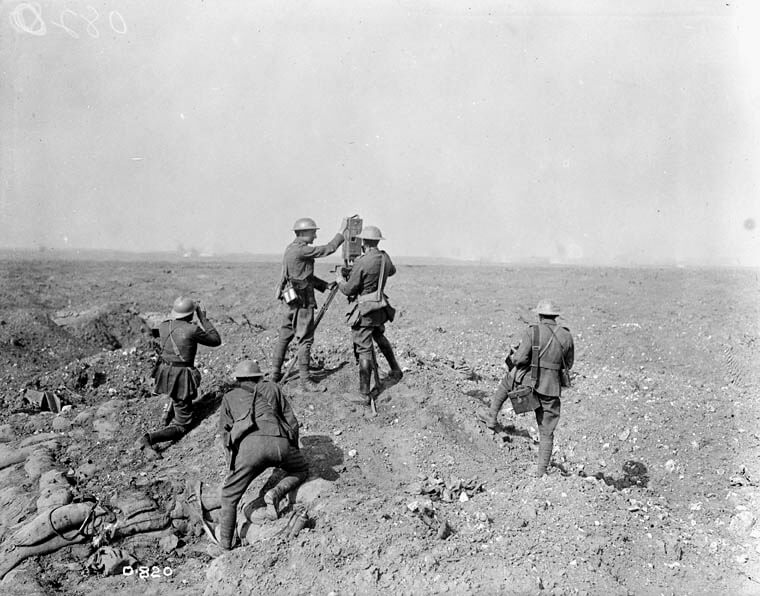
Photographer William Ivor Castle appears in one of his own pictures, taken in fall 1916 in the vicinity of Courcelette, France. It was captioned “Canadian Official Photographer with artillery watching a battle on the Western Front. September, 1916.” [William Ivor Castle/DND/LAC/PA-000660]
On manipulating Vimy Ridge photographs
We see this happen again with the Battle of Vimy Ridge, where Ivor Castle photographed the fighting from April 9-12, 1917. He seems to have been spending some time with the 2nd and 3rd divisions, but when we look at who he was photographing, we know they were follow-up troops, seemingly doing a bit of cleanup rather than engaged in intense battle.
There was a practical reason for this, of course: he doesn’t want to get killed.
When I was studying photographs from the Battle of Vimy Ridge, I realized there were a lot showing shells bursting. Eventually, I noticed that one shell burst exactly matched another in a different scene—and that you could match them all up.
Castle had a famous photo called “The Taking of Vimy Ridge.” It shows men of Vancouver’s 29th Canadian Infantry Battalion walking over no man’s land and there are dead bodies in the foreground and shells bursting in the background. Historians have since identified that he added the bodies to create a sense of how terrible the battle was for the Canadians.
Castle wanted an image to show how much victory costs, and so he created this composite photograph from at least three different negatives. It was exhibited in London in July 1917, and it turns out that a lot of other composite photographs were also exhibited at the same time.
He’s manufacturing these scenes of war. If it couldn’t exist through the photographic medium by simply photographing a scene, he made it exist.
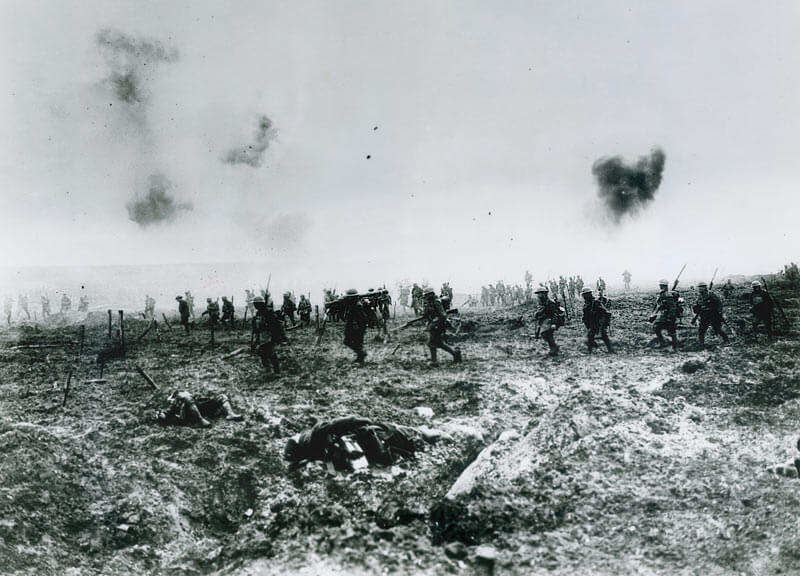
William Ivor Castle’s famed “The Taking of Vimy Ridge” image. [William Ivor Castle/LAC/3628659]
On the Vimy nationhood myth through a lens
The misunderstood nature of Ivor Castle’s photographs has persisted for decades. You’ll probably still see, around April 9, organizations posting these photos on social media, talking about Vimy being the birth of a nation, without further introspection on how that myth was supported with the use of images that were manufactured.
The myth of the photographs and how they came to be made really needs to be dismantled, as well as the myth of the birth of the nation.
On the legacy of Ivor Castle
In The Taking of Vimy Ridge, I really wanted to strike a balance between establishing that Ivor Castle essentially created manipulated works while not being judgmental of him, because that’s not really what I’m here to do. People can decide for themselves what they think of that.
This was a journalistic standard of the time. Castle wasn’t the only one doing it. He has the distinction of having photographed some of the most iconic Canadian moments of the Great War, and I think that’s a really great legacy.
It’s unfair to just dismiss these photos as “fake.” If we understand how his photographs were made and situate them within their proper context, then they have value for us.
This interview has been edited for brevity and clarity.
Advertisement