




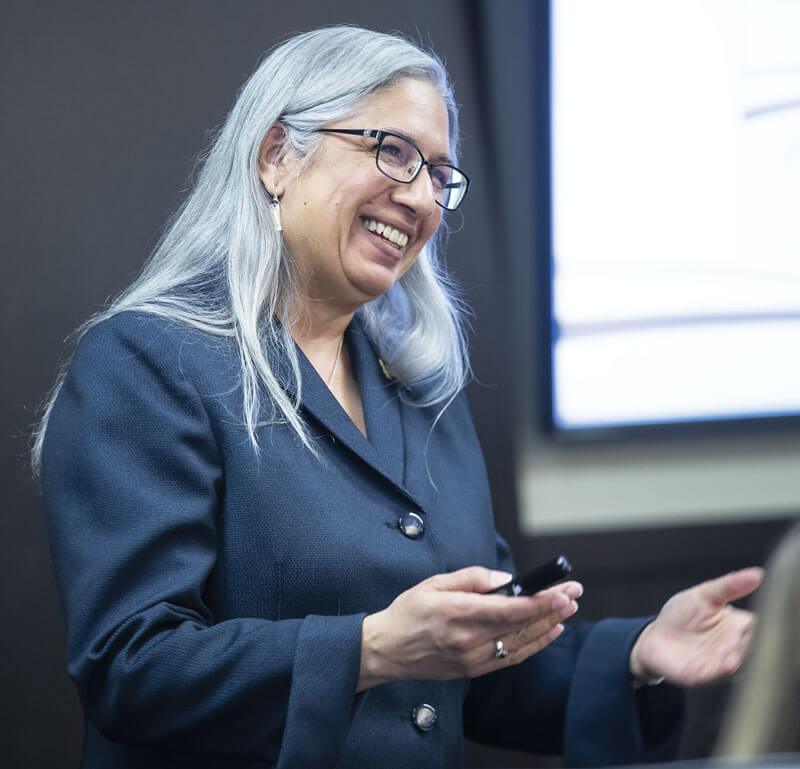
Veterans Ombud Nishika Jardine. [Stephen J. Thorne/LM]
Neither an advocate for Veterans Affairs Canada nor, strictly speaking, for veterans themselves, Jardine’s job—along with some 30 colleagues—is to determine what’s right and just. Whether the issues involve VAC’s benefit-related decisions, broader health-care provisions or fundamental support for former personnel, the veterans ombud strives to resolve disputes between the government and those in its care.
Jardine, first appointed to the role in 2020, wishes only to “give back to my community,” having served for 37 years in the Corps of Royal Canadian Electrical Mechanical Engineers. Now, her duty is to identify some of the leading challenges facing veterans—and what VAC could, and perhaps should, do to address them.
One way of achieving that objective is through the office’s “spotlight” reports, annual assessments of how VAC has responded to and implemented the recommendations they’ve made to the minister. Here, in a Legion Magazine exclusive, the watchdog-in-chief outlines a few such recommendations—and how her office is meeting ongoing concerns.
On recent changes to the veterans ombud office
In order to evaluate whether a veteran or a family member has been treated fairly, we need to understand the governing legislation, regulation and policies that are applicable. Some cases can be quite complex. What we were missing were senior investigators who have a great deal of experience, who have a deeper understanding of governing legislation, regulation, and policies. So, we’ve created those positions, which I believe will allow us to offer a better and timelier service to those veterans who come to us with complex issues.
On family doctor issues and telemedicine
A veteran contacted us a while ago. He has severe post-traumatic stress and was being treated at an operational stress injury clinic. The psychiatrist there recommended medication to help him, but they couldn’t write a prescription because the veteran needed a family doctor to monitor his health while taking it. The veteran didn’t have a family doctor and was on a waitlist with 10,000 other people in his community. So, he couldn’t get the prescription he needed. The only recourse he had was to try telemedicine, but he had to pay for it out of pocket.
Veterans Affairs launched the Veteran Family Telemedicine Service in February 2026. This is for veterans who don’t have a primary health care provider and have been released after April 1, 2025. While it wouldn’t have helped the veteran I mentioned, who was released years ago, at least going forward, this trial telemedicine service provides coverage through the Maple virtual care network to veterans and their families for up to two years.
On unfairness in VAC’s internal claim review process
I’ll give you a scenario. Let’s say, for example, that I have a knee problem and VAC has given me a disability claim for it. My doctor then says that it’s not getting better and wants to prescribe a new treatment, but Veterans Affairs denies me coverage for it. I have appeal rights, a right of review under the current legislation, so I submit my request for review in what’s called the national first level of appeal (N1LA), and I get denied there before going to the second level of appeal—there are two.
Technicalities aside, we’ve found that the reasons given by N1LA decision-makers for denying veterans’ claims didn’t meet the standard of fairness that the Supreme Court of Canada set out years ago. These responses often didn’t even address the point that the veteran made when they asked for the appeal. Veterans Affairs is failing veterans by not doing this work in a way that meets these standards.
On inequity in the Veterans Independence Program
If you have a condition recognized by Veterans Affairs as a disability that makes it difficult for you to contribute to housekeeping or groundskeeping chores, then the department’s Veterans Independence Program will provide you with a grant to help offset the cost of hiring someone to do it for you.
In the process of making that application, however, VAC asks if there is another family member living with you who could do that work. That’s asking families to shoulder the burden of their veteran’s service to Canada. We have said in our recent report on the burden of care that this is unfair and it needs to stop.
On better support for veterans’ family members
The report we did in January 2021 on mental health support for families is another recommendation that we’ve made to the department. These are individuals whose mental health has been affected by their service as a family member of a Canadian Forces veteran. They should be entitled to mental health treatment support.
The Canadian Forces and the RCMP demand a lot from families in order for that member to serve. But when the time comes to support those families, while VAC goes as far as it currently can, legislative change is needed to extend benefits, mental health support or treatment to family members in their own right as a result of their own service to Canada.
Just think about when a military member is killed while in service, and they have little kids. Those children may get grief counseling at the time, but as they grow, they continue to process that grief until—and including—adulthood. They may need further assistance with that, but there isn’t that mental health treatment support over the long term. And that’s just one example.
I’ve heard from the spouse of a veteran who was grievously wounded in Afghanistan. She has to spend all her time taking care of him, but they have three kids, as well. Those kids miss out on their parents’ attention. Meanwhile, the spouse is completely exhausted and at the end of her rope. She could definitely use that kind of support, but VAC can’t provide mental health treatment to her in her own right.
A third example might be tragically when a veteran dies by suicide. Because the veteran is no longer there, the family is immediately cut off from any kind of mental health support. It’s cold comfort to a new widow to learn that the legislation can’t help them.
On the broader veterans’ relationship with the government
For the most part, Veterans Affairs does a good job. Many veterans come up to me and say, “I’m happy. I’m satisfied with what I’ve got. I couldn’t be happier with the service I’ve received from Veterans Affairs.” There is a cohort, however, who really struggle and who are deeply frustrated with their interaction with VAC. And it’s not a small number.
Every single complaint that comes to us where we find unfairness, we go over to the department and, most of the time, they resolve it. Our overriding priority is to reconnect veterans to the department on which they will depend for benefits, usually for the rest of their lives.
Our role is to do everything we can to foster veterans’ trust in us. It’s about them knowing that if they come to us and they’ve been treated unfairly, we will seek a resolution. In the bigger picture, it links them back to the department and helps them rebuild trust in Veterans Affairs, too.
This interview has been edited for brevity and clarity.
Advertisement