

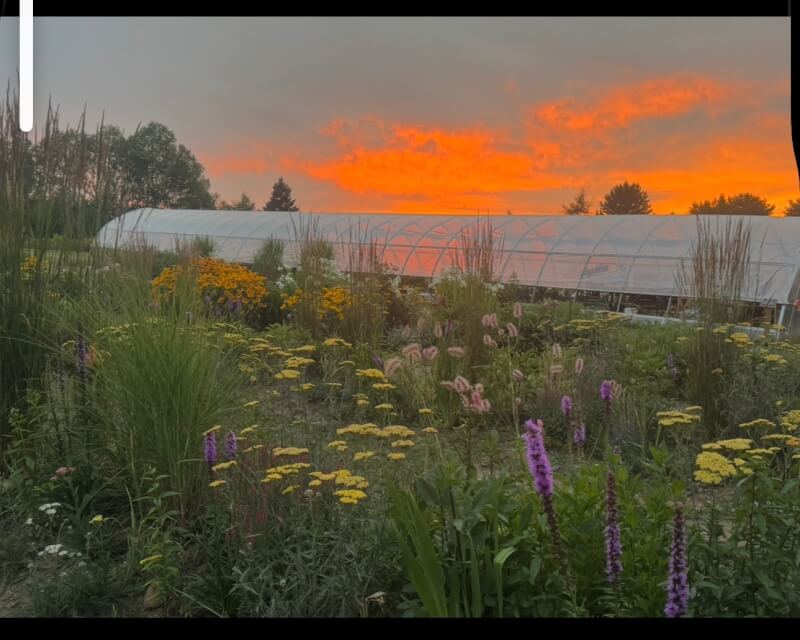
Gardens and a greenhouse at the Veteran Farm Project property in Sweets Corner, N.S. [courtesy Jessica Miller]
“Farming is never as straightforward as you hope it will be,” said retired sergeant Jessica Miller. The former medic would know, having traded tourniquets for trowels after a 22-year career in the Canadian Armed Forces.
When a 2015 service-related injury prompted her departure from the military, Miller strove to navigate civvy street as best she could. Finally, in 2018, she and her husband, retired sergeant Steve Murgatroyd, established the Veteran Farm Project in Sweets Corner, N.S. The not-for-profit community space tackles food insecurity in the province and has evolved into a safe, nurturing and nature-based sanctuary for women of varied backgrounds—uniformed or otherwise.
The Veteran Farm Project now offers an array of grounding activities, from green-thumbed volunteering to workshops and informal peer-support gatherings. On July 30, 2026, it also unveiled the Honouring Garden dedicated to individual women whose military contributions have historically received limited recognition.
Speaking to Legion Magazine, Miller recounted the project’s journey so far.

Retired sergeant Jessica Miller is a co-founder of the Veteran Farm Project. [courtesy Jessica Miller]
On buying the farmhouse
Steve and I both knew that we were retiring due to service-related injuries, and we knew we wanted to stay in Nova Scotia. He had lost his leg in a motorcycle accident in Truro, N.S., after three deployments overseas.
We knew staying here would be best for him because Nova Scotia has the best prosthetic care in Canada. But neither one of us wanted to retire.
That’s when we found a derelict farm here in Sweets Corner. It was a mess. And neither of us was in any physical position to make the place what it is now or where it’ll go in the future. But we bought it.
On developing the Veteran Farm Project
We initially moved into a condo in Bedford, N.S., and commuted every day to work on the property. I wasn’t a horticulturist that first year. I didn’t know how to grow stuff properly, so I made a few garden beds in the field. I was so damn proud of myself that I had a head of cauliflower. But no one told me that I needed to cover the leaves over the head of the cauliflower or it turned purple.
Anyways, I planted way more than Steve and I could possibly consume, so when one of my friends, a fellow medic who retired around the same time as me, asked if I had any extra produce, I was like, “Absolutely, yeah. I grew radishes—I hate radishes.” I packed up a whole bunch of stuff—potatoes, beans and other stuff I don’t even like—and sent it off with her to give to a senior couple, a veteran and his wife who were struggling to get by. I probably gave them two or three packages over that season as things became available.
Later, I was like, “Shit! I grew stuff and gave food to people? Maybe I could carry on doing something like this.”
I put together a basic proposal for the Legion’s Nova Scotia/Nunavut Command. At the time, they were looking to support women-driven organizations, so they took it to their AGM. That first year, they gave us $5,000, and I said that I would support 10 families with food throughout the season. And we did.
We would take the bags down to Legion headquarters every week back then. I was baking the bread for the parcels. It worked out awesomely, and because we’re retired and don’t need to make a salary, it felt like service after service.
By 2019, we were supporting 20 families, which was a steep learning curve. And then we were like, “We can do more.”
What happens in 2020? The pandemic hits. We had to keep our bubbles small here on the farm in order to make things happen. There were three veteran women who would come almost every week to help. That then turned into me supporting them through learning. It became almost a peer-support-type situation that I hadn’t been anticipating.
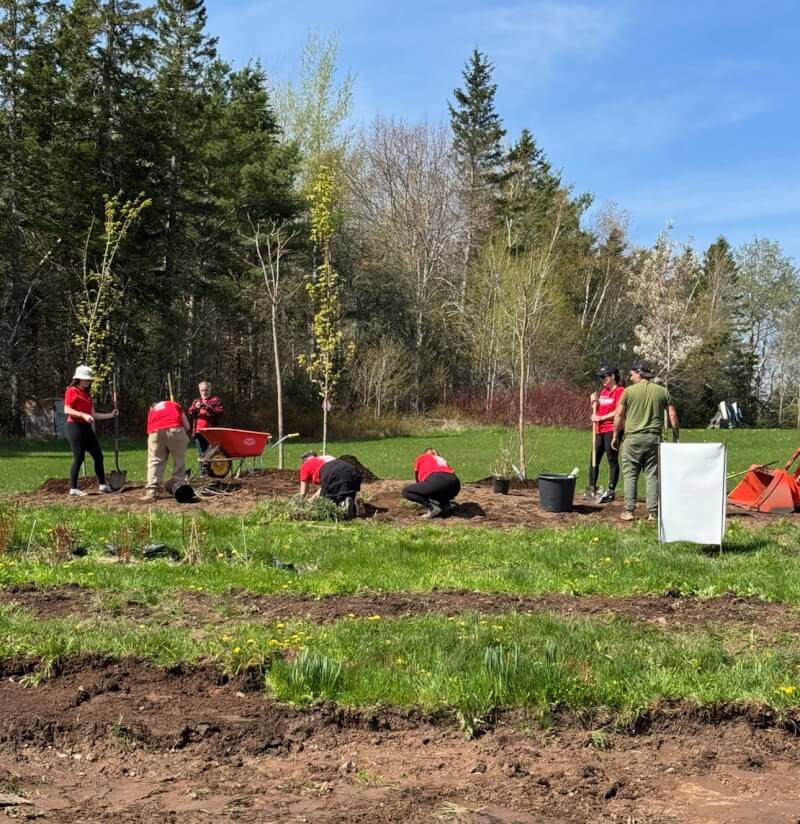
Veterans plant trees during a peer-support gathering at the Veteran Farm Project property. [courtesy Jessica Miller]
On continuing growth and challenges
So, 2020 was the year that we had the idea of creating free workshops, giving other women and families the opportunity to come to the farm and learn something.
In 2021, things opened a little bit more, but it wasn’t so much workshops then; it was more about volunteering. We also created the Sub-Lieutenant Abbigail Cowbrough Garden for Joy when she passed [age 23 in a helicopter crash off the coast of Greece]. I didn’t know her, but I just felt a strong connection because, when I was sailing for the last 10 years of my career, I did a lot of helo extractions with patients off ships. I had an idea of what it was like to be in that helicopter.
From there, we found a wholesaler in Annapolis Valley, N.S., called TapRoot Farms, and we purchased our bread products from an organization called Baker’s Choice, which was started by a veteran. We were then able to support even more people because we didn’t have to grow the produce, which was just getting to be way too much work and the pests had found us by then.
Over the years, we just kept getting bigger. In 2023, we supported 256 participants in workshops on the farm. Sometimes, guest hosts will come in and teach things about felting, art or essential oils. I also hold a lot of workshops myself.
Then in 2024 our food insecurity hampers were no longer being funded by Veterans Affairs Canada. By that stage, we supported close to 55 families and two community food pantries at Military Family Resource Centres. We calculated that we’d donated over eight tons of food to families.
On the 2025 summer season
I think last year was probably the hardest year because of the fires, the drought and the extreme temperatures. I couldn’t have any volunteers here because it was just too dangerous heat-wise for a lot of women—many of them in their 50s or older.
Then we had a lack of funding. I had to explain to all the Legions what was happening and why, and it was heartbreaking.
Thankfully, at the end of March 2026, the VAC Well-Being Fund reached out and we received grant funding—not as much as we’d hoped for, but it allowed us to support 30 families monthly for a full year. We’re now working with Landing Strong and VETS Canada to support families needing support.
On the Honouring Garden unveiled in July 2026
On July 30, we had a dedication ceremony for a three-year-long project called the Honouring Garden. The Veteran Farm Project has been working with the Music for Veterans Project out in Victoria. Emily Armour—whose husband is a veteran—is a piano instructor and classically trained pianist. She had the idea of having her students create original pieces of music for other veterans.
Now, we’ve worked together to create a space honouring women veterans here on the farm. Abbigail Cowbrough has been honoured. Captain Nichola Goddard has been honoured. We’ve also honoured figures from World War One, World War Two, and others.
Perennials chosen by either the family or us have been planted. Each is marked with a beautiful plaque showing who they were. There is also a QR code that takes you to a webpage about that individual. There, you’ll find a bit of their story and a blurb about the student who created an original piece of music for them. That’s where you play the music, too. You can play the music written for that woman right there, where the plant has been placed for them.
We haven’t been able to find anything like it anywhere in the world—let alone in Canada.
On her hopes for the future
I don’t have an exact vision because every year is different. But my ultimate goal has been—and always will be—to have informal peer support become a social recommendation made by clinicians. Research has been done into informal peer support and how it’s so impactful and significant in people’s recovery or transition from service. But there’s no standardized way that organizations should approach it.
I’m just providing a space and an opportunity for women to come together, and then they experience what they experience. There are certain rules, such as no talking about our traumas or issues with VAC as a group, and everybody knows that.
Mostly, it’s hilarious conversation between these women—veteran and civilian. Their husbands suck. Their kids are idiots. That kind of stuff. There’s nothing better than hearing belly laughter coming from a group of women who may not have laughed in a long time.
This interview has been edited for brevity and clarity.
Advertisement