



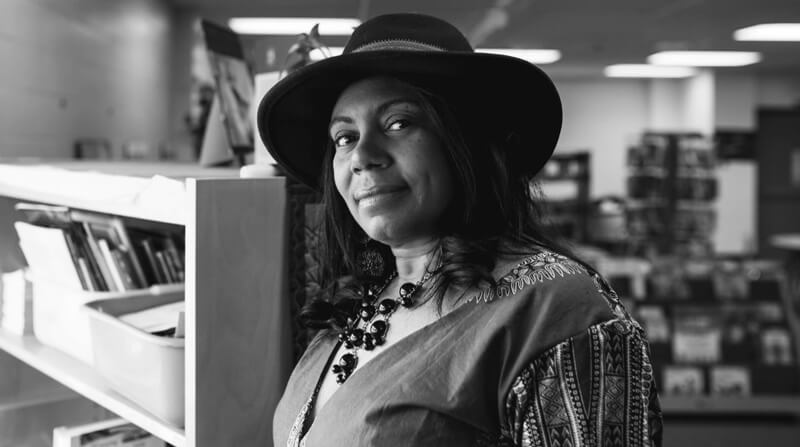
Kathy Grant, historian and co-founder of Black Canadian Veterans Stories. [Kathy Grant]
It’s inevitable, though no less tragic, that Canada’s Second World War generation is beginning to fade from living memory, a testament to the passage of time more than 80 years after the guns fell silent.
On March 26, 2026, Alvie Burden of Tisdale, Sask., died at age 104. Not only was he reportedly the oldest Black Canadian veteran—having first served as a home-front test subject for chemical agent trials before fighting overseas—but he was also one of the last of that community from WW II.
Among those striving to preserve his legacy, alongside the many thousands of other Black veterans who have donned a uniform throughout Canadian history, is historian Kathy Grant.
“When you have the likes of D-Day and Dieppe anniversaries,” she noted, “we don’t really see a lot of our community members having their military experiences publicized in the press.”
Grant works to address just that through her team’s website, Black Canadian Veterans Stories, which now serves as an online database for oft-underrepresented tales. Together with a significant social media presence, the initiative’s founder continues to be heartened by ever-increasing interest and engagement.
Here, in a Legion Magazine exclusive, Grant detailed her efforts.

Grant’s father, Owen Rowe, during the Second World War. [Black Canadian Veterans Stories]
On a familial connection to her work
My father, Owen Rowe, was a Second World War veteran who volunteered to fight for Canada from the island of Barbados. He was part of the signal corps and got his training in Huntingdon, Que. Afterward, all his friends were called to go overseas, but his name wasn’t called. He was just left on the parade square.
He instead went to Kingston, Ont., and ultimately to Nanaimo, B.C., from where there was a possibility that he might join a restrictive, segregated American unit, but they didn’t want him. My dad felt he was jinxed by that point.
He ended up joining the Royal Canadian Air Force and trained to be a wireless air gunner, becoming a pilot officer and, later, a flying officer.
Dad didn’t often talk about his wartime experience, but he shared some of his images and sometimes talked about some of the men he had served with. Before he passed away in 2005, I made a promise to continue his legacy by documenting and digitizing Black Canadian veteran stories so that future generations could learn more about their service to Canada.
On creating the online database
It was in 2010 when it started, but it wasn’t until 2012-2013 that we created the Facebook page. It took about a year to get 100 members, but we now have over 30,000 followers, with a million viewers overall every month. We find that the community shares their images, shares their stories and we post them.
We started the Black Canadian Veterans Stories website in 2021, and as a result, more educators are sharing it with their students.
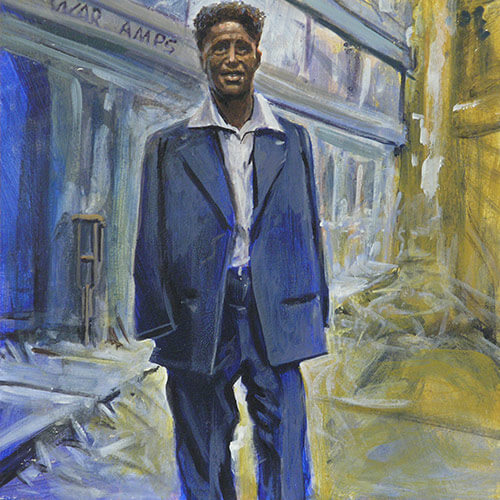
An artist’s depiction of First World War veteran Ethelbert (Curley) Christian. He was wounded during the Battle of Vimy Ridge and had all four limbs amputated. [The Military Museums]
On some of the stories highlighted
Many people don’t realize that in both the First and Second world wars, the Black population in Canada was less than a quarter of one per cent, so it’s not so much that their history has been hidden. It’s more that people are just not aware because the numbers were so small.
A lot of people also think that all Black men weren’t allowed to serve in the Great War until the all-Black No. 2 Construction Battalion was formed, but that’s a myth. There were Black men who joined other units from 1914.
I think of the story of Ethelbert (Curley) Christian. He was a First World War veteran from the U.S., and he was at the Battle of Vimy Ridge, where he lost all four of his limbs—and survived. He was later hospitalized in Toronto, where he managed to charm one of the nurse aides, and they ended up getting married.
Curley eventually helped his son get into the navy when he was initially denied. He also helped start the veterans’ allowance program so that family members could take care of their loved ones at home.
Or you have Jean-Napoléon Maurice, who was with Les Fusiliers Mont-Royal at Dieppe during the Second World War. He helped save numerous soldiers on the beaches, later becoming a sleeping car porter.
On the importance of awareness
Black people have served in Canada since the War of 1812 and beyond. We’re now finding that a lot more recent veterans, whether from the Gulf War or Bosnia, are beginning to share their stories, and there’s increasingly an appetite to hear them.
When we go out to schools and share these stories, we find that some of the Black students are able to feel connected with them—to feel represented. We’ve since found that through education, more people want to learn more about everyone who served—of all ethnicities and genders.
This interview has been edited for brevity and clarity.
Advertisement