

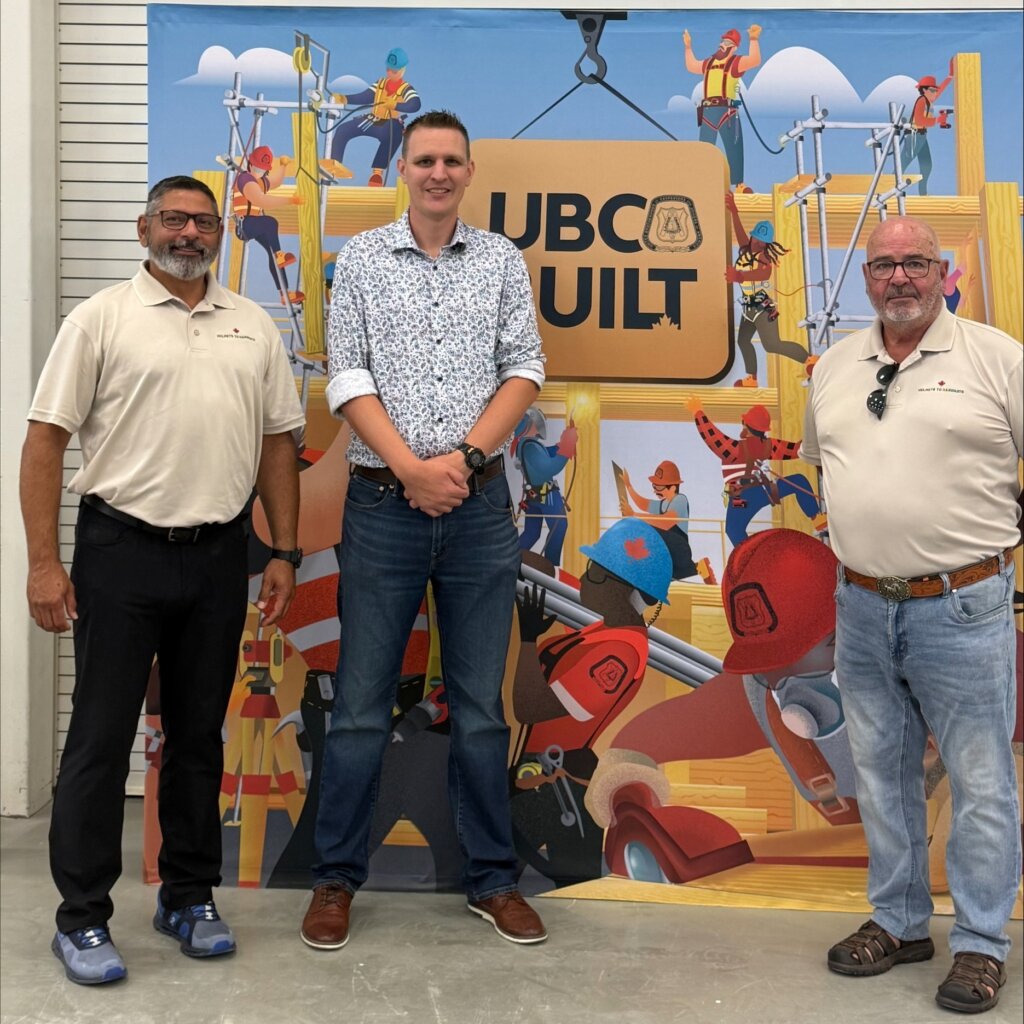
Dustin Hare (centre), a non- commissioned member in the Royal Canadian Naval Reserves and the business manager of the Carpenters Union Local 1946, gives Helmets to Hardhats Canada outreach specialists Normand Trepanier (right) and Pat Rizzo (left) a tour of the London, Ont., facility in summer 2025. [Helmets to Hardhats Canada]
When military veteran Justin Curtis hung up his uniform after eight years of service, he asked himself the question that countless comrades throughout the history of the Canadian Armed Forces have asked before: what next?
The challenges that others have faced in navigating civvy street were not lost on the former infantryman. Nevertheless, explained Curtis, his own transition proved to be “seamless” after discovering Helmets to Hardhats (H2H), a program that pairs military community members with jobs in the unionized skilled trades.
An impactful conversation with an H2H liaison officer set him on his chosen path. Within two days, Curtis was already in constructive talks with Halifax union representatives. It wasn’t long thereafter that he was working in construction itself.
The largely veteran-operated H2H—a nationwide initiative—operates on a recognition of widely transferable skills and traits between the military and the world of labour. As of late 2025, the national program had registered no fewer than 341 veterans, 28 dependents and four senior cadets during the last year.
Hundreds more have been supported since H2H’s founding nearly 15 years ago, a journey of personal—and, ultimately, infrastructural—development. Sable Frey, H2H’s director of communications, spoke to Legion Magazine about what interested individuals can expect.
On the overall program
Helmets to Hardhats started in Canada in 2012. We’re a national not-for-profit organization that helps Canada’s military community—veterans, reservists, senior cadets, and their family members—find rewarding second careers in the unionized skilled trades. These are the sorts of well-paid jobs that really value their skills, and it also strengthens the unionized industry at the same time.
We hear a lot from these employers that the military community has the right characteristics—things like a strong work ethic, showing up on time, teamwork and leadership. For the military community, we find that camaraderie is a big part of what attracts them to the skilled trades.
Those interested can register with us online, even before they’ve transitioned out of the Canadian Armed Forces. Once they’ve registered , our outreach advisors will contact them directly for background information on their military service. It’s then that the advisors can provide insights on where their skills from the military might line up in the skilled trades.
Some people may want to do something totally different, too, and we can work with that. From there, we can help match them up with training programs, apprenticeships and job referrals wherever possible.
When it comes to choosing employers, the majority are unionized and locally affiliated within Canada’s Building Trades Unions. We mostly go for these because they can provide the things that veterans are most looking for when they leave the military, like stable pay, security, more standardized hours—but with some flexibility when needed—and understanding in terms of family commitments.
On eligibility for families and reservists
Beyond veterans and military members, we also help family members, which is important because the family serves, too, and gains a lot of those skills—things like dedication and persistence—that employers are looking for.
We also take reservists, which is great because, depending on their class, they may need employment in addition to their service. When they sign up with Helmets to Hardhats, they know they’re going to find employers who understand that they’re in the reserves and they may be taken away from their skilled trade jobs to go out on a different mission.
One of our outreach advisors told me once that they had heard from a client who was a reservist. They said that they built what they protected and protected what they built.
On what the initiative signifies
When you see the Helmets to Hardhats sticker on a literal hard hat, you know that it signals reliability, that the skills learned in the military are being put to good use. Beyond the pay, benefits and pensions, it’s really about finding that sense of purpose, that sense of identity. What’s great about the building trades is that you’re still committed to your country; you’re just building it up in a different way.
This interview has been edited for brevity and clarity.
Advertisement