



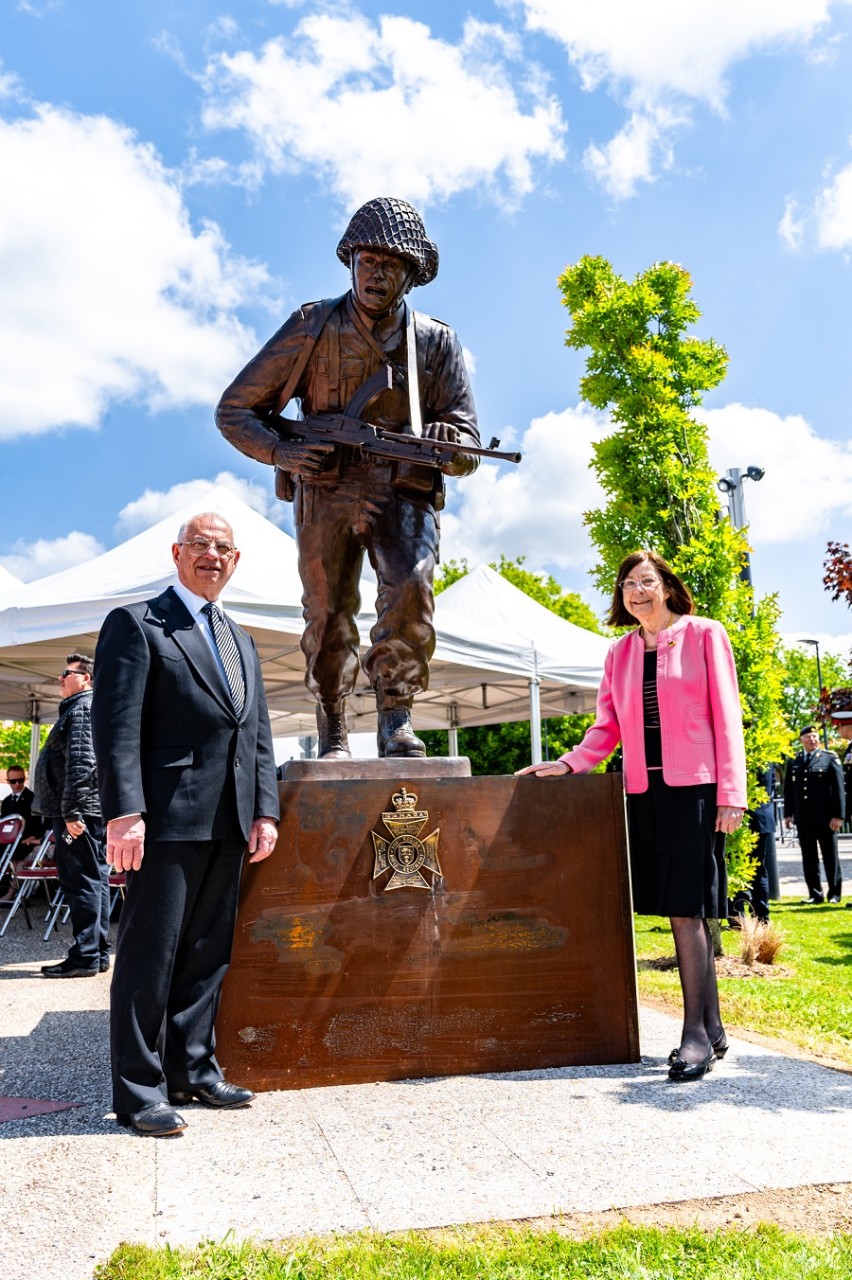
Don Begg and Shirley Stephens-Begg stand with The Royal Regina Rifles commemorative statue they sculpted during its unveiling at Thue et Mue, France, on June 5, 2024. [Corporal Antoine Brochu/Canadian Forces Combat Camera]
“How many people,” asked sculptor Don Begg of Studio West Bronze Foundry & Gallery in Cochrane, Alta., “get the chance to make something that will last 1,000 years?” Certainly, he and his wife, fellow sculptor Shirley Stephens-Begg, are two such artists.
Having created more than 100 public installations across North America and beyond since their workshop’s founding in 1970, the pair take particular pride in commemorating Canadian military history and heritage. Their sculptures include the Great War nursing sister depicted on the Saskatchewan War Memorial in Regina; “The Infantryman” in Oromocto, N.B.; the “Let’s Go” monument portraying a Korean War soldier in Calgary; and various cenotaphs throughout Canada.
Speaking to Legion Magazine, Don and Shirley reflected on legacy, both their own and those who they immortalize.
On learning the craft
Shirley: My father was Doug Stephens. He was a renowned illustrator taught by [American artist] Norman Rockwell. Growing up with an illustrator, I think that’s how Don and I approach our sculptures, because we’re actually illustrating a figure in that particular moment and time. That approach is very appropriate for military sculptures, because authenticity and accuracy are so important.
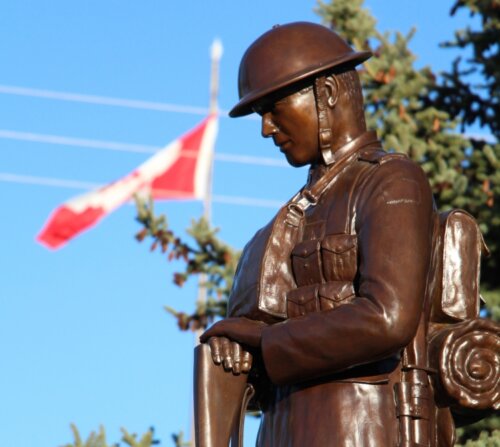
The bronze soldier, sculpted by Begg and Stephens-Begg, atop the cenotaph in Cochrane, Alta. [VAC]
On immortalizing military figures
Shirley: It’s an honour and privilege, but it’s also a huge responsibility, because we’re representing real people. When we receive a commission to do a military figure, the first thing we want to know is what the organization, regiment or historian wants the statue to convey and represent. After that, we meet with people who know the subject’s posture, uniform and the action we’re depicting them doing—how they hold a rifle, for example, and exactly what weapon it is.
We’re fortunate that military museums, veterans and other experts have been so wonderful in sharing their knowledge and expertise. That gives us confidence that we’re doing it right.
With that confidence, we then make a full-size clay model and take it through the lost-wax bronze casting [a process in which a wax model is encased in a heat-resistant mould, melted away and replaced with molten bronze].
Don: Most take about a year from the time we start talking until it’s unveiled.
On the challenges of the process
Don: Everything is a challenge. We learn so much from each one.
Shirley: Early photographs aren’t very clear. That’s why it’s so important for us to be able to go into the military museums and see their collections, measure and take photographs, as well as talk to veterans. But photography in general doesn’t really do justice to the human figure.
Commanding officers of many units that we’ve worked with have been great in supplying us with sailors or infantrymen to use as live models. They’re the ones, after all, who handle the weapons, who can get the poses correct.
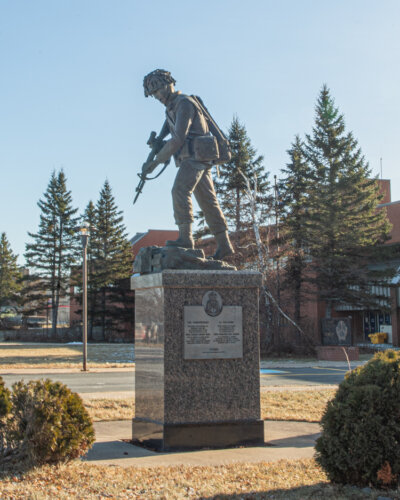
“The Infantryman,” which was unveiled in 1992 in commemoration of the 50th anniversary of the Royal Canadian Infantry Corps, in Oromocto, N.B. [VAC]
On showcasing humanity in bronze
Shirley: At the very beginning of the commission for the Royal Regina rifleman unveiled in France on the 80th anniversary of D-Day in 2024 [image at top], it was made clear to us by the regiment that the soldier’s expression was important to them. They wanted the expression to look afraid but determined.
The biggest compliment was one of the veterans who looked at the statue and said, “he looks determined, but you can see the fear.” I thought, well, I got it.
Don: When you’re creating a regular soldier, you want them to represent all soldiers, not just one. We try not to do portraits of individuals. If you look at 50 soldiers, there’s a resemblance to them all so that they honour all families.
The war wasn’t won by one single man or woman. It was a collaboration. That’s what we try to represent.
This interview has been edited for brevity and clarity.
Advertisement




Another of Don Begg’s work. The Confluence (Fort Calgary) and also a second casting at Ottawa’s RCMP Headquarters