


A new exhibit at the Canadian War Museum explores the Canadian connections to the U.S. Civil War. [CWM2026-0021-0050-Dm/Courtesy Canadian War Museum]
On Oct. 18, 1864—a mere six months before assassinating U.S. President Abraham Lincoln in what would be the immediate aftermath of the American Civil War—John Wilkes Booth checked in to the St. Lawrence Hall Hotel in Montreal. Renowned for its high-end luxuries, the lodge had likewise earned a reputation for hosting Confederate officials, spies and sympathizers amid hostilities south of the border. Booth was simply the latest such guest to support the rebel cause.
But might the killer’s nine-day visit have been of far greater consequence? Could it have been there—on British North American soil—that Booth plotted the death of the U.S. commander-in-chief?
“Speculation persists to this day,” said Canadian War Museum historian Tim Foran of that mystery, citing Booth’s signature on a torn page of the hotel’s register as “pretty damning evidence.” That same signature is now one of some 100 artifacts featured in a new exhibition dedicated to Canadian connections to the American Civil War.
An expert on British North American history, Foran worked with numerous other specialists, collectively covering a multitude of related topics, to bring the display to life, shedding new light and offering fresh interpretations on a conflict of truly global consequences—not least in Canada. The exhibit runs until Feb. 28, 2027.
Foran spoke to Legion Magazine about the collection.

Canadian War Museum historian Tim Foran was instrumental in developing the new exhibit. [Courtesy Canadian War Museum]
On the timing of the exhibition
Every exhibition is many years in the making. I first heard about the project in 2021, and I began thinking about ways of trying to make it relevant. Now, with the current geopolitical situation—with talk of the 51st state, invasion and annexation—it has become very relevant, almost to the point that it feels a bit too on the nose.
People ask, “why is the Canadian War Museum doing an exhibition on the American Civil War?” Our interpretive approach was to focus on legacy, and in doing so, offer five answers to that question. There are five key legacies of the American Civil War that are formative, that are indeed foundational to the Canadian story, and the exhibition endeavours to explore those legacies.
On formerly enslaved Black Americans in Canada
The first legacy relates to freedom seekers, formerly enslaved men, women and children who left the United States after Congress passed the Fugitive Slave Act [of 1850]. They made their way to British North America, where they found British freedom in the colonies—but certainly not social acceptance or social justice.
These Black Americans carried on fighting for abolition in the United States, but here in Canada, they also began publishing, fighting for social justice and advocating for integrated schools. This struggle among racialized groups in Canada continues to this day, but it really began in that period.
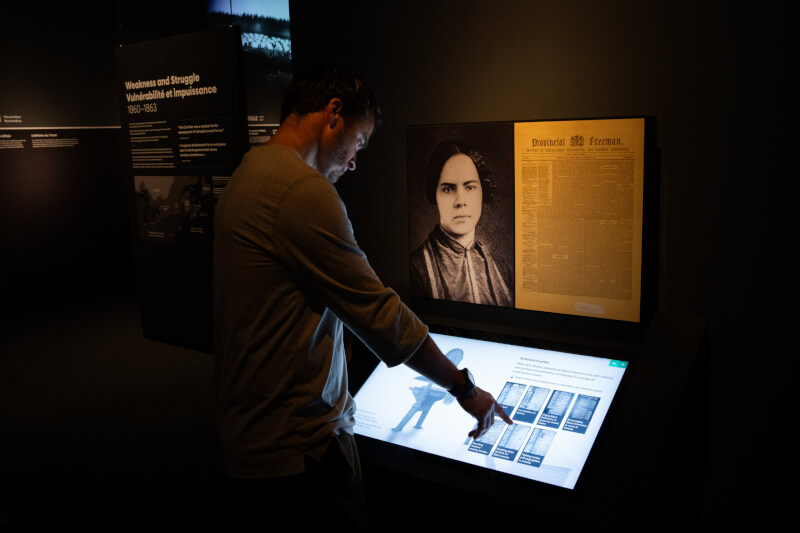
A visitor explores an exhibit display about Mary Ann Shadd, North America’s first Black woman newspaper editor (of the Provincial Freeman, which she
launched in 1853). During the Civil War, she was a Union recruiting officer for the State of Indiana and actively recruited soldiers from both sides of the border. [CWM2026-0021-0025-Dm/Courtesy Canadian War Museum]
On the development of a Canadian military and militia
The second legacy is the Canadian Armed Forces. Essentially, we’re making the argument that during the American Civil War, as tensions between the United States and the British Empire became more significant, British North Americans came to the realization that imperial forces couldn’t defend their long frontier anymore.
This behooved Canadians and Maritimers to play a larger role in their own defence, joining local militia companies, establishing new ones and, in the process, kickstarting a movement toward a professional armed force in Canada that, for the first time in our history, wasn’t really reliant on British regulars; rather, it was based on the need for the colonial population to defend itself.
On Canadians fighting in the U.S. Civil War
Our next story is a complicated one, which we’ve titled Embroilment.
It’s about exactly that: how, despite these deepening tensions between the British North American colonies and the northern United States under the Lincoln administration, somewhere between 33,000 and 55,000 British North Americans—British subjects who were legally obliged to stay neutral in the American Civil War—broke the law to enlist in foreign service.
The overwhelming majority of them fought for the Union Army, but you also had a tremendous degree of moral and financial support of the Confederacy coming from Canada and the Maritimes.
Confederates availed themselves of British neutrality to have these staging grounds [in British North America] for operations into the northern states. The St. Albans Raid is the most infamous example of this, where you had a small group of Confederate soldiers, based in Montreal, who crossed the border to attack St. Albans, Vt.—the northernmost action of the U.S. Civil War, resulting in worsening tensions between the British North American colonies and the Lincoln administration.
On the war’s influence on Confederation
I truly believe that Confederation was a response to the threat of American invasion and annexation. It was a means to an end—and that was to avoid becoming American. It was an instance in which these previously separate and vulnerable British North American colonies put their differences aside to forge a new federal union within the British Empire.
The American Constitution—and its perceived negative impacts among some—was another aspect. There was this idea among the Fathers of Confederation, especially John A. Macdonald, that the cause of the civil war was political decentralization, that the U.S. states had too much power. To avoid this, there was a desire to create a federal system in which all the important powers resided with Ottawa and not the provinces. That was the fatal mistake of the American Constitution according to Macdonald.
The institutions that still govern Canada come into being at that moment.
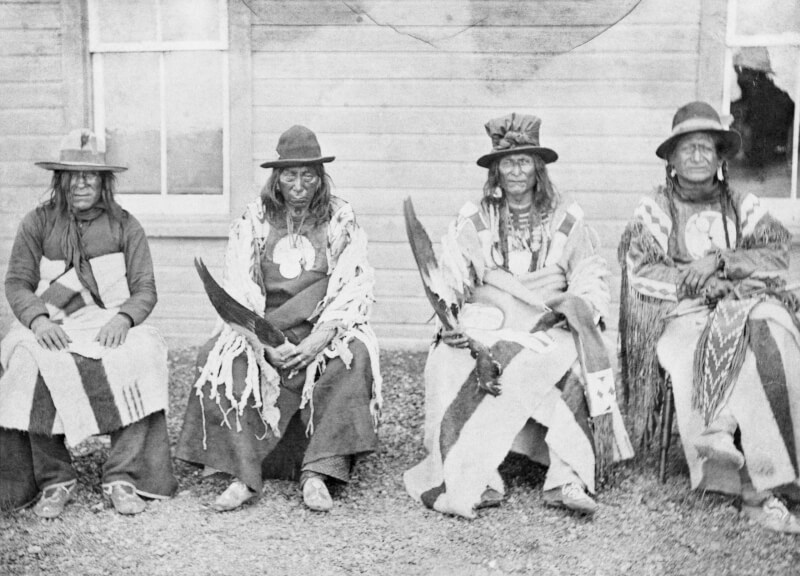
Blackfoot Chiefs who negotiated and signed Treaty 7 in 1877, including Sitting Behind Eagle Tail (Piikani), Crowfoot (Siksika) and Red Crow (Kainai). The Blackfoot understood the agreement as a pledge of mutual support in a time of chaos; Canada saw it as a land transfer. [CU1115353/Glenbow Library and Archives Collection]
On the enduring impacts on Plains First Nations
If Confederation was an effort to promote collective security and avoid American invasion and annexation, the rapid westward expansion of the young Dominion of Canada was an attempt to prevent American encirclement. It was an attempt to take over territories in the West for the British Empire before the Americans did.
The exhibit tells the story of the surveying and enforcement of a border—the Medicine Line—that cuts right through the homelands of Plains Indigenous Peoples. We focus specifically on the Blackfoot story, a Confederacy of Blackfoot-speaking people—the Siksika, Piikani and Kainai—who experienced Canadians and Americans carving up their land for themselves in that period.
We developed this content through traditional Blackfoot knowledge-sharing protocols to highlight the effects of the border on the holistic integrity of the Blackfoot Confederacy, past and present.
On his hopes for visitors
I hope that Canadians will recognize that so many of our defining features, our defining characteristics, came into being during—and in response to—the American Civil War and its immediate aftermath.
There is a deep history of fear of the United States in this country, yet it’s not insignificant that maybe 55,000 British subjects crossed the border and fought in the American Civil War. Despite the fear and the fact that there was an official narrative of American opposition and antagonism, the reality on the ground was so much more complicated. Many of these young men were ardent abolitionists, and many looked to the United States as this hopeful example of what human beings could do. Even though these were British subjects, many at the time took to heart the promise of Lincoln’s Gettysburg Address, that notion of fundamental equality and brotherhood.
Fundamentally, I think it shows that we have so much more in common than we have separating us.
This interview has been edited for brevity and clarity.
Advertisement