

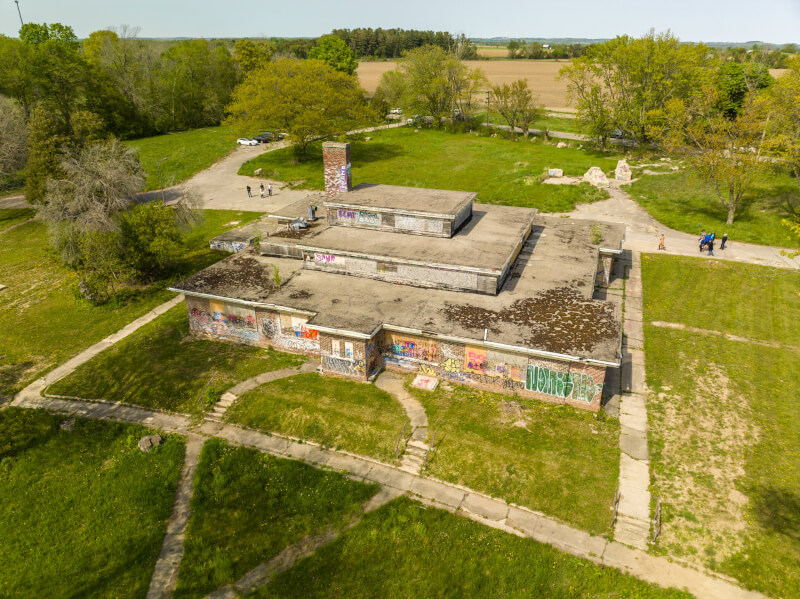
A recent aerial view of the former cafeteria building of WW II PoW Camp 30 near Bowmanville, Ont. [Jury Lands Foundation]
A community campaign to save Canada’s last surviving WW II-era prisoner-of-war camp has reached a new milestone, according to its stewards.
The historic Camp 30 site in Bowmanville, Ont., has languished for years due to various complications. Now, plans are underway to preserve its former cafeteria building after the local council approved fundraising efforts, effectively saving it from demolition.
Approximately $1.6 million will be required to complete the initial phase of the project being spearheaded by the Jury Lands Foundation. Established in 2014, the non-profit organization strives to protect as much of the aging property as possible, recognizing its infamy for the so-called Battle of Bowmanville, where German prisoners revolted against Canadian guards.
Having already made considerable headway, the foundation has until the end of 2026 to raise the needed funds. Speaking to Legion Magazine, Marilyn Morawetz, the initiative’s board chair, detailed the camp’s history and hoped-for future.
On the site’s early history
It was once a purpose-built juvenile training school. It was started in 1924, with the first students attending the following year.
When conflict broke out in Europe, and prisoner-of-war camps began filling up in that theatre, it was decided that PoWs could be shipped to Canada and, later, the United States. Camps were built in North America as a result.
Bowmanville, being a training school that had housed 300 boys at one time, was largely set up for that already, so it eventually hosted 800 PoWs at its height. Locals, of course, were dismayed when German captives were marched through the town from the railway station up to the campsite, but that sort of settled out over the years as people engaged with the prisoners.
The Germans were subsequently given an opportunity to sign out on their Ehrenwort—“word of honour”—not to escape, allowing them to walk down to Lake Ontario for a swim. They were likewise allowed to go cross-country skiing and permitted to go to Toronto for studies.
It’s been written before that if you were going to be a PoW anywhere, being one in Canada was particularly good. And if you were in Bowmanville, you were especially fortunate because the facilities were almost hotel-like. There was, for example, an indoor swimming pool and gymnasium. There was space to grow plants and to do other activities. It was a unique situation for the high-ranking officials kept at Camp 30. Out of that came some incredible stories.
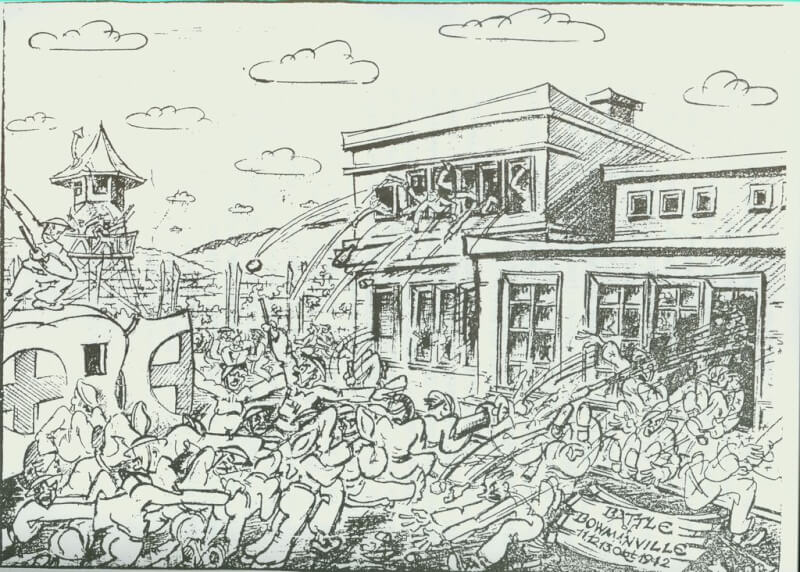
A cartoon depiction of the so-called 1942 Battle of Bowmanville. [Clarington Library, Museum & Archives/Wikimedia]
On the Battle of Bowmanville
In the aftermath of 1942’s Dieppe Raid, a number of dead German prisoners were reported to have been shackled on the beaches, along with paperwork disclosing the fact that such an order had been given.
That developed into a request by Hitler to shackle Allied forces who were in German PoW camps. Winston Churchill wasn’t happy about the scenario, and so he ordered the shackling of German PoWs in Canada—including at Camp 30.
In Bowmanville from Oct. 10, 1942, the Germans refused to co-operate, and so, there was a three-day skirmish, or battle, or riot—whatever you want to call it. Some people take umbrage at calling it a battle, but it was the only one, Time magazine once wrote, that happened on Canadian—or North American—soil.
The prisoners locked themselves inside various buildings, but one by one, they were recaptured. In true Canadian fashion, since the PoWs didn’t have any kind of weaponry, the guards decided that it would be a fair fight, so they used hockey sticks, baseball bats and water hoses.
Some people think that makes light of the situation but, had there been any serious injuries or deaths—which there weren’t—it was well-known that the German establishment in the war theatres would have taken revenge on Allied PoWs. The way the Canadians handled it saved many lives.
On the site’s postwar deterioration
After the war, authorities took down all of the extra barracks that had been built, and within a year and a half, they had repatriated the PoWs. The boys were then brought back into the school environment.
When discussions surrounding the Young Offenders Act arose in 1979, the training school closed. It sat empty for a short period before being leased out to several other schools, remaining in use until 2008.
There was then a breach of the sewage treatment plant on the property, resulting in the site’s closure. Its believed the owners weren’t fully aware of its historical significance, so they left it unrepaired. That’s when it really started to decline.
The site was later used for a video game background. They were allowed to graffiti the buildings, but when the work was over, they weren’t required to restore them. Eventually other people defaced the buildings, but more concerning was when people started to vandalize and steal bits and pieces of the history.
In 2009, there was a fire in the former administration building. For liability reasons, the developer who owned the property had to demolish it.
Out of around 18 original buildings, there’s now the cafeteria, which is the building we’re working to rehabilitate and restore, along with five other buildings still owned by the developer.
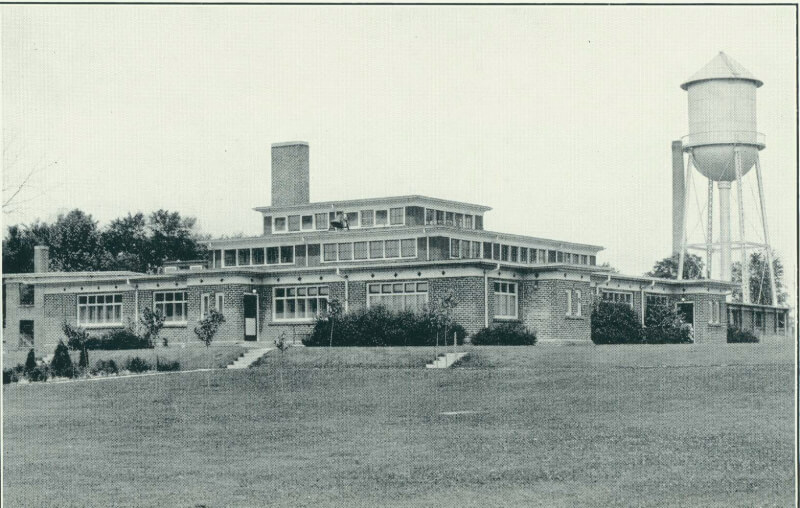
The non-profit Jury Lands Foundation aims to restore the Camp 30 cafeteria to its former glory in part to memorialize the site’s historic significance. [Jury Lands Foundation]
On the latest preservation efforts
There have been efforts through our work—as well as through support groups in our community—to save the site for a historic or heritage park that would be municipally owned and would welcome national and international guests.
Our vision is to take the remaining buildings and refurbish them. We’re starting with the cafeteria in the hope of transforming it into a community hub. It belongs to the municipality now, and we’ve been given the privilege of fundraising to bring it back to life while still having it serve as a source of historical education.
We recently met with the local council and presented a plan to involve an interested heritage group that could bring in specialists for things like brickwork and abatement. We were given the go-ahead to do that. Through this summer’s work on the site, we hope that the cafeteria will be rehabilitated to a safe and secure structure. It won’t be finished on the inside, but it’ll no longer be in its current state of disrepair.
On the required financial support
We need about $1.6 million to finish our current work. We’ve now raised over a million, $500,000 each from the federal and municipal governments. Hopefully, we’ll see most of the initial work completed. Then we’ll get onto the next phase, should additional funds permit. We hope that people who treasure this history and Canadians’ part in it are compelled to help.
There’s a tremendous interest in this. It’s a great opportunity to honour those who put their lives on the line throughout the war and to remember the people at home who supported those efforts.
This interview has been edited for brevity and clarity.
Advertisement