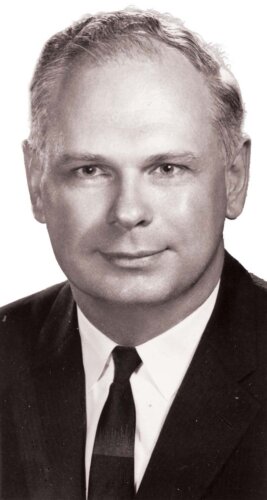



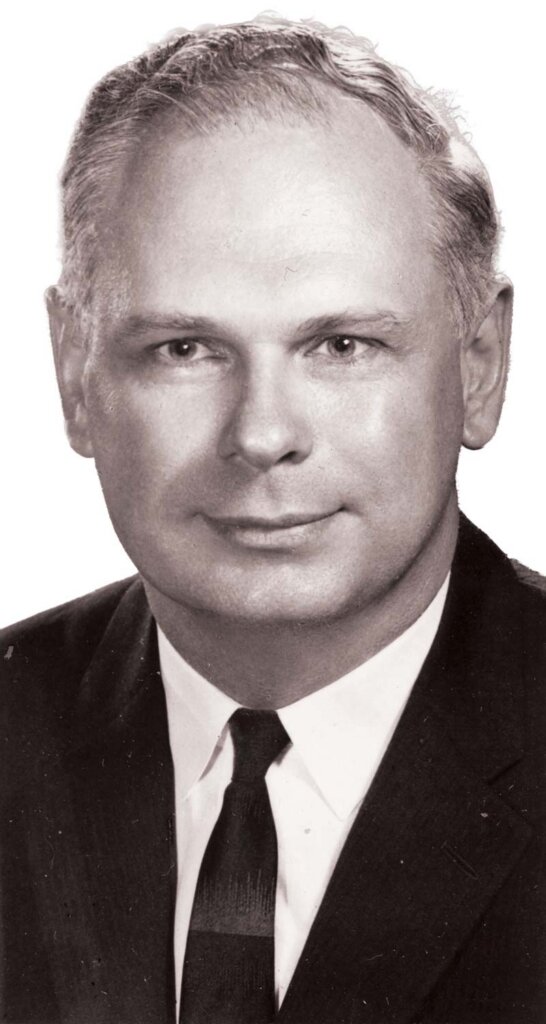
Defence Minister Paul Hellyer [LM Archive]
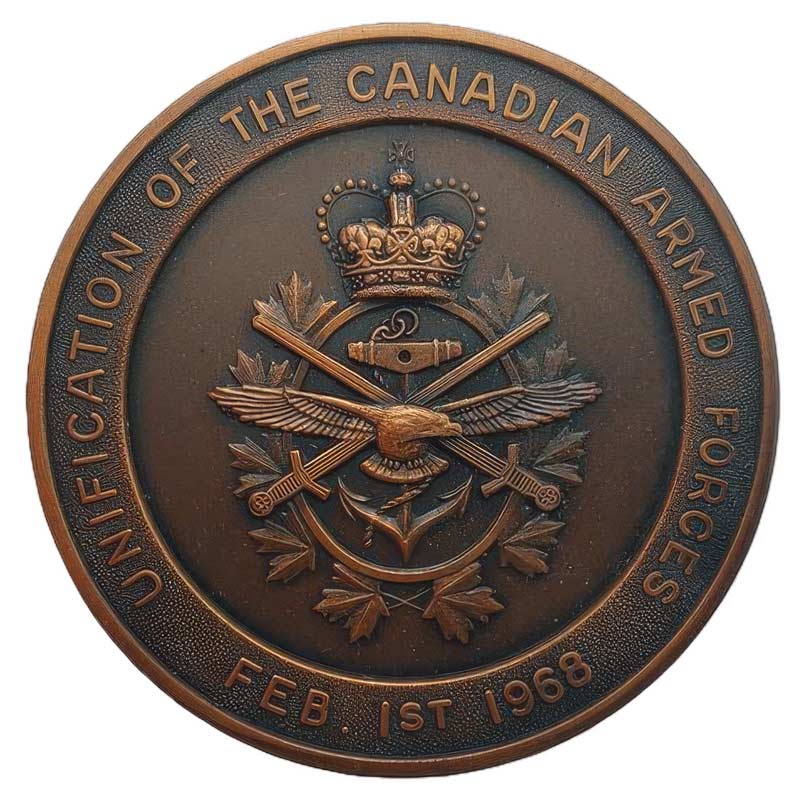
A medallion was created to commemorate the unification. [numista.com]
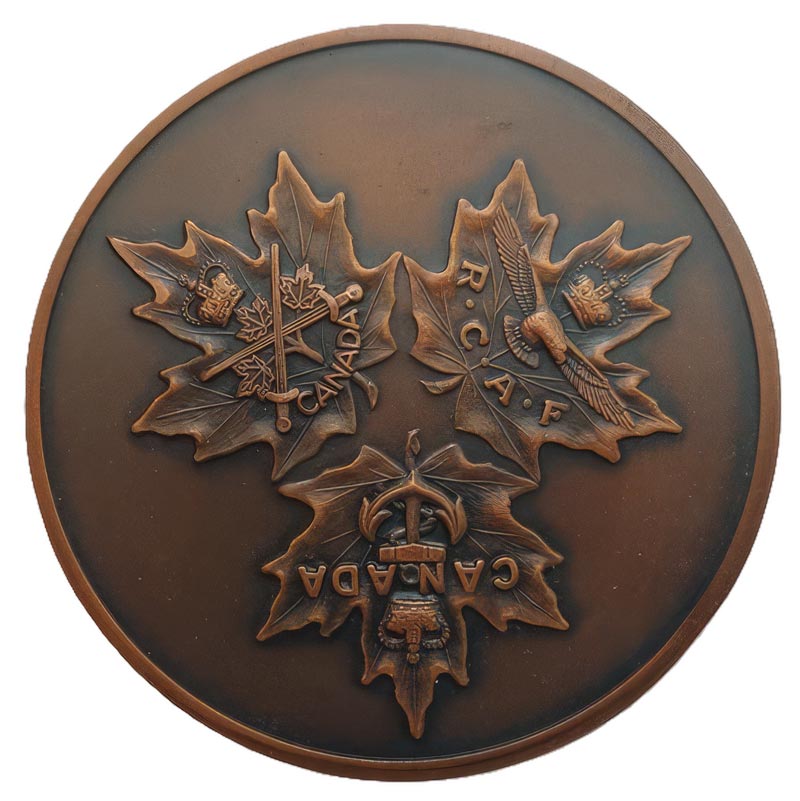
A medallion was created to commemorate the unification. [numista.com]
Paul Hellyer joined the Royal Canadian Air Force in 1944 as an aircrew trainee when he was 20. Posted to Camp Borden in Ontario, he spent weeks on “useless duties” waiting for his training to begin, but the RCAF decided there were 4,200 surplus aircrew and he was sent to Toronto to await his discharge. When it finally came after nine weeks, he joined the army and was posted to Camp Petawawa northwest of Ottawa.
“The whole indoctrination process was so absurd,” he wrote in his 1990 memoir Damn the Torpedoes: My Fight to Unify Canada’s Armed Forces.
Hellyer received new dog tags, relearned the rudiments of drill and had his immunization shots again. When he protested, he was told, “yes, but those were air force shots.” At the time, the army overseas was short of reinforcements, and, Hellyer wrote, “I abhorred the fact that…grown men indulged in silly games that squandered valuable time. There was little effective co-operation between the services.”
He was right and, although he denied it was a significant factor in his decision two decades later to unify the forces as defence minister, it seems clear that the runaround he endured had an effect on him.
Hellyer ran a clothing store with his wife after the war. He also became a successful property developer, got into politics and was elected to Parliament as a Liberal in a Toronto riding in 1949—then the youngest MP to win a seat. He won again in 1953 and briefly served as associate defence minister until the Liberals were defeated in 1957. Hellyer lost his seat, too, but was eventually re-elected as an Opposition member in a 1958 byelection.
Lester B. Pearson made him defence critic and, after privileged briefings at Norad and NATO persuaded him that Canada was shirking its international commitments, Hellyer persuaded the Liberal leader to support nuclear weapons for the country’s Bomarc missiles, CF-104 fighter-bombers and its NATO brigade. Largely based on that issue—along with divisions in John Diefenbaker’s cabinet and caucus—the Liberals won a minority government in 1963. Prime Minister Pearson duly appointed Hellyer defence minister, and thus began his four-year campaign to unify the country’s forces.

“As my first step as minister, I resolved not to sign anything of substance for the first thirty days,” wrote Hellyer in his memoir. “I was well aware that civil servants and the military try to take advantage of the naivety of new ministers by presenting them with a rash of submissions ‘requiring urgent approval.’”
After creating departmental study groups, Hellyer determined that a white paper on defence was necessary and he decided to do it himself, the first iteration written in longhand. He sent parts of the draft to the chiefs of staff committee and received generally favourable feedback.
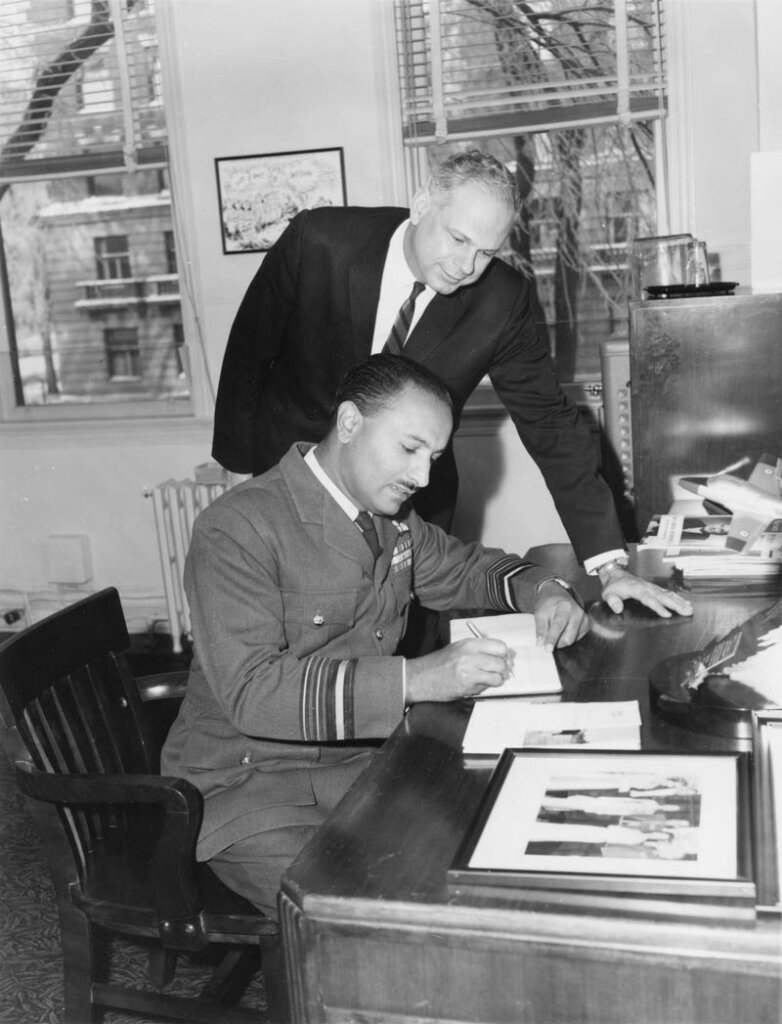
Defence Minister Paul Hellyer (standing) with Air Marshal Roy Slemon (seated) led the campaign to unify the Canadian Forces. [LAC/3725774]
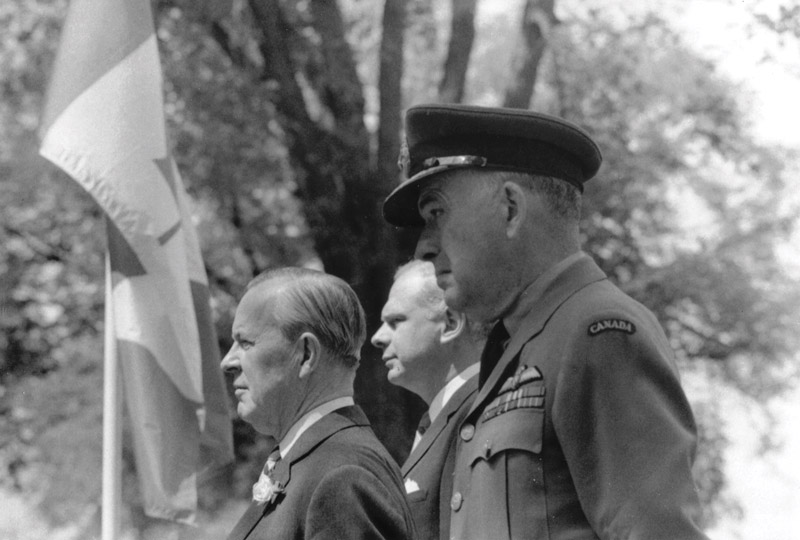
Prime Minister Lester B. Pearson, Hellyer and Air Marshal Frank Miller attend a June 1965 event. [Duncan Cameron/LAC/PA-117109]
Hellyer had not, however, included his thoughts on reorganization. Those he put in a letter to Pearson: his ideas on integration would increase civilian control, reduce waste and make the three services work together more efficiently. Pearson was on board but, when briefed in February 1964, the service heads weren’t.
Hellyer’s proposal was to fully integrate Canada’s armed forces and replace the three service leaders with a single chief of defence staff (CDS). “The object is complete unification of the three forces into a single force with resultant improvement in efficiency and tremendous savings.” And after hearing critical responses, Hellyer noted in his diary, “It is the issue of who is going to set military policy—the military or the government.”
For the next month, Hellyer fought opposition to his plan with the cabinet
committee on external affairs and national defence, and in the full cabinet. He got his way, however, and the white paper published in March 1964 included this key paragraph:
“Following the most careful and thoughtful consideration, the government has decided that there is only one adequate solution. It is the integration of the Armed Forces of Canada under a single Chief of Defence Staff and a single Defence Staff. This will be the first step toward a single unified defence force for Canada.”
The white paper predicted savings from slashing the number of headquarters and training establishments, which would increase funds for equipment. And for those who worried about the effects of unification on morale, the document reported, “There is no thought of eliminating worthwhile traditions.”
The parliamentary and public response to the white paper was generally positive, and Hellyer appointed a CDS, a vice chief, and officers filling functional posts on Aug. 1, 1964. But the minister wasn’t finished. There was to be a single recruiting organization, a single basic training organization and full integration of headquarters and commands.
“If in achieving these objectives, a single unified Defence Force for Canada is clearly the logical end result, then such a unified Defence Force will be established,” he continued. “This is where the Canadian Defence Forces are going and all concerned must realize this fact.”
The CDS, Air Marshal Frank Miller, told his colleagues that force strength would be reduced by 20 per cent of the estimated 50,000 in support roles, which would amount to 10 per cent of 120,000 regulars. Plus, 20 per cent of personnel at the Ottawa headquarters would be cut. Some “premature releases” were necessary and those who left would receive compensation, soon known as the “golden bowler.” By late 1966, 3,344 servicemen had taken the “bowler” and more than 26,000 had left the military.
The additional funding for equipment Hellyer had promised through integration was also delivered. In December 1964, he announced $1.5 billion for armoured personnel carriers, self-propelled artillery, mortars, four helicopter-equipped destroyers, new supply ships and more transport aircraft.
In Ottawa, change continued at Canadian Forces Headquarters (CFHQ), too. Three comptroller-general branches merged, as did personnel branches, public relations directorates, construction engineering staffs, pay systems, intelligence divisions, communications systems, and recruiting organizations. Even the 350 trade classifications in the three services were reduced to 97 in the new system. Without doubt, this was a major achievement for Hellyer.
In June 1965, the revamping of the field commands into functional structures took effect. The 11 commands of the three services were reduced to six:
- Air Defence Command;
- Air Transport Command;
- Material Command;
- Mobile Command, with two brigades and tactical aircraft;
- Maritime Command, with ships and air units;
- and Training Command, with personnel selection and training from basic to advanced levels.
The forces in NATO reported to Ottawa and the reserves were controlled by regional offices reporting to CFHQ. All this was well received, and Hellyer was pleased. “I think it makes a lot of sense,” he had noted in his diary, “and the reduction from eleven to six will save us a lot of overhead and money.”
By the end of 1965, Hellyer was riding high. He had integrated the Canadian Forces and carried the military with him in doing so. He had saved money and used it to get badly needed equipment. And at a time when Prime Minister Pearson’s popularity was slipping—his government managed only another minority in the November election—Hellyer stood out among aspirants for future leader. He was tough, determined, and had proven he could get things done.
On Jan. 27, 1966, Hellyer wrote to Pearson that it was time to move forward with unification. But, he recognized there would be opposition. “Unification…will raise emotions associated with the change of names and traditions,” said Hellyer, “and in these circumstances a decisive approach is essential.”
“It is the issue of who is going to set military policy—the military or the government.”
The Prime Minister let Hellyer proceed, but added that the sentiments and traditions of the military should be retained wherever possible. It was good advice, but it went largely unheeded.
The House of Commons standing committee on national defence held hearings on Hellyer’s departmental estimates in 1966, and members pressed to have serving officers testify. The minister agreed, and in his own testimony on May 12, he stated flatly that, “We have now reached the stage for final steps toward a unified force.”
His senior officers at last began to express doubts publicly—and act. When Hellyer made Lieutenant-General Jean-Victor Allard the new CDS, Lieutenant-General Robert Moncel, who had expected the appointment, left the forces along with two other senior officers. More would follow. While Allard, commander of Mobile Command, was a good fighting soldier, as a francophone, he intended to push bilingualism, adding more uncertainty to the changes already afoot in the largely anglophone forces.
In the meantime, Rear-Admiral William M. Landymore, the East Coast naval commander, was telling his officers and ratings that unification would destroy the effectiveness and morale of the Royal Canadian Navy. He told the standing committee the same. On July 12, Hellyer sacked him. Landymore then spoke to the Canadian Press saying that unification had demoralized the officer corps.
Hellyer noted in his diary in response that the law of the land, “puts the military under civilian control and this is the way it’s going to be run for a change…. I only hope that [the senior officers] don’t become martyrs.”
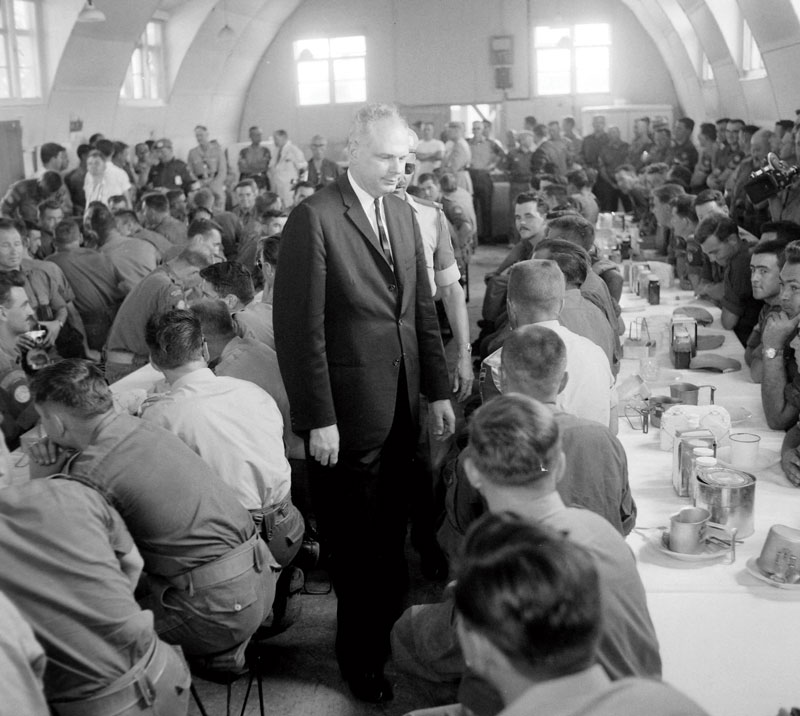
Hellyer meets Canadian peacekeepers in Nicosia, Cyprus, in June 1964. [Smith Archive/Alamy/2Y7HFXP]
By the end of 1965, Hellyer was riding high. He had integrated the Canadian Forces and carried the military with him in doing so.
Worried that his defence minister was going to cause the government trouble, Pearson again urged caution, noting that, “as many of the service traditions and as much of the old distinctions”—the historic names, uniforms, rank designations—should be preserved. Hellyer courteously reminded Pearson that he had been consulted at every stage of the process.
Now dissenters in the reserves and among veterans’ groups were organizing. They created TRIO, short for Tri-Services Identities Organization, which was led by navy and army officers. It soon had 35 branches across Canada. While it received favourable media coverage, it wasn’t enough to swing public opinion against unification. A Gallup poll around the time indicated that 48 per cent of Canadians were in favour of unification and only 33 per cent were against it.
Hellyer now had to get amendments to the National Defence Act to authorize unification through Parliament. His advisors in the Defence Council, with new senior officers in place of those who had retired or resigned, were happy.
“All of the discussion was ‘pro,’” Hellyer noted in his diary of the council’s position. A cabinet committee approved the amendments, including a common rank structure for the forces; the full cabinet endorsed them, too, on Aug. 11. The next day, Hellyer saw the new dark green uniform to be worn by all services and accepted it.
The defence minister introduced the Canadian Forces Reorganization Bill in the Commons on Nov. 4. The Progressive Conservatives filibustered, but the government outlasted the Opposition and unification passed second reading by a vote of 98-62. The fight then went to the standing committee on national defence where the Tories argued against every clause.
So, too, did Admiral Landymore. He told the committee of his campaign against unification and his difficult relationship with Hellyer. Landymore erred badly, however, when he charged that Mobile Command was so large that it was “dangerous to our democracy.”
“If ever a commander of that Command decided to set himself up to control this country of ours,” Landymore continued, “he has a ready-made organization to achieve it.”
But in Hellyer’s testimony a week later, he too slipped when he said that “Landymore was fired for 18 months consistent disloyalty to the policy of the people he was paid to serve.” That caused a furor and Hellyer had to retract the allegation.
Pearson then waffled, telling Hellyer that the unification bill might not get passed in the present session of Parliament, which would have effectively killed it. But cabinet strongly supported Hellyer and the prime minister acquiesced. Pearson still wavered though, seemingly appreciating better than Hellyer that symbols remained important to veterans and those still serving.
The debate went on so long in the House that the government finally shut it down with closure. The bill passed by a vote of 127-73, and the forces were officially unified on Feb. 1, 1968.
The victory was pyrrhic for Hellyer, having upended his chances of political advancement. More importantly, it would take Canada’s military years to recalibrate from the tense times and much of what was accomplished would be rolled back during the next decades.
Advertisement