


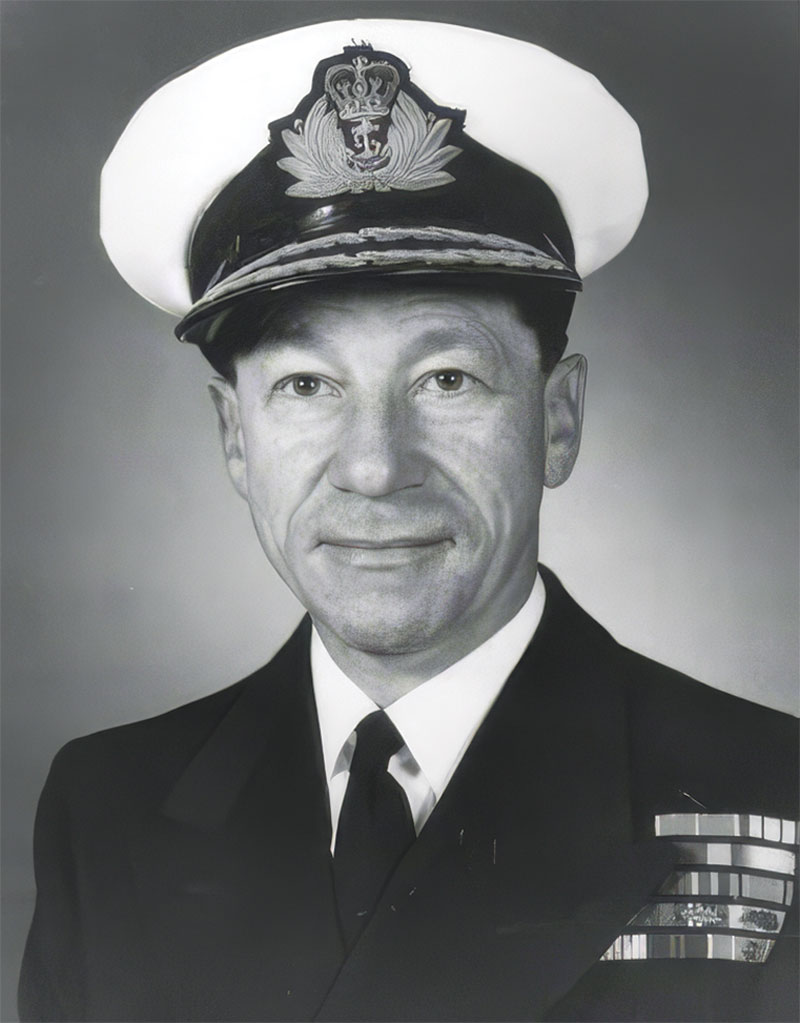
Rear-Admiral William Landymore [DND]
William Landymore
“If I didn’t speak out, who would?”
—William Landymore
In 1966, Rear-Admiral William Landymore became the de facto head of the Royal Canadian Navy just as the federal government was poised to pass legislation that would unify the country’s three armed services into one centralized formation. Effectively, the navy that Landymore had dedicated his life to serving would cease to exist.
In 1936, the 20-year-old Landymore had been commissioned into the RCN. Seconded to the Royal Navy, he served on three cruisers by the time war broke out on Sept. 1, 1939. Returning to the RCN, Landymore survived the sinking of two ships on which he served. During the Korean War, he commanded HMCS Iroquois for two tours of duty, received a Mention in Dispatches for a second time and was appointed an officer of the Order of the British Empire.
All-out unification struck Landymore as going too far.
In 1958, he assumed command of Canada’s aircraft carrier, HMCS Bonaventure. Promoted to rear-admiral in 1962, Landymore became the first commander of Maritime Command in 1966. This position replaced the chief of the naval staff, which the federal government abolished in 1964 as it began its unification plan.
With unification moving full-speed ahead, Landymore tried to make the government reverse course.
“If I didn’t speak out, who would?” he asked.
While some integration seemed necessary, all-out unification struck Landymore as going too far. All three services would be abolished, replaced by generic “elements.” Naval and air force ranks would disappear and those of the army would be imposed. Sailors would replace their traditional uniforms with a bottle-green concoction for all military personnel that was modelled on those of the U.S. air force.

In November 1964, Landymore told Defence Minister Paul Hellyer that he couldn’t accept unification. Landymore began openly organizing opposition to unification, condemning it as the “most unwieldly, unsatisfactory, idiotic move that was ever made because it didn’t make sense at all.”
On July 12, 1966, Landymore refused Hellyer’s demand to resign. Hellyer then decided “there was no alternative but to fire Landymore. He didn’t seem too surprised when he heard the verdict.”
Returning to Halifax, Landymore went public about his dismissal, sparking a nationwide controversy over unification. As Landymore departed his command, historian Tony German later noted, “every ship in harbour flew signal flags spelling Landymore’s name; above them flew flags BZ: Bravo Zulu: ‘Well done, Landymore.’”
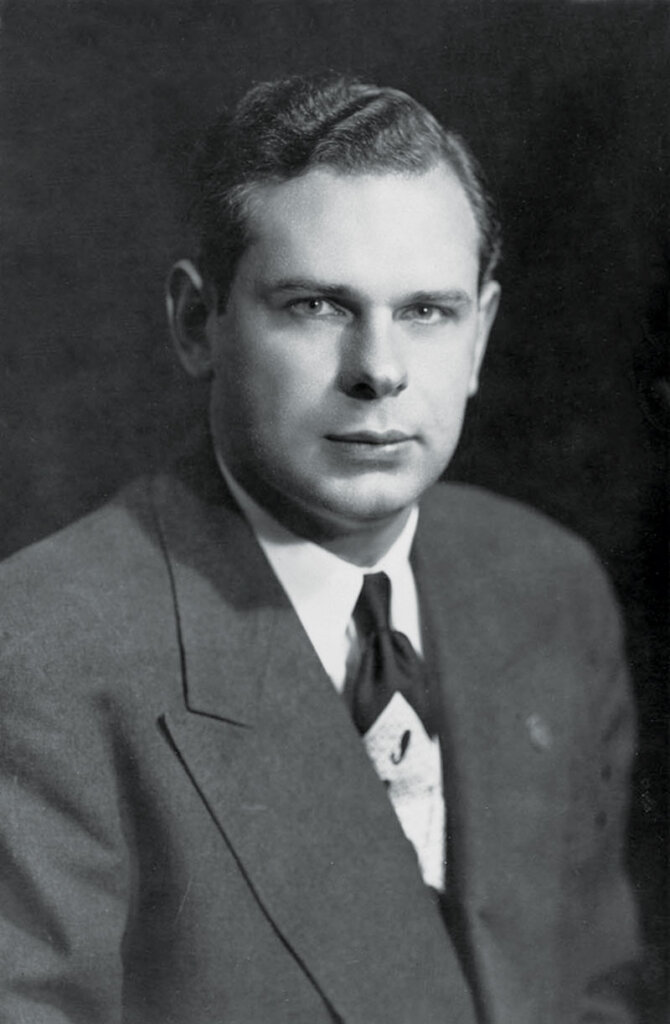
Lester B. Pearson [Arthur Roy/LAC/PA-047164]
Lester B. Pearson
The Lester B. Pearson government’s decision to impose a unified command on Canada’s three armed services had no stronger advocate than Paul Hellyer. This was partly fuelled by personal experience.
During the Second World War, Hellyer had initially served in the Royal Canadian Air Force before the 1944 personnel crisis prompted his reassignment to the army. Being required to complete a second basic training course may have imbedded a belief that separate services created avoidable inefficiencies and duplications.
In 1963, Hellyer was appointed defence minister. The following year, the government tabled a white paper on defence proposing an integrated administrative structure under a single chief of defence staff.
Hellyer, an ambitious politician, was determined to go further, believing that reforming the military away from its British roots would appeal to Canadians. Hellyer pushed beyond integration to
outright unification of all three services into an indistinguishable amalgam. A standardized uniform, a single-rank system based on army conventions and a single-command structure would not only transform the military but irrevocably break its connections to the past.
Hellyer singled out the navy as needing the most reform.
“I knew I had my work cut out for me,” Hellyer wrote. “The navy was going to need a lot of modernization….”
While there was resistance to unification in the air force and army, the navy openly rebelled under Rear-Admiral William Landymore’s lead.
“The navy was going to need a lot of modernization to make it contemporary.”
—Paul Hellyer
Landymore, and most senior military officers, accepted the merits of greater integration to avoid duplication, reduce costs and enable better co-ordination. In the 1960s, the Defence Department was consuming about 25 per cent of the federal budget and facing major cost overruns for acquisition projects. Some reform was obviously needed.
With Hellyer’s senior naval commander openly criticizing his policy, a showdown was inevitable.
“To his credit,” Hellyer wrote, “he took me seriously and worked out a strategy not unlike a political campaign.”
In response, Hellyer fired Landymore.
Hellyer believed that reforming the military away from its British roots would appeal to Canadians.
Unification proceeded on Feb. 1, 1968. Hellyer predicted other countries would follow Canada’s lead. None did. By 2014, unification had been mostly reversed. Uniforms and ranks were returned. Military heritages were restored and celebrated. The navy and air force became royal again.
Advertisement