
This is the first part in a series examining the critical work of the Commonwealth War Graves Commission.
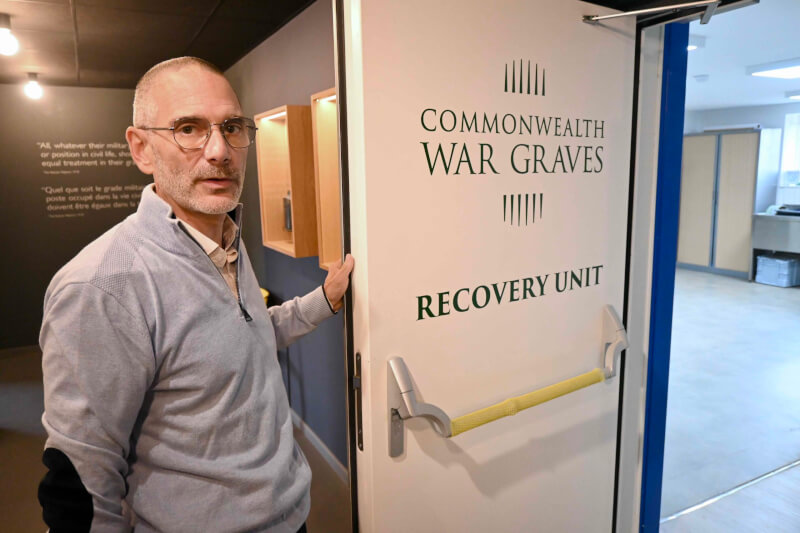
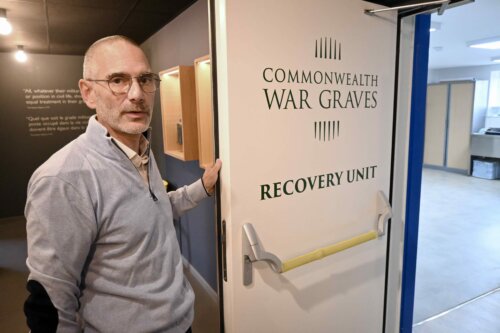
Bio-archeologist Stephan Naji, head of the recovery unit at the Commonwealth War Graves Commission, at his laboratory in Beaurains, France. [Richard Foot/LM]
As head of the recovery unit at the Commonwealth War Graves Commission (CWGC), Naji’s focus should be fixed firmly on the past. Lately, however, he has been planning for the future—specifically for the next global war, and how mass casualties from that conflict can be recovered, identified and commemorated.
Naji is co-director of a NATO working group that started meeting last year to figure out how NATO countries, including Canada, can prepare to handle tens of thousands, perhaps hundreds of thousands, of anticipated combat deaths if, or when, World War Three breaks out.
That may be a hard truth to comprehend. But the fact is that Naji, and other experts like him, are actively planning for a mass casualty conflict the likes of which the world hasn’t seen in more than 80 years.
“All militaries today are prepping for a Third World War scenario,” Naji told Legion Magazine during a recent interview at his laboratory at CWGC headquarters in Beaurains, a community outside Arras, France—not far from Vimy Ridge.
“They’re saying, ‘What do we do? How do we handle a large-scale conflict with large numbers of dead?’ And everybody is like, ‘We don’t know. We haven’t done anything on a large scale since the Second World War.’”

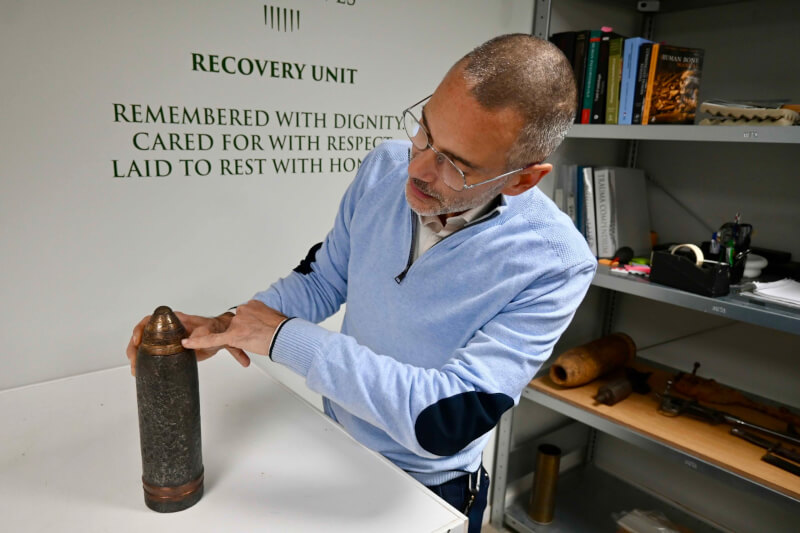
Naji examines an unexploded shell recovered from a First World War battlefield. [Richard Foot/LM]
“At the moment, every major nation is upgrading their mortuary affairs capabilities because they realize if there’s anything close to what Ukraine is undergoing at the moment, nobody’s ready—including the U.S., France and the U.K.,” said Naji. “Not a single country has the military capability to handle more than a thousand deaths per year.”
The main purpose of the Commonwealth War Graves Commission is the commemoration of 1.7 million people who died in service with its six member countries—U.K., Canada, Australia, New Zealand, South Africa and India—during the First and Second world wars. The CWGC maintains meticulous cemeteries and monuments honouring those dead around the world, as well as a rich database of online records.
The commission also operates a forensic recovery unit based in France, tasked with handling and identifying the remains of Commonwealth soldiers, sailors and aviators whose remains routinely surface in unknown graves across the planet. That highly sensitive task requires not only cutting-edge scientific knowledge, but also vast logistical capability in co-ordinating the demands of local police and national defence ministries, as well as the excavation, preservation and chain-of-custody of human remains.
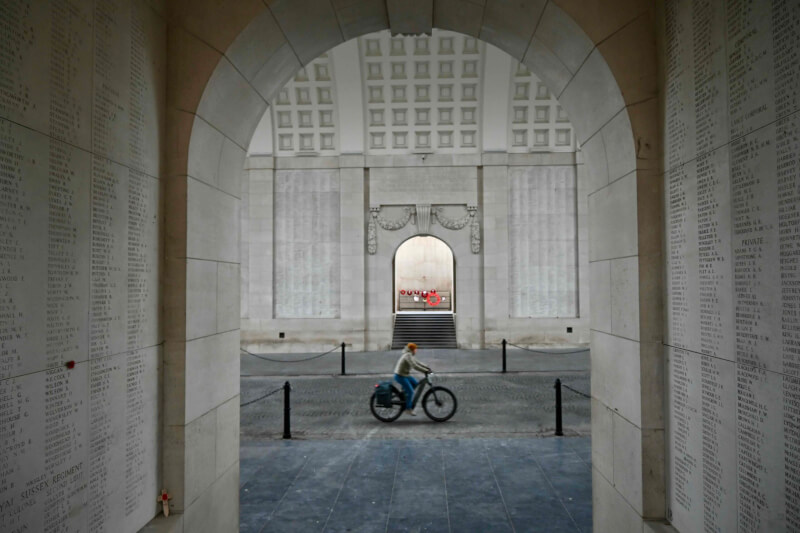
A cyclist passes through the Menin Gate memorial in Ypres, Belgium. The memorial holds the names of more than 55,000 Commonwealth soldiers, including 7,000 Canadians, who died in unknown graves in Belgium during the First World War. [Richard Foot/LM]
The CWGC is one of the only organizations in the world with active expertise in the recovery, handling and identification of mass wartime casualties. Perhaps its most unique attributes are that its reach is global—it maintains war graves from Alaska to Ascension Island, a remote outpost in the South Atlantic—and it has been doing so for more than 100 years.
The only institution with comparable knowledge is the U.S. Defense POW/MIA Accounting Agency (DPAA), which leads the recovery efforts for American military members lost around the world in U.S. conflicts dating from the Second World War to the present. But despite its enviable resources and abilities, not even the DPAA has ever recovered and commemorated—as the CWGC did in the immediate aftermath of the First World War—hundreds of thousands of casualties from a single conflict.
“We’re still recovering First World War casualties, we’re still identifying them, and we still can inform modern mortuary affairs on what not to do if you want to make sure you identify your troops killed in action,” said Naji.
“So, we’re actively discussing this with NATO and with ICRC—they’re setting some of the global standards for missing-in-action, killed-in-action recovery and identification processes.”
Naji is currently co-director of a committee leading the Battlefield Forensics Programme, a collaboration between NATO’s Science For Peace and Security branch, and various universities and NATO member militaries, as well as the Ukraine Ministry of Defense. For the past two years, the group has met periodically at a military base in Denmark to share ideas and workshop strategies.
“NATO doesn’t have mortuary affairs end-to-end capability,” said Naji. “They have skills, spread out through NATO countries, but they don’t have a single, focused capability. That’s what we’re building with them now based on what we know how to do.”
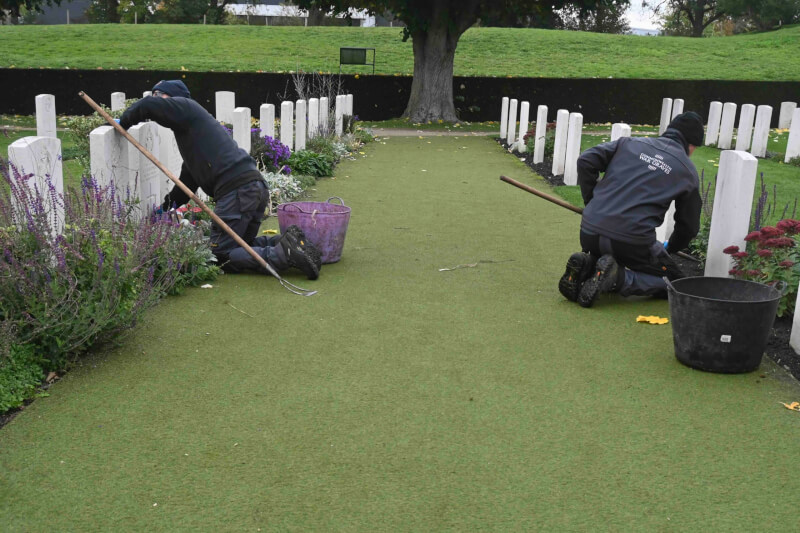
Commonwealth War Graves Commission gardeners maintain flower beds at the commission’s Essex Farm Cemetery near Ypres, Belgium. [Richard Foot/LM]
That means the remains of a First World War Canadian soldier recovered today near Ypres, Belgium, will be buried in Belgium. Or the remains of a Second World War Canadian pilot found in an aircraft wreckage in, say, Hong Kong will be buried in or near Hong Kong.
The public may find it difficult to accept this practice for contemporary casualties. During the war in Afghanistan, the remains of all 158 Canadian soldiers killed there were brought home as part of public repatriation ceremonies. But doing this on a massive scale in a global war across multiple theatres would likely be impossible for NATO member governments.
“Any new, large-scale conflict, they’re not going to be able to repatriate everyone,” said Naji. “They won’t have the budget. So, how do you commemorate 10,000 Canadians killed in Germany, Poland or Ukraine? We know how to do it, at a large scale, with the highest standards of cemetery maintenance, public inquiries, public archives, digital database, all of that.”
Naji also knows that modern sensibilities wouldn’t tolerate the burial of unidentified contemporary casualties. This may be the toughest hurdle of all, requiring large forensic and research resources to put names on every set of unknown remains.
“Public perception today would not understand or accept bringing back an unknown soldier,” said Naji. “That would not cut it. That would be a disaster politically. And so, these countries need to upgrade their mortuary affairs, their identification programs, their preparedness standards—because right now they aren’t prepared to guarantee 100 per cent identification if there is a large scale, protracted conflict.”
Advertisement