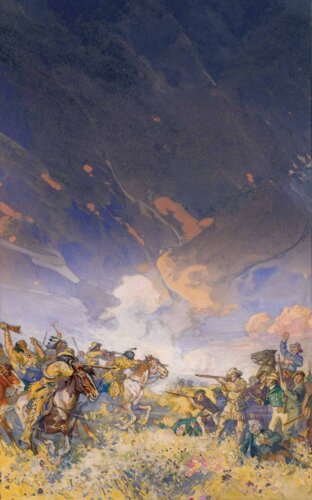



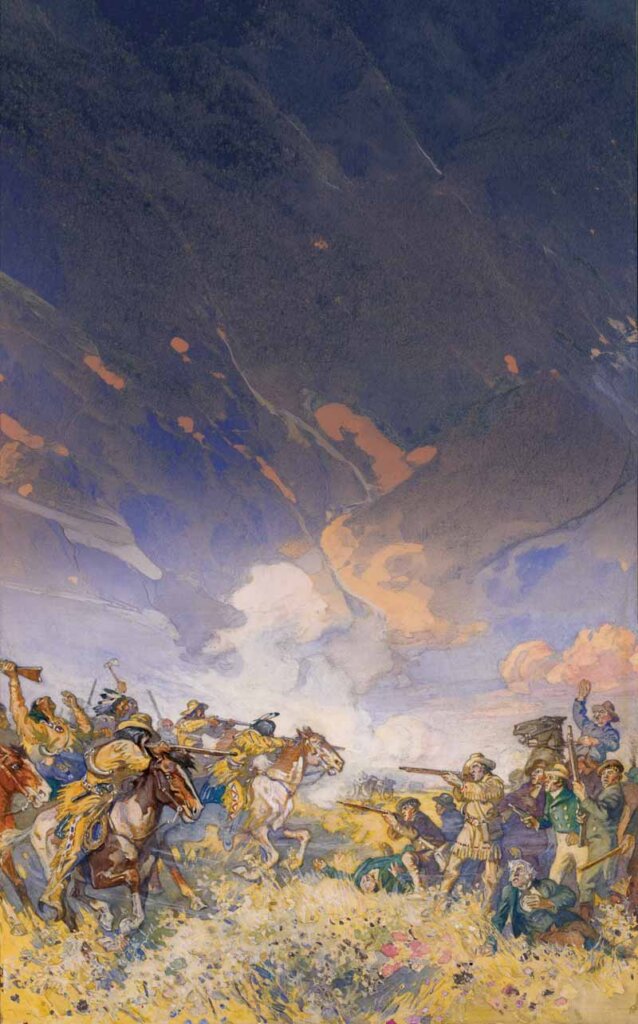
Artist Charles William Jefferys depicts Métis horsemen allied with the North West Company fighting Hudson’s Bay Company men on June 19, 1816. [Charles William Jefferys/LAC/2835228]
[Charles William Jefferys/LAC/2834709]
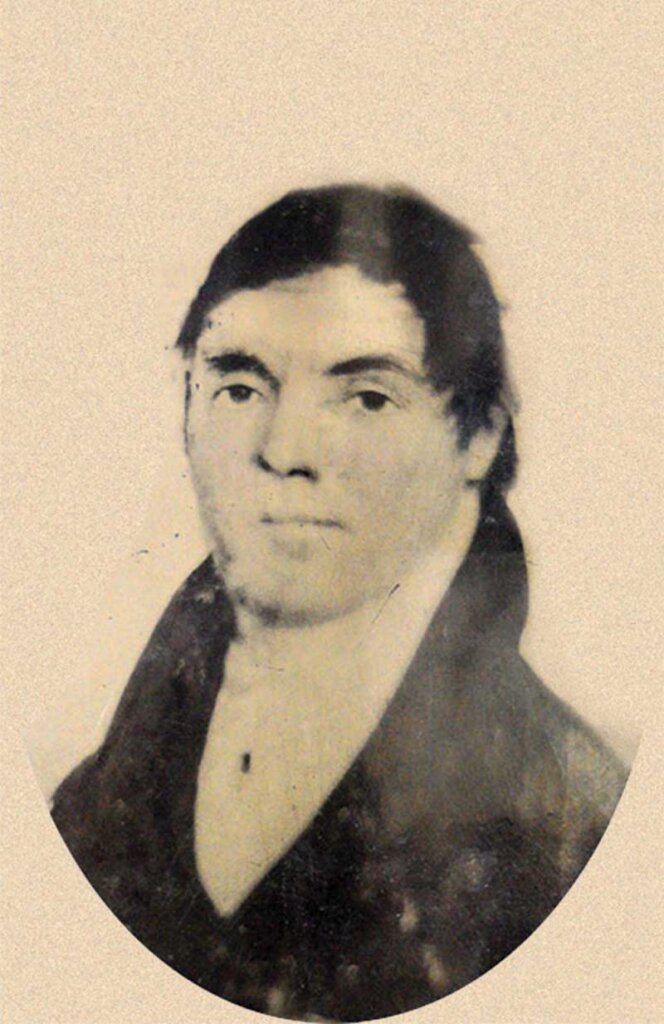
NWC officer and Métis leader Cutbert Grant (photographed) eventually shot Robert Semple, the HBC governor of Rupert’s Land, during the melee. It was largely tied to shipments of pemmican, dried buffalo meat that helped fuel fur traders. [LAC/C-000624]
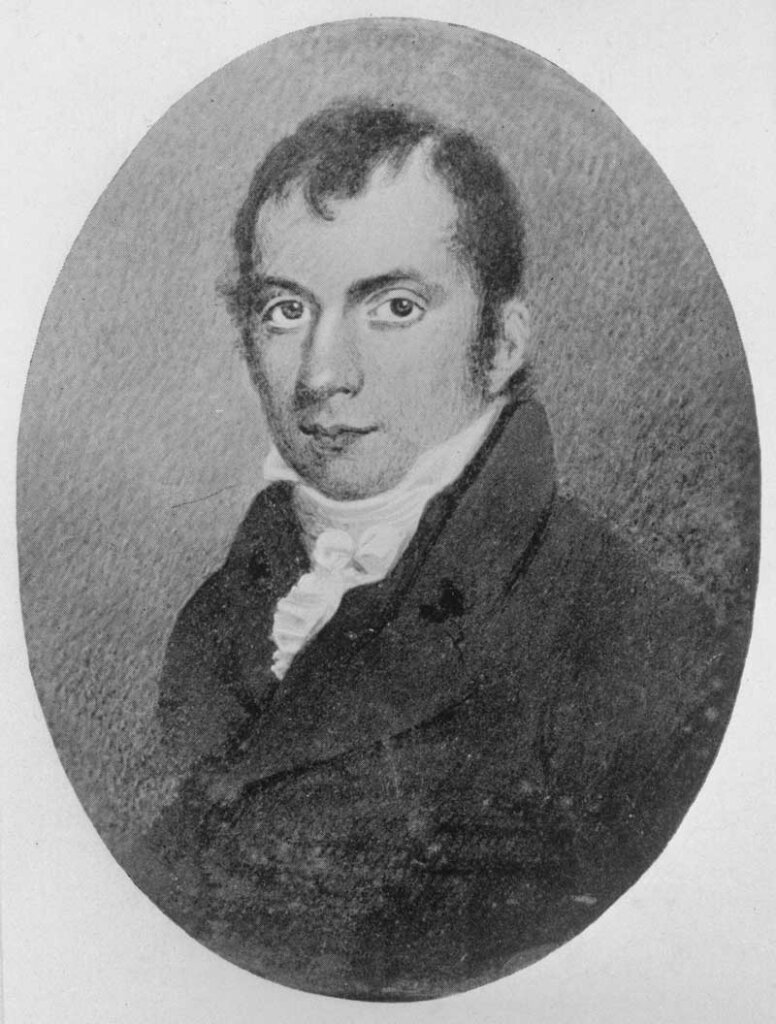
Robert Semple [Archives of Manitoba/Wikimedia]
The gunfire lasted only a few minutes, shattering the stillness of a late-spring prairie evening and any delusions about how ugly the great fur trade feud had become.
Robert Semple, the Hudson’s Bay Company (HBC) governor of Rupert’s Land, was the first casualty—shot in the leg, then dispatched by a Métis rifleman who placed the barrel of his gun against the wounded man’s chest and fired.
Earlier that day, June 19, 1816, Semple had learned that a party of about 60 Métis and First Nations men, allied with the HBC rival North West Company (NWC), were riding north on horseback, carrying a supply of pemmican. The dried buffalo meat, ground into powder, mixed with buffalo fat and stored in leather bags was the essential lifeblood of both the Nor’Wester canoe brigades and the Métis economy. The shipment skirted an HBC gunboat blockade of the Red River, which—along with its recent burning of the Nor’Wester’s fort just downstream—were part of an HBC campaign to enforce a prohibition on pemmican exports from the area.
As the Métis saw it, the blockade and the destruction of their ally’s garrison meant they weren’t just on a mission to evade the export ban, they also wanted to teach the HBC a lesson it wouldn’t forget. The riders, led by NWC officer and Métis leader Cuthbert Grant, were wearing war paint and spoiling for a fight.
Semple gathered up a lightly armed group of about 25 HBC men and confronted the Métis horsemen at a cluster of trees called Seven Oaks (in present-day Winnipeg). The two groups met in the long shadows of twilight, with the Métis alert in their saddles, arranged in a tight semi-circle around Semple’s men.
One of Grant’s lieutenants, a Métis man named François Boucher, barked at the HBC party to lay down its weapons, then demanded: “What do you want?”

“What do you want?” Semple hollered back.
“We want our fort,” said Boucher.
“Well, go to your fort,” Semple answered.
“Why have you destroyed our fort, you damned rascal?”
Affronted, Semple stepped forward to grab Boucher’s rifle and the reins of his horse.
There are differing accounts of who fired first, but Semple was soon shot in the leg by Grant. As some of Semple’s men rushed to the side of their ailing governor, the Métis men—all seasoned, disciplined hunters—slid down en masse from their saddles and aimed across their horses’ backs into the confused HBC party, who tried to shoot back, but were cut down by the crossfire. When the Métis then lay down in the grass to reload, Semple’s men interpreted the pause as victory. They sent up a cheer, but their exuberance was greeted by another Métis fusillade, then hand-to-hand combat.
When it was over, Semple and 20 of his men lay dead, along with one 16-year-old Métis rider. Grant and his party then mutilated the HBC corpses and sent one survivor—who had feigned death and then begged for mercy—back to the HBC fort with a letter demanding its immediate surrender.
The Battle of Seven Oaks, as it came to be known, was the bloodiest episode of the Pemmican War of 1812-1821. The conflict wasn’t really a war. Rather, it was a violent culmination of the epic, decades-long contest between the two commercial titans of the Canadian fur trade. Nor was the fighting really about pemmican—or ideology, or even territory per se. It was instead an internecine feud over beaver pelts, and the corporate profits that flowed to whomever controlled the vast forests that yielded them in abundance.
It was an internecine feud over beaver pelts, and the corporate profits that flowed to whomever controlled the vast forests that yielded them in abundance.
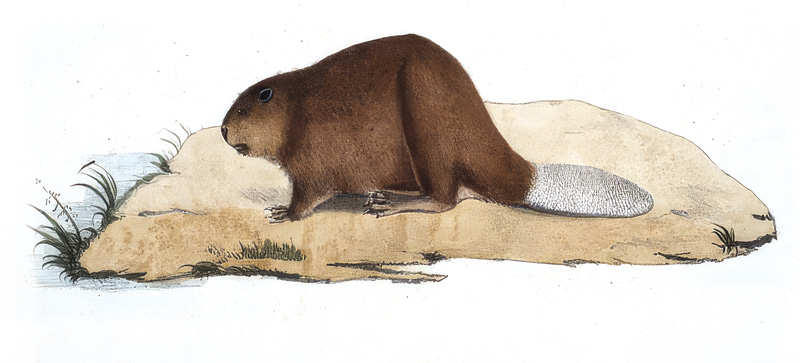
The 1812-1821 Pemmican War was really a decades-long contest between rival fur trade companies over beaver pelts and the profits that flowed from them. [LAC/C-097661]
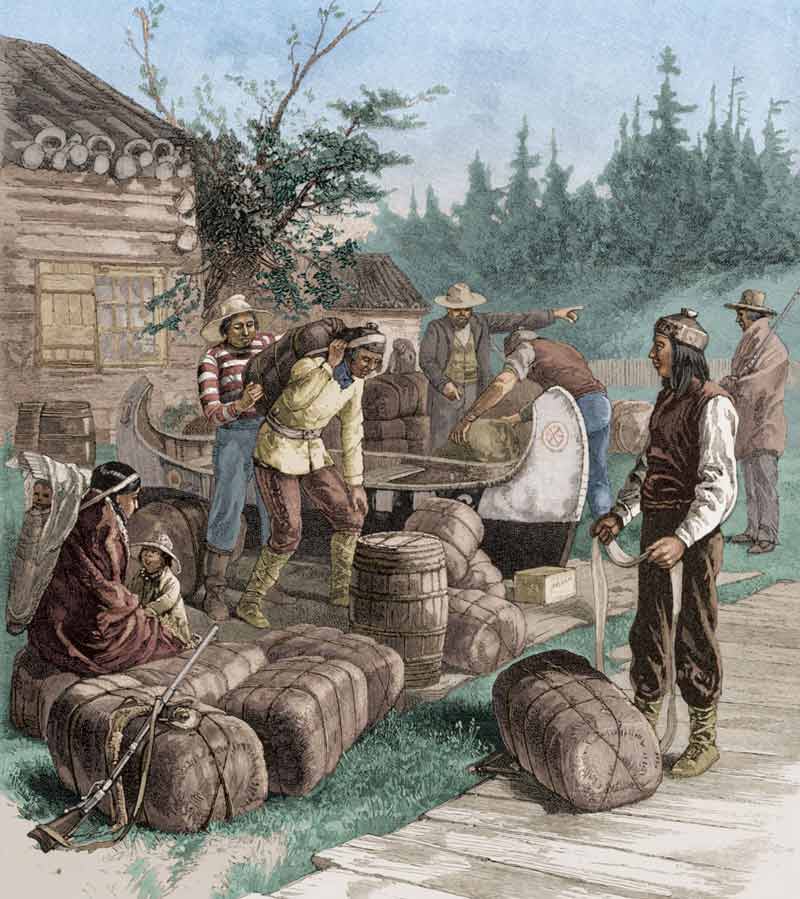
An artist depicts Indigenous Peoples trading goods at a Hudson’s Bay Company post. [LAC/3019061]
At the centre of this struggle were the First Nations—Blackfoot, Cree, Ojibwe and others—who trapped and supplied the furs in return for valuable trade goods including axes, sewing needles, guns and liquor. These commercial relationships forever disfigured the fortunes of the Indigenous Peoples of the West, most obviously via the unceasing volumes of alcohol shamelessly funneled into the region as a weapon of corporate warfare—each company using booze to entice trade.
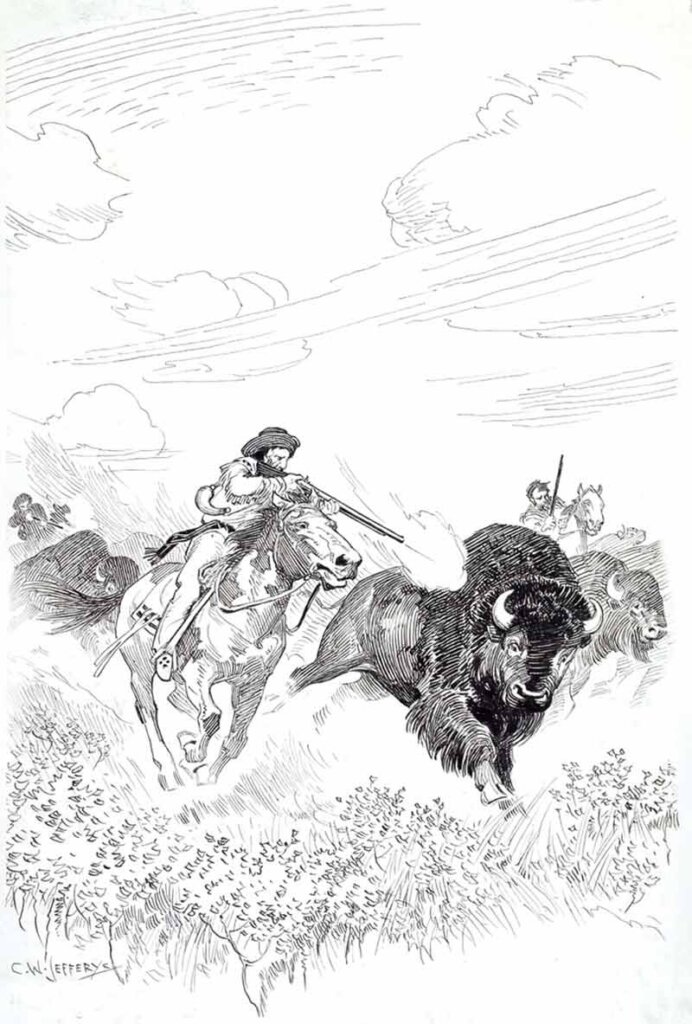
Also at the heart of the contest were the Métis, the offspring born across centuries of primarily French, English and Scottish fur traders and their Indigenous country wives. On the Prairies, the Métis had forged their own distinct economy and culture, primarily as buffalo hunters who served as an essential link in supplying the fuel—pemmican—that sustained the canoe brigades on their long, mosquito-plagued journeys transporting trade goods into the West and carrying furs out.
Journalist and fur trade chronicler Peter C. Newman has described the Pemmican War as “Canada’s first war of liberation.” The Métis of the West—feeling the first, populist stirrings of nationhood—fought not only to defend the North West Company, whose destiny was tied to theirs, but also to preserve the land and way of life they saw as threatened by encroachments of the Hudson’s Bay Company.
The HBC had been a powerful player in the North American fur trade since 1670, when the company was granted exclusive trading rights by the British crown over the enormous territory of Rupert’s Land, which covered all the watersheds draining into Hudson Bay (about one-third of modern-day Canada, plus parts of the American Midwest).
From faraway London, HBC governors conducted their business via a series of lonely outposts strung along the frozen shores of the company’s namesake bay. Cree traders brought furs to the posts, from which they were shipped to Britain to be made into felt hats for fashionable Europeans.
Meanwhile, a parallel but different system was developed by the French out of Montreal. Here, a multitude of small partnerships hired crews of voyageurs to trade with First Nations around the St. Lawrence valley and the Great Lakes. After the conquest of New France, this system became dominated by merchants from the U.S. colonies, England and Scotland, who in 1779 combined forces by forming the North West Company.
Unlike the stuffy and centralized HBC, whose agents in Canada were salaried servants, the free-wheeling NWC directors shared control of their enterprise with the men who led their canoe brigades ever farther west in search of new beaver supplies. These “wintering partners” participated in company decision-making and profit sharing. The Nor’Westers also encouraged inter-marriage between their traders and Indigenous women, a policy that cultivated not only stability among the labour force, but close ties with First Nations and Métis.
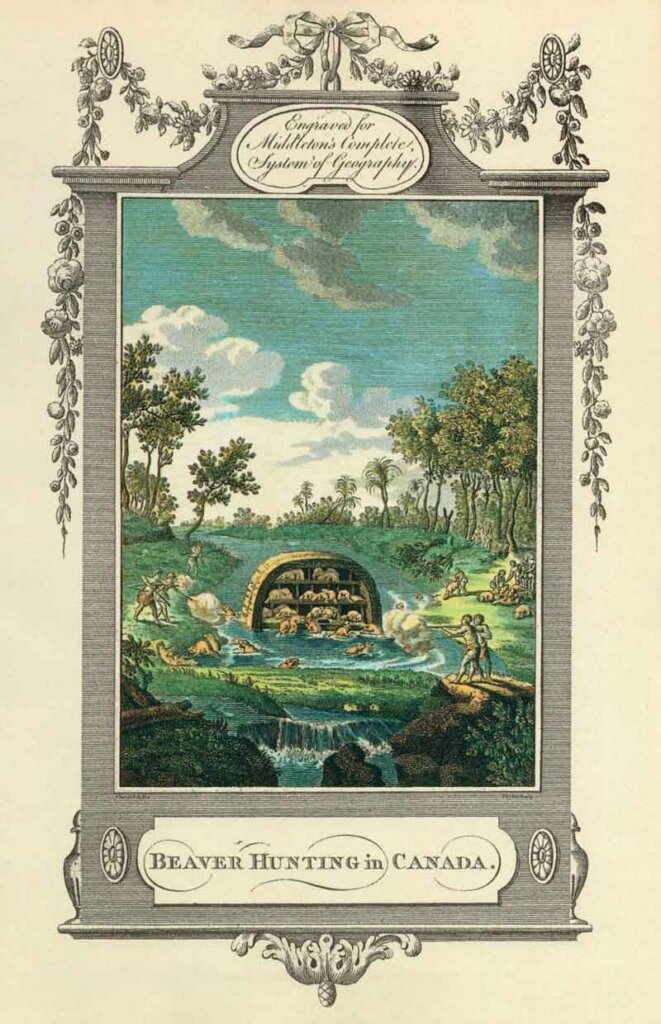
Beaver pelts were prized by settlers, who shipped them overseas to be made into felt hats for fashionable Europeans. [Archives of Manitoba/Wikimedia]
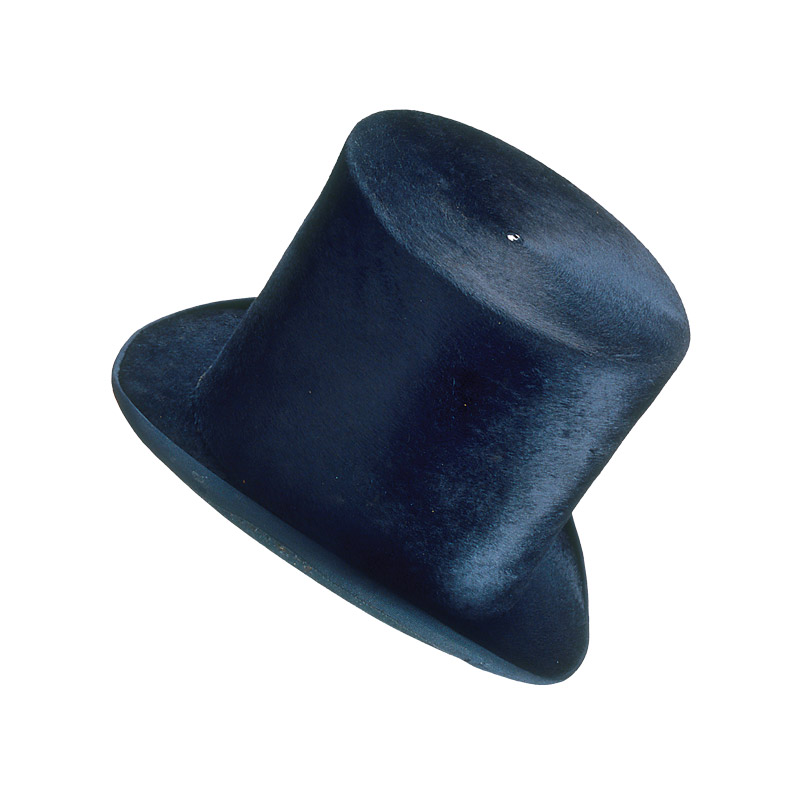
A felt hat. [Canadian Museum of History/980.10.26 a-b]
By the late 18th century, the NWC had pushed the boundaries of its trading grounds west of the Great Lakes to the rich fur-bearing forests around Lake Athabasca (straddling the northern reaches of today’s border between Alberta and Saskatchewan). It would eventually reach the Pacific, creating North America’s first transcontinental trading system. Each spring, a thousand birchbark canoes laden with goods would set out from Montreal for the long journey to Fort William, the bustling, palisaded Nor’Wester stronghold on the northwest shore of Lake Superior. There they would rendezvous with similar brigades bringing furs from the West. Cargos were exchanged, with trade goods paddled into the interior and furs to Montreal before winter.
The most prominent leaders among the NWC directors—“knights of the forest,” Newman has called them—were a handful of transplanted Scots, their growing wealth reflected in the lavish mansions they built for themselves in Montreal.
Their increasing dominance over the fur trade eventually woke the London governors of the Hudson’s Bay Company from their competitive slumber. By the turn of the century, the HBC was also sending its own trading parties west from its shipping depots on Hudson Bay, determined to protect its interior fur supplies and meet the commercial threat posed by the Nor’Westers.
The result was cutthroat competition in the forests, and soon, an explosion of violence across the northwest.
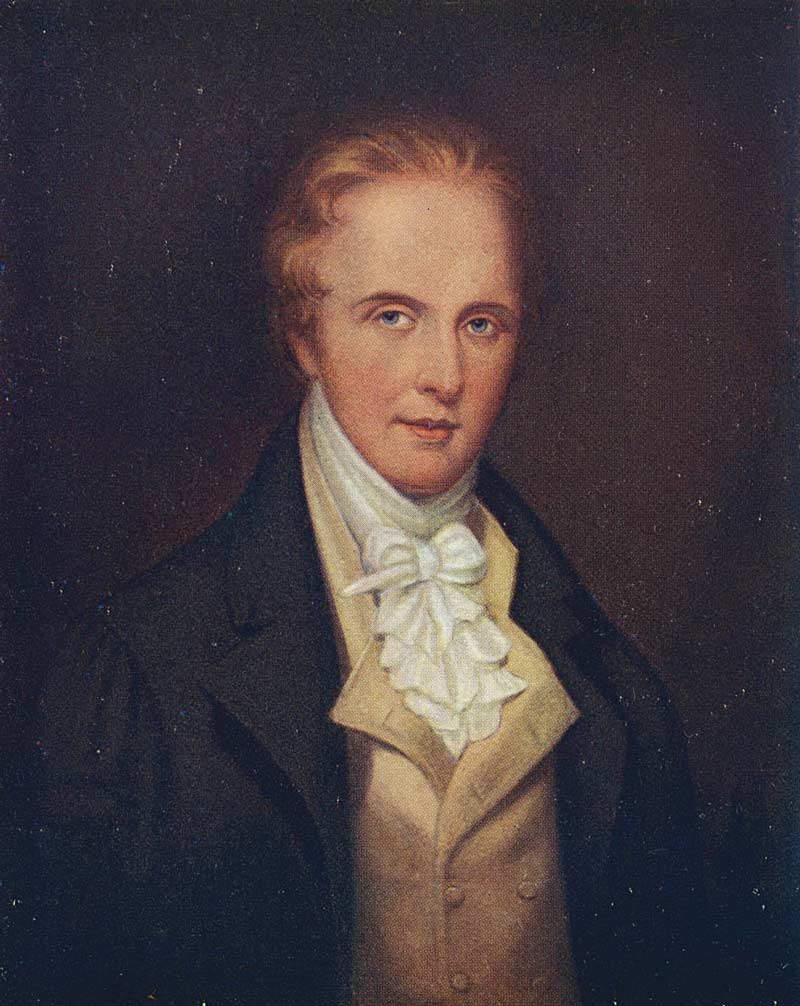
Thomas Douglas, the 5th Earl of Selkirk, helped establish the Assiniboia colony starting in 1811. [Wikimedia]
Thomas Douglas, the 5th Earl of Selkirk, considered it his mission in life to alleviate the suffering of the starving Scottish peasants who had been evicted from their tenant farms during the Highland clearances of the
18th century. A wealthy Scottish aristocrat, Selkirk organized a series of privately funded emigration projects to relocate displaced Highlanders across various parts of the British Empire.
In 1811, he acquired from the HBC a land grant of 300,000 square kilometres—across parts of present-day Saskatchewan, Manitoba, Ontario, North Dakota and Minnesota. It was five times the size of Scotland. Without asking any of the Indigenous Peoples already living there, Selkirk began recruiting Scottish settlers to develop an agricultural colony he called Assiniboia.
The grant was made possible when Selkirk, through a series of Hudson’s Bay Company stock purchases and personal alliances, gained effective control over the company’s governing committee. The other HBC governors, while amused by Selkirk’s do-gooder desires, could see the practical advantages of an inland colony: it would provide needed supplies of labour and food to support HBC efforts to reinforce its trade networks in the interior.
Selkirk would have a home for his dispossessed Highlanders, while the company would plant a flag in the heart of fur country and strike a competitive blow against the pesky Nor’Westers.
For the HBC governors, it was all the better that a half-dozen of the North West Company’s most important trading posts were located in the new colony, and that its boundaries included the Red River basin, a critical network used by NWC canoe brigades to bring furs from the interior to Fort William. Although butting heads with the NWC wasn’t Selkirk’s own purpose, conflict seemed an inevitable outcome.
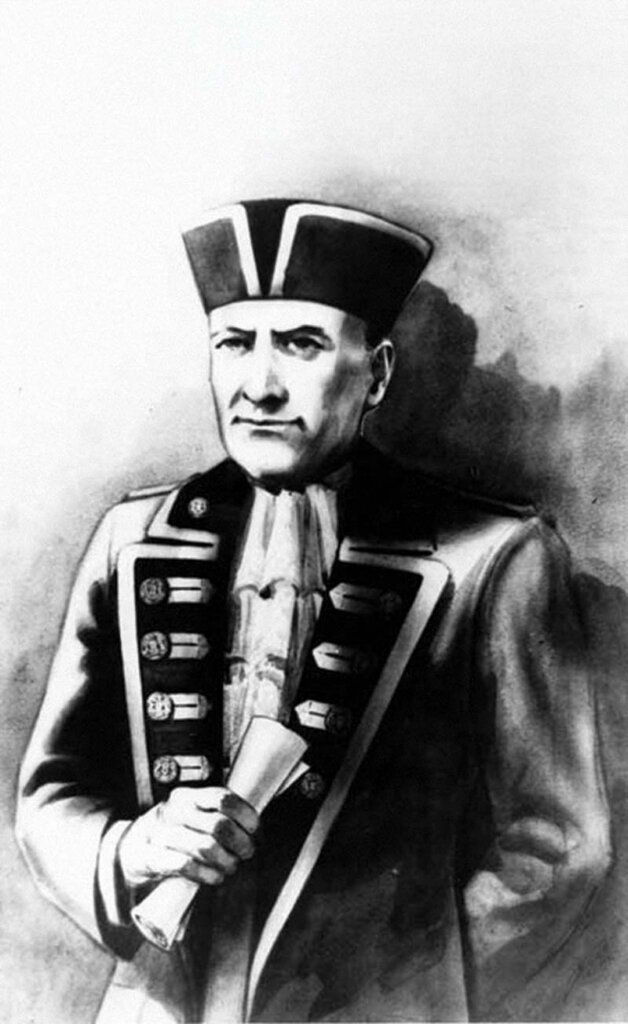
The Assiniboia colony was under the leadership of Miles Macdonell. [Manitoba Historical Society Archives]
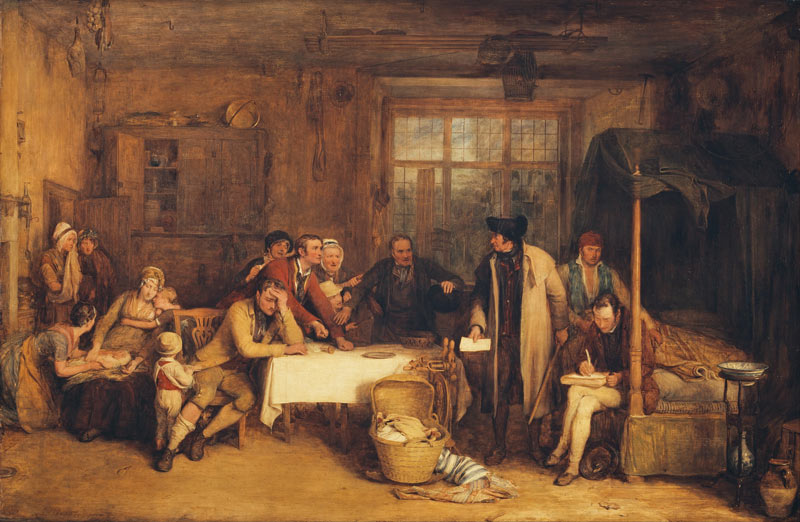
An artist depicts Scottish peasants being evicted from their tenant farms during the Highland clearances of the 18th century, some of whom immigrated to the new colony. [David Wilkie/National Galleries of Scotland/Wikimedia]
The first group of settlers left Scotland in summer 1811. After a harrowing transatlantic passage and a hard winter near the coast of Hudson Bay, about 20 Highlanders arrived in Assiniboia under the leadership of Miles Macdonell. He had been hired by Selkirk to prepare the colony for settlement. Specifically, they put down roots near the junction of the Red and Assiniboine rivers (present-day downtown Winnipeg), where the rival NWC already had a thriving trading post, Fort Gibraltar. Macdonell stationed his newcomers about a kilometre downstream on the west bank of the Red River and established Fort Douglas as the colony’s headquarters.
During the next several years, successive waves totalling close to 300 Highland settlers arrived in Assiniboia, better known as the Red River Colony. The families who braved the journey and struggled to cultivate crops while scratching out a life on the raw prairie—McKays, McLeods, McPhersons, McKinnons and others—were initially tolerated and even assisted by the NWC traders at Fort Gibraltar, as well as by the local Saulteaux, who helped them survive the freezing prairie winters.
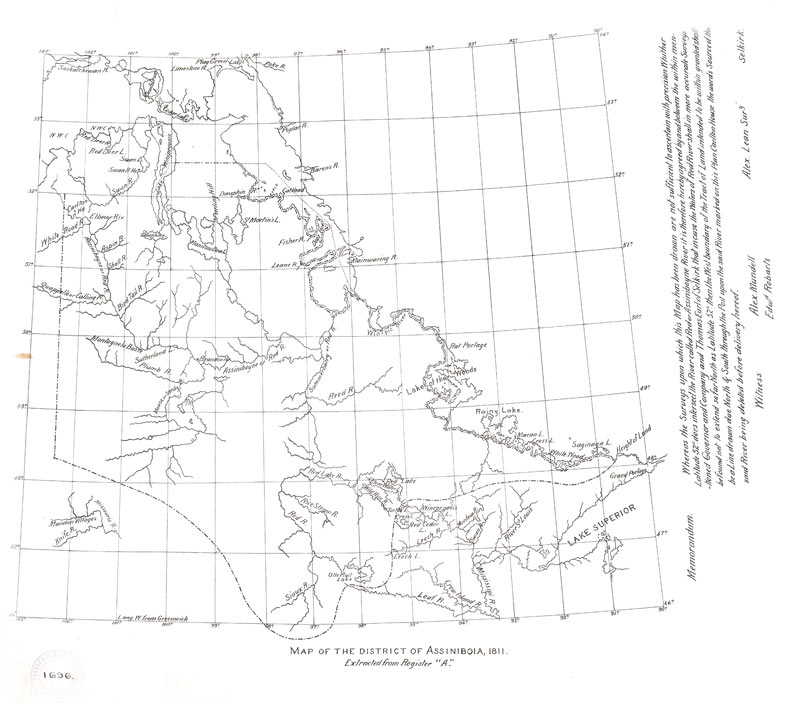
An 1811 map of the Assiniboia area. [Digital Archive Ontario/912-7126-M127]
It was a different story for many of the Métis, who had much earlier settled the Red River valley and developed a distinct identity and economy supplying pemmican to the Nor’Westers. In particular, the Métis objected to the farm plots the Highlanders laid out for themselves on the banks of the river. As the journalist Newman explained it in Caesars of the Wilderness, his magisterial 1987 history of the North West Company, the Métis hunter-warriors viewed the Scottish farmers as alien trespassers.
“Here was a group of cast-offs from another continent insisting they had been granted title to the very land the Métis claimed by right of occupation—not to mention descent from Cree and Saulteaux ancestors who had been its original inhabitants,” wrote Newman.
By winter 1814, it was clear the settlement still lacked the means to feed itself, having failed to grow enough crops the previous summer. If not for meat provided by sympathetic Saulteaux and pemmican purchased from the NWC, the colonists would have starved. This prompted Macdonell to issue a series of ill-fated orders—ostensibly to protect food supplies for settlers, but also aimed squarely at disrupting the NWC’s operations.
The first was a sweeping ban on exports of all food provisions, including pemmican, from the colony. Huge quantities of locally produced pemmican were distributed by Red River Métis each year to NWC trading posts across the northwest.
“From the point of view of the Nor’Westers and the Métis, the ‘pemmican proclamation,’ as it came to be known, was an open declaration of war,” wrote Winnipeg historian Herbert Mays in the Dictionary of Canadian Biography.
“From the point of view of the Nor’Westers and the Métis, the ‘pemmican proclamation,’ as it came to be known, was an open declaration of war.”
Macdonell followed with further provocations: He banned the hunting of buffalo from horseback within the colony and stationed HBC “constables” along the Red River, supported by artillery, to intercept supplies of pemmican coming downriver—and hundreds of bags were confiscated and placed under armed guard at Fort Douglas.
Finally, Macdonell sent notices to all NWC forts within the colony’s boundaries, ordering them to evacuate their posts within six months.
The incensed Nor’West directors, gathering for their annual meeting at Fort William, decided the Red River Settlement had to go. They made plans to arrest Macdonell, mount a campaign to entice the colonists to leave and, if all else failed, incite the Métis into armed resistance against the settlement and its sponsor, the HBC.
During spring and winter 1815, this campaign was carried out by NWC partner Duncan Cameron, aided by a posse of Métis horsemen led by Cuthbert Grant. The two men visited the Red River settlers and persuaded them to leave the colony with the offer of free transport and land available in Upper and Lower Canada. Those promises were followed by menacing nighttime raids by Métis riders, firing into the air, trampling crops and burning houses.
By the end of the summer, all but 13 families had fled the settlement. Hoping to avert an escalation of violence, Macdonell surrendered himself to Cameron at Fort Gibraltar, the NWC base, and was escorted to Montreal to face trial for the alleged “crime” of confiscating pemmican. The remaining settlers soon drifted away, leaving homes and crops in the ground to be further vandalized by the Métis.
“The amalgamation brought peace to the Canadian fur trade, and an end to the swashbuckling days of the Nor’Westers.”
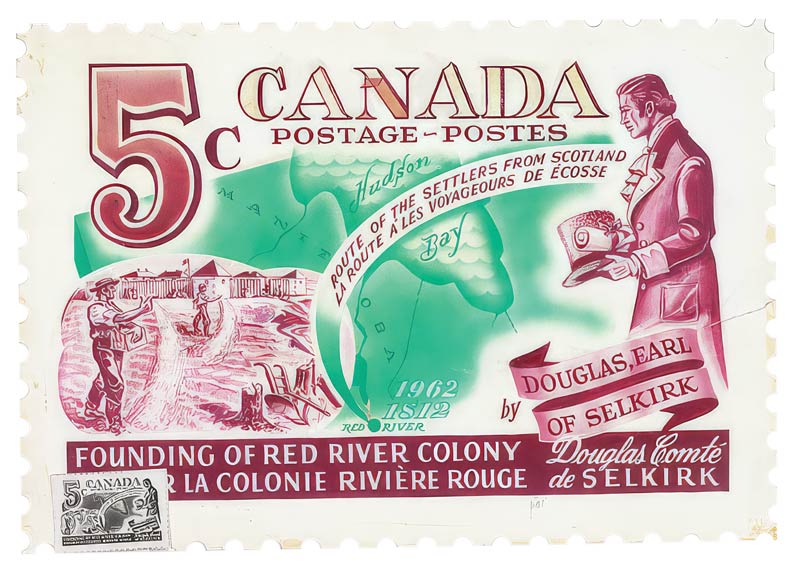
A stamp commemorating the founding of Assiniboia, now more commonly known as the Red River Colony. [LAC/Canada Post/2264703]
That autumn, the HBC hit back. It sent additional settlers to the Red River under the command of Robert Semple, the newly appointed governor of not only the colony, but all of Rupert’s Land—proof to the Nor’Westers that Selkirk’s settlement was simply a tool of the HBC. As tensions continued to rise, Semple and other HBC agents attacked and captured Fort Gibraltar and took Cameron prisoner. Semple soon ordered the fort demolished and set ablaze.
For the Métis, “the sight of the great fort in flames was too much,” wrote historian Marjorie Wilkins Campbell in The North West Company. “Like a prairie fire, news of the destruction of Fort Gibraltar raced from post to post, and from camp to camp wherever Métis and Indians gathered to hunt buffalo. The ancient war spirit of their Indian mothers, augmented by many a strain of fighting French and Highland Scots paternity, urged them to defend their existence.”
In response, Grant and his band of 60-odd Métis riders plundered the HBC trading post at nearby Brandon, then set out to run the blockade on the Red River, intending to transport pemmican downriver and out of the colony in defiance of the export prohibition. They were intercepted by Semple’s party at Seven Oaks, most of whom soon lay dead on the grass below the trees. The HBC base at Fort Douglas would also fall into Nor’Wester hands, with settlers abandoning the colony once again.
Before this, the so-called Pemmican War had been a series of minor skirmishes, arrests and angry words between two rival enterprises. The killings at Seven Oaks transformed the conflict into open warfare. At stake: nothing less than supremacy over the northwest.
Earlier that spring, Selkirk had set out from Montreal with a flotilla of canoes that included a regiment of Swiss and German mercenaries, determined to reach, restore and protect the Red River Settlement from the depredations of the NWC. En route, he was shocked to learn about the deaths at Seven Oaks and the capture of Fort Douglas.
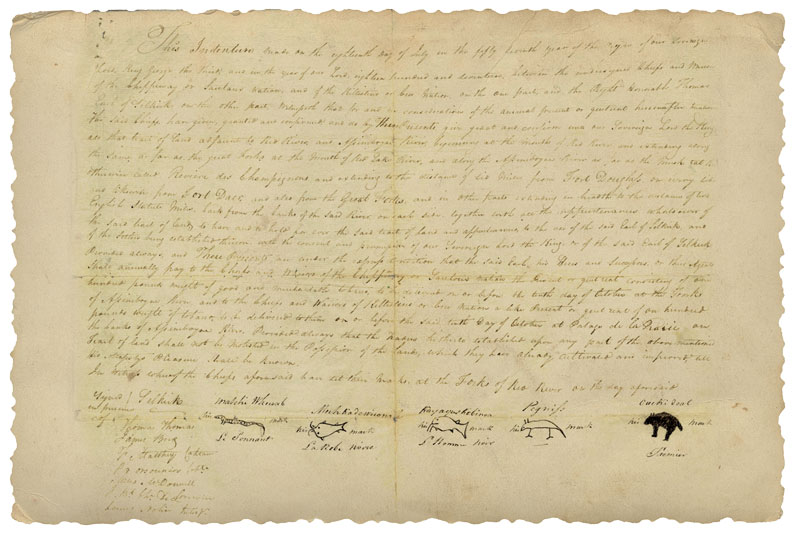
The 1817 Selkirk Treaty [LAC/3972577]
Although sick with tuberculosis, Selkirk immediately set a new course for the NWC stronghold of Fort William on Lake Superior. Arriving in August, his armed force captured the fort, impounded its stock of furs and “arrested” about a dozen astonished NWC partners who happened to be in residence. The partners were placed in canoes as prisoners and sent back to Montreal to face trial for the NWC-instigated killings at Seven Oaks (some drowned on Lake Superior during the journey).
After wintering at Fort William, Selkirk’s party reached the Red River in spring 1817. His mercenaries recaptured Fort Douglas from the NWC during a surprise night assault, and Selkirk spent the summer trying to restore faith in the colony and convince some of its scattered settlers to return.
The turmoil then moved north to the rivers and forests around Lake Athabasca, the wild, fur-rich domain Nor’Westers had once controlled. Newly established HBC posts in the area created heated competition. For several years, agents and allies of both companies attacked each other’s forts, ambushed rival canoe brigades, and seized and imprisoned senior traders and officials at gunpoint.
With the northwest deteriorating into chaos, the governor of Lower Canada appointed a commission to investigate the causes of the violence and to “quiet the existing disturbances.” Commission members journeyed west in 1817, armed with a detachment of government troops and an official letter from Lord Bathurst, the British colonial secretary, ordering the end of hostilities, the restitution of seized property by all sides and, most notably, the arrest of Selkirk, for his allegedly illegal occupation of Fort William.
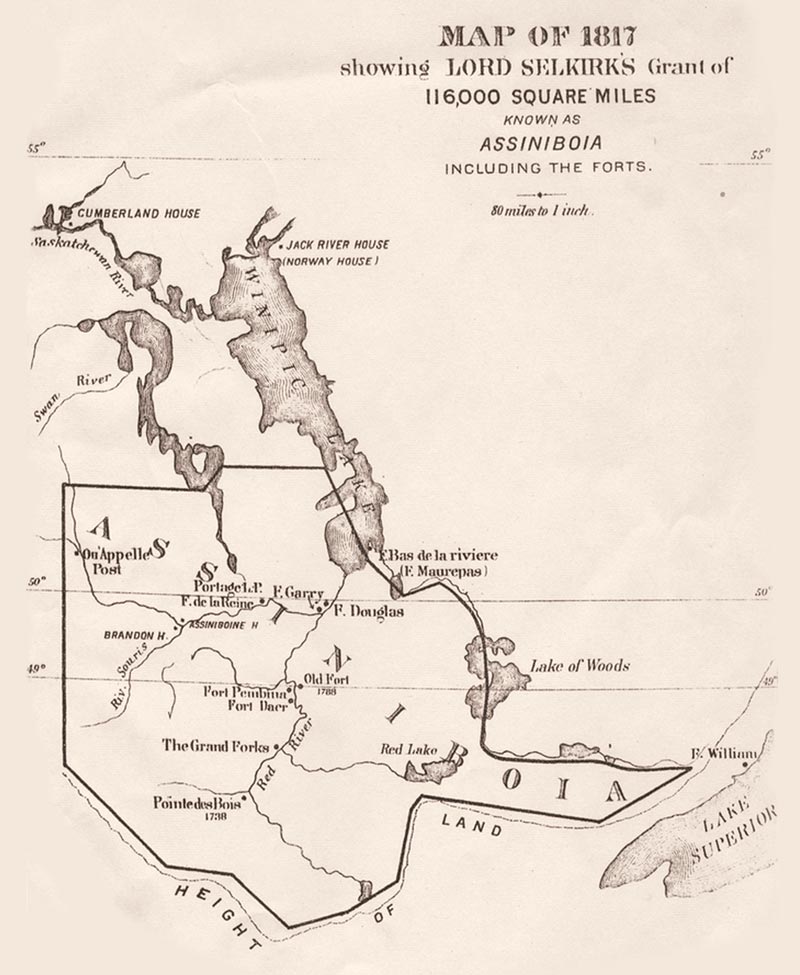
An 1817 map of Selkirk’s land holding. [Wikimedia]
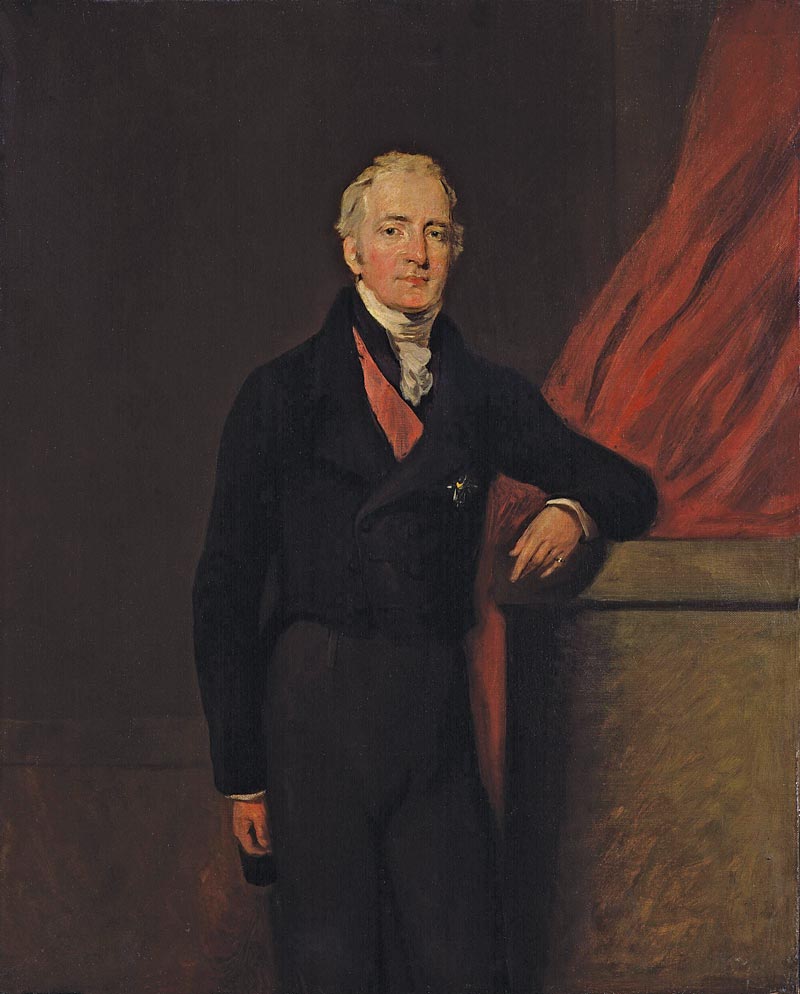
That year, Lord Bathurst, the British colonial secretary, ordered the end of hostilities. [U.K. National Portrait Gallery/Wikimedia]
The commission’s report, tabled the next year in the British Parliament, cast doubt on the legality of the Red River Settlement and sympathized with the Nor’Wester’s claims about the threat the colony posed to its fur trade operations. It also, however, condemned the “system of intimidation and violence” the NWC had used to protect its interests. Although the report had little practical effect on the conflict, its conciliatory approach may have encouraged the companies to seek a surprising détente.
The commission’s position—combined with cash flow problems plaguing the NWC due to the fierce HBC competition for Athabasca furs, and the realization on all sides that the war was at an impasse—prompted the start of negotiations
in London about a corporate merger. Discussions also unfolded amid pressure from the British government, which wanted a single, financially sound organization to exert British influence across the North American continent.
In 1821, the rivals agreed to end their feud via a “merger,” which was in fact a takeover by the HBC, advantaged as it was with deeper pockets and greater political influence in London. The amalgamation brought peace to the Canadian fur trade, and an end to the swashbuckling days of the Nor’Westers—“that defiant alliance of voyageurs and Highlanders,” wrote Newman, “whose audacity had established Canada’s first indigenous national enterprise…. They had set down the matrix of a country and had been its uncrowned rulers.”
No one at Seven Oaks was convicted for their role in the massacre. Many of the Métis riders present that day were soon killed themselves in various circumstances—one was gored to death in a buffalo hunt; another was skewered by a wooden stake as he jumped from a haystack; yet another was thrown into a fire during a squabble with companions.
Cuthbert Grant and his lieutenant François Boucher were both arrested and taken to Montreal to face murder charges. Grant jumped bail and escaped by canoe back to the northwest. After Boucher was acquitted, the charges against Grant were shelved. In the years following the HBC’s takeover of the NWC, Grant transferred his loyalties and served as a paid HBC special constable and, later, as the company’s “warden of the plains of Red River.”
Selkirk, meanwhile, had returned to Montreal to fight the criminal charges laid against him in the wake of the commission. He became enmeshed in a years-long legal struggle to clear his name. Weakened by tuberculosis, he eventually left Canada and retired to France in search of a healthier climate. He died there in 1820—a year before the rivals amalgamated—denied the satisfaction of seeing his NWC foes vanquished by the HBC.
Selkirk left behind a bankrupt estate, and the unfulfilled dreams of a fledgling colony still struggling for survival on the banks of the Red River.
Advertisement