


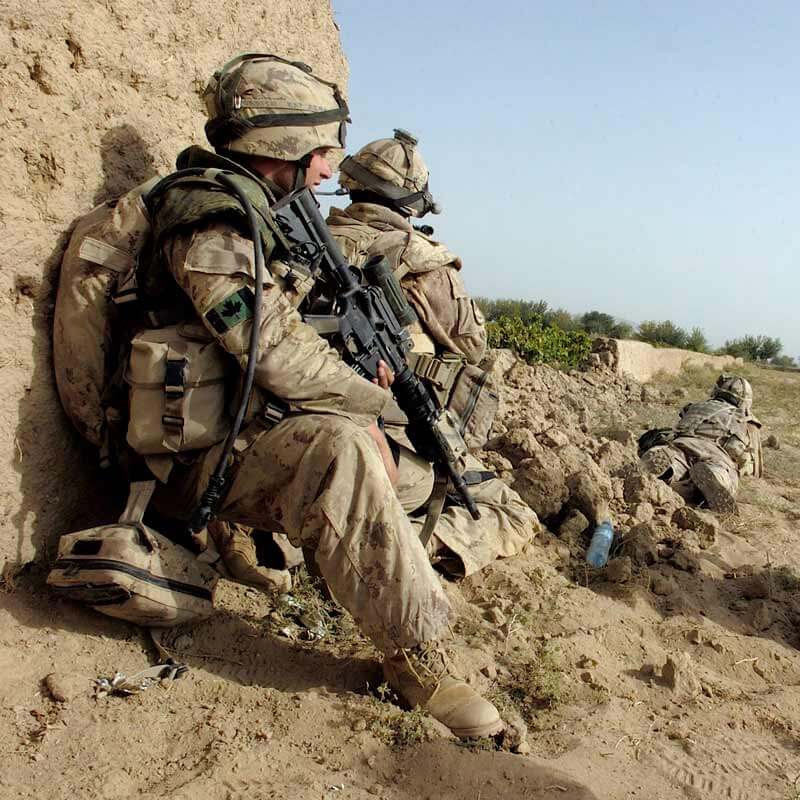
Members of 2 Platoon, Bravo Company, 1 RCR, prepare to storm a compound during Operation Medusa near Kandahar on Sept. 4, 2006. [MCpl Yves Gemus/DND]
A retired colonel, Gasparotto led 23 Field Squadron, a combat engineer unit of the 1st Battalion, Royal Canadian Regiment Battle Group, during some of the toughest fighting in Kandahar province in 2006.
Of the 135 troops under his command, one member, Sergeant Shane Stachnik, was killed in action (one of 19 members of 1 RCR Battle Group killed by the enemy in Afghanistan). Seven other soldiers with 23 Field Squadron were severely wounded and repatriated to Canada. Dozens of others returned home after the mission with post-traumatic stress, two of whom have since died by suicide.
“I was nearly killed six times,” wrote Gasparotto in a recent brief to the Senate, “surviving an IED [improvised explosive device] strike, a mortar round landing three metres away, a rocket propelled grenade flying by my head, and an A-10 [attack aircraft] friendly-fire incident.”
Gasparotto submitted his written testimony to the Senate as part of its recent hearings on Bill S-246, the Wartime Service Recognition Act, a private member’s bill aimed at changing the way Canada designates the service of veterans on foreign missions.
The bill, championed by Ontario Senator Hassan Yussuff, was passed unanimously by the Senate earlier this month and is now in front of the House of Commons. If it becomes law—a long shot for most private members’ bills—it will resolve a longstanding irritant among Canada’s modern veterans, many of whom want Ottawa to change the way it classifies their service.
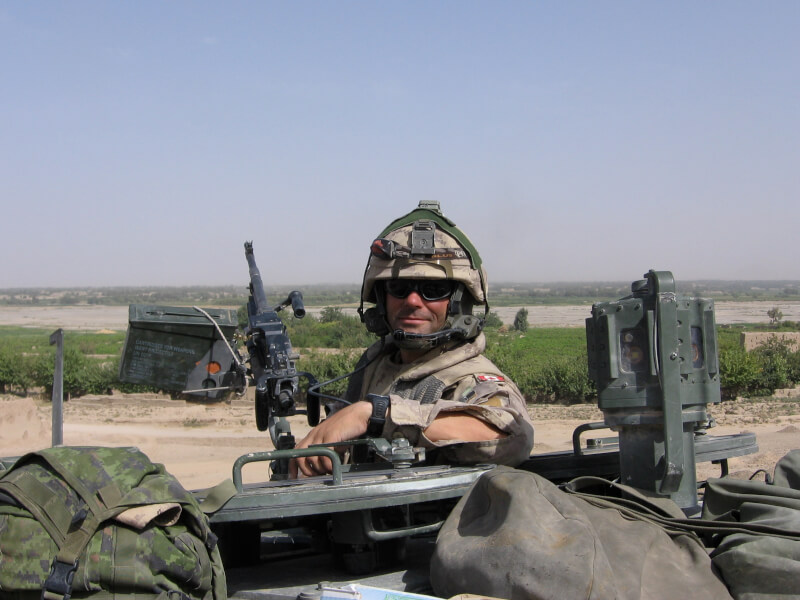
Mark Gasparotto, then the commander of 23 Field Squadron, combat engineers, in Afghanistan in 2006. [Courtesy Mark Gasparotto]
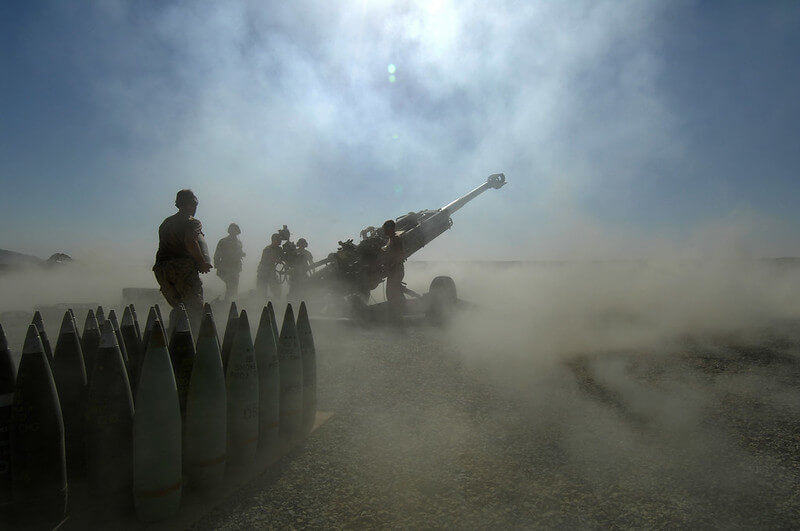
Gunners from X Battery, 5e Régiment d’artillerie Légère du Canada (5 RALC) at Patrol Base Wilson, conduct a fire mission to support coalition forces who have located a Taliban position in Afghanistan. [DND IS2007-0467]
That means, for example, that the federal government does not officially consider the 1990s United Nations missions in the Balkans, where Canadian troops faced numerous threats in an active war zone, or even Afghanistan, where 158 soldiers died and many more were wounded, to have been wars. Nor does it designate the Canadians who served in those wars to be war veterans.
The same is true for Canadian veterans of the 1990-1991 Persian Gulf War, and of the UN missions in Rwanda, before and after the 1994 genocide.
“This is not right,” said Harold Davis, who served as a weapons technician, arming helicopters flying off the deck of HMCS Athabaskan during the destroyer’s deployment in the Persian Gulf War. He is now president of Persian Gulf Veterans of Canada, an association that has been leading efforts to change the law for more than a decade.
“Every time something happens—Afghanistan, Rwanda, the former Yugoslavia—we’ve got to fight to be recognized for what we did,” Davis told Legion Magazine. “We didn’t go over to these places to hand out candy.”
Nothing in the proposed legislation would alter the financial or medical benefits currently available to post-Korean War veterans under the existing Veterans Well-Being Act. The change in how service is described would be purely symbolic.
The bill would require Ottawa to formally review all military operations since the Korean War according to four criteria: the level of risk faced by veterans during their service; the “nature, rhythm, duration, scale and intensity” of the operation; exposure to potential physical or psychological injury; and the existence of an armed conflict in the geographic location of the operation.
“Every time something happens—Afghanistan, Rwanda, the former Yugoslavia—we’ve got to fight to be recognized for what we did,” Davis told Legion Magazine. “We didn’t go over to these places to hand out candy.”
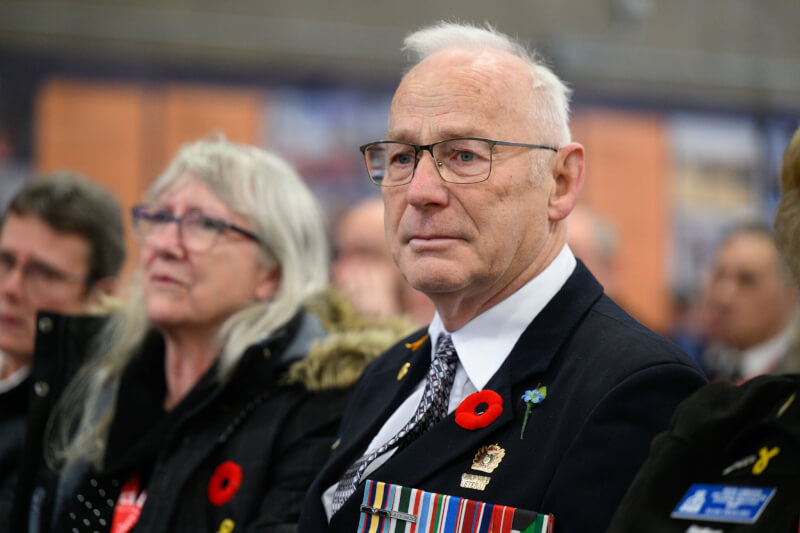
Harold Davis, president of Persian Gulf Veterans of Canada, attends Persian Gulf War commemoration events in Halifax on Feb. 25-March 1, 2026. [VAC]
Veterans of operations that meet the criteria would be deemed to have “wartime service.” For such missions, the bill would also require the government to take “measures to recognize non-Canadian Armed Forces personnel who have served alongside or in support of a Canadian Armed Forces operation.”
The criteria do not guarantee that every overseas mission would qualify for the updated designation.
Gasparotto, who was posted to Bosnia in 2001 prior to his deployment to Afghanistan, does not consider his experience there as wartime service, given that the mission mostly entailed the enforcement of political agreements and dealing with organized crime. However, he believes that earlier missions to the same region in the 1990s, when war was still raging across the Balkans, would likely qualify.
Yussuff says the legislation would bring Canada in line with the U.K., Australia and the U.S., all of which have similar laws to determine if military missions qualify as wartime service.
Prime Minister Mark Carney promised during the 2025 election campaign to review how Canada recognizes wartime service, however that pledge remains unfulfilled. Yussuff, who sits in the Senate as an independent, told Legion Magazine that he has received no official support for his bill from the Liberal government. Still, he is hopeful the House of Commons will take up the legislation and possibly pass it after the summer recess.
“Time is of the essence,” he said. “Every day, a veteran passes away. It’s sad that someone would die and not get the recognition they and their family deserve. Every day we wait is a day too long.”
Why would a purely symbolic measure be so important to many veterans?
“It’s about mental health,” said Davis. “[Being called a war veteran] will help me stand a little prouder when I’m out on parade. I got called to do what my country asked me to do, but they don’t want to tell me that I did it.”
“Time is of the essence,” he said. “Every day, a veteran passes away. It’s sad that someone would die and not get the recognition they and their family deserve. Every day we wait is a day too long.”
Davis said he knows some Persian Gulf veterans today who refuse to wear their medals.
“They think, ‘Why should I turn around and advertise for the military—to show other Canadians they should put on the uniform and defend their country—when the country won’t even recognize what [I] did?’”
Gasparotto says changing how the government labels his own service in Afghanistan won’t impact him personally.
“I know what we did,” he said. “The naming of it doesn’t factor into my individual journey of recovery. But I believe it does for others.”
He repeated Napoleon’s famous reminder about the sacrifice soldiers make in return for “a bit of coloured ribbon”—in other words, for recognition.
“We should be honest about the words and terms we use,” said Gasparotto. “From an emotional and symbolic perspective, what we had to endure and sacrifice for in Afghanistan cannot be called anything other than wartime service.”
Advertisement



Having been a member of the Legion for approximately 50yrs first the British and currently the Canadian I’ve seen a lot of changes over the years, I do have my opinions but I don’t usually put them in writing, The article war is war I strongly agree with in fact my personal opinion is that all serving members I consider to be veterans even if they never were in a conflict because the moment they sign up they are giving permission to put their lives in danger and give up a lot, however at least the four main criteria proposed by Senator Hussan is a good base.