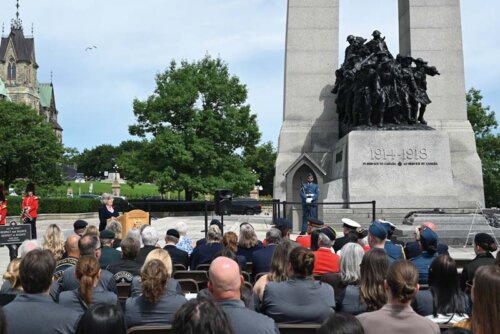





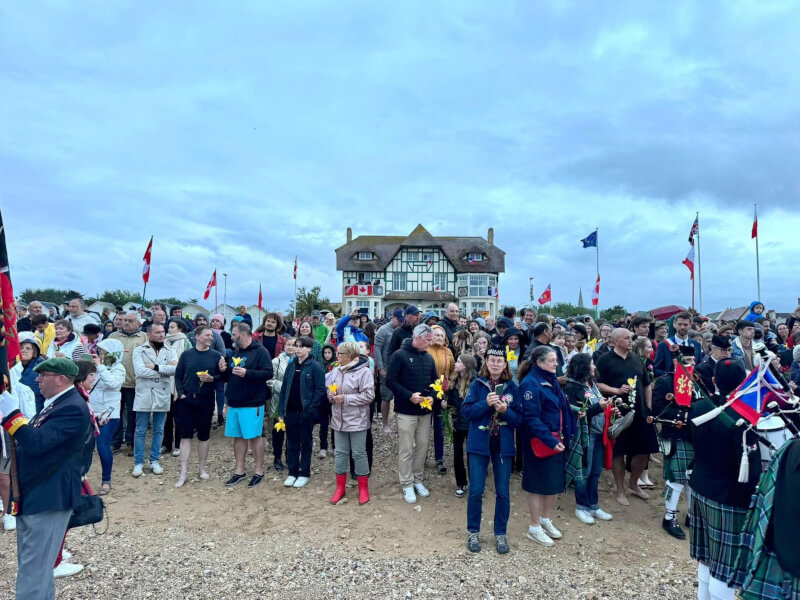
A commemorative event honouring Canadians’ role in D-Day held at La Maison des Canadiens in Bernières-sur Mer, France, is held each year on June 6. [Facebook.com/La Maison des Canadiens]
This will be the 10th year that Hoffer—who died suddenly in January 2017 at age 65—will not be present at the beautiful ceremony he conceived and came to embody decades ago.
Hoffer’s family owns the large, half-timbered house that stands prominently behind the old seawall in the Normandy village of Bernières-sur-Mer. Now known as La Maison des Canadiens—Canada House—it was one of the first French homes liberated by Allied forces on D-Day.
Every spring in the lead up to the D-Day anniversary, Hoffer would light a paraffin lantern on the balcony of his house. After twilight on June 6, he would carry the flickering lantern down to the beach, watched by solemn crowds and often serenaded by a bagpiper. Then he would wade up to his waist into the sea and set the lantern adrift on the English Channel.
Speaking in French, Hoffer called it “a symbolic gesture to the Canadians who came from the sea, to give us back our freedom.”
At the time of Hoffer’s death in 2017 (following a stroke) Clive Addy, a retired major-general and former president of the Canadian Battlefields Foundation, described Hoffer as “a hero to many Canadians … Hervé was absolutely dedicated to the idea of service to your country, the importance of democracy and the idea of education—especially educating young people about the war.”
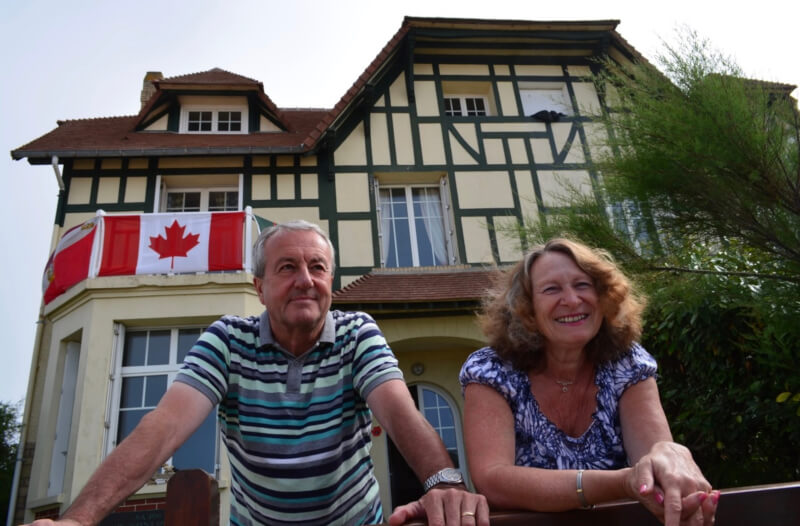
Hervé Hoffer and his wife Nicole Hoffer at their home in 2012. [Richard Foot]
The house is characteristic of the large holiday beach homes that were once common along the Normandy coast. While the Germans demolished many of them during the Second World War, the Hoffer house was spared after an officer evicted the Hoffers and installed himself there during the Nazi occupation.
Incredibly, the house also survived the bombardment of the Allied invasion in 1944. When Canadians landed on D-Day, German soldiers fired a machine gun at them from the home’s front porch. Black-and-white photos of the time show the house bruised and battered but still standing tall beyond the beach.
“This house was liberated at first light on D-Day, 6 June 1944, by the men of The Queen’s Own Rifles of Canada,” says a plaque in front of the house today. “Within sight of this house, over 100 men of The Queen’s Own Rifles were killed or wounded, in the first few minutes of the landings.”
“Within sight of this house, over 100 men of The Queen’s Own Rifles were killed or wounded, in the first few minutes of the landings.”
Remembrance of the war had waned in France by the time Hoffer and his wife Nicole inherited the house from his parents in the 1970s. However, starting in 1984—the 40th anniversary of D-Day—large numbers of Canadian veterans began coming back to Normandy for the first time.
Hoffer noticed the curious Canadians outside his house, pointing and taking pictures. He invited them inside, heard their stories and became aware that the home where he had spent his summers since childhood was the most historic building on Juno Beach.
This ignited a passion that would change Hoffer’s life and benefit Canadian remembrance in immeasurable ways. For three decades he welcomed veterans and other Canadian pilgrims into the house, making close contacts with members of the regiments that landed on D-Day, particularly The Queen’s Own Rifles of Toronto and Le Régiment de la Chaudière.
He amassed an impressive collection of wartime memorabilia—flags, regimental insignia, uniforms, maps and artifacts—which he and Nicole proudly displayed throughout their house, transforming it into more of a private museum than a family home.
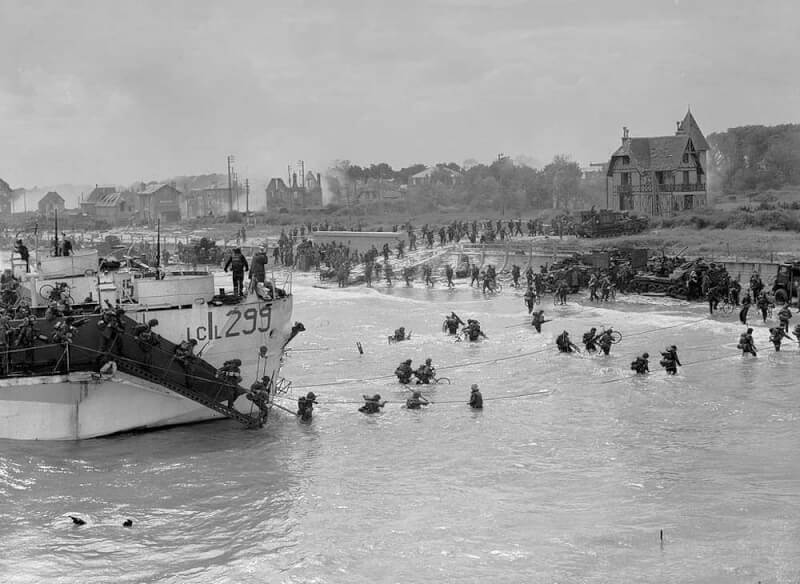
Troops of the 9th Canadian Infantry Brigade head ashore from Landing Craft, Infantry at Bernières-sur-Mer, France, on D-Day. [LAC/3408540]
Hoffer also made several trips to Canada, visiting veterans in hospital, and once bringing a group of French schoolchildren to tour the country.
But it was the warmth and generosity that he and Nicole showed the parade of tourists, school groups and veterans who came to their door—all of whom were invited inside if the Hoffers were home, to talk and perhaps share a beer or a sip of Calvados—that made Hervé the most beloved figure for Canadians on Juno Beach.
Rebecca Grimes, an Ontario teacher who made several trips to Normandy with students over the years, said Hoffer’s stories about what Canadians did for his family and his country brought the war to life in a way no history textbook ever could.
As Grimes once said: “The French talk about the ‘devoir de souvenir’—the responsibility to remember. He embodied this value.”
In 2022, the Canadian government recognized the Hoffers by awarding each of them (Hervé posthumously) the Meritorious Service Medal, one of Canada’s highest civilian decorations.
The heavy responsibility of looking after the house and its treasures has been maintained in the years since Hervé’s death by Nicole and L’Association la Maison des Canadiens, a small army of volunteers on both sides of the Atlantic led by president Gauthier Hebbelynck.
“In just a few short years, the association has evolved from a handful of individuals into a community of more than 150 devoted volunteers,” Hebbelynck told Legion Magazine. “Some dedicate themselves to preserving the house, others to welcoming and guiding the many visitors who come through each year.
“Visitor numbers have grown beyond anything we initially imagined. Today, several thousand people come each year. And on June 6 alone, up to 1,500 people gather with us.”
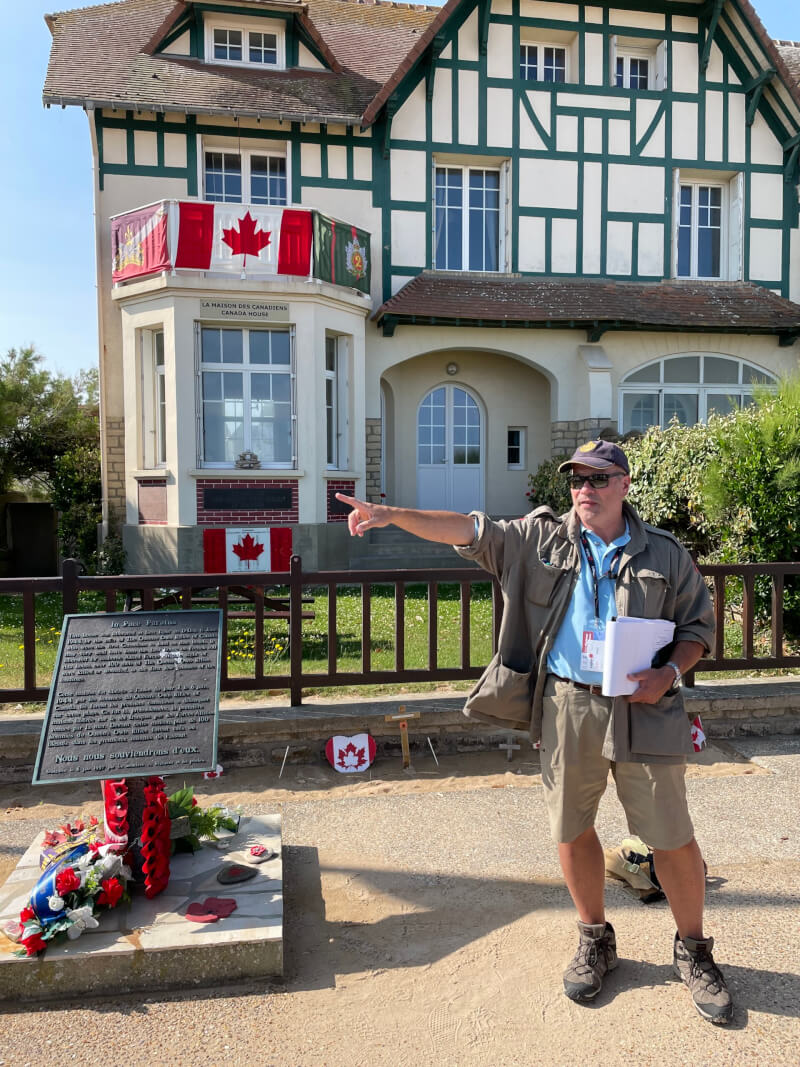
Canadian guide John Goheen explains the significance of the house during the 2023 Legion Pilgrimage of Remembrance. [Aaron Kylie/LM]
While preservation of the left side of the building is secure, the fate of the right-side is uncertain. Sold three years ago by the family that owned it, the right-hand unit in the duplex was acquired by a partnership of local municipal and regional authorities. Today it is empty, in need of care, its future unresolved.
“Perhaps one day The Queen’s Own Rifles—whose story is so closely bound to this place—may become involved [with the right side] in a shared commemorative project with the Hoffer family,” Hebbelynck said hopefully.
For now, the family and its supporters remain focused on continuing what Hervé started and nurtured. The lantern—lit and hung weeks ago from the balcony of the house—will be carried down to the beach on Sunday by a member of the Hoffer family.
“The lantern ceremony is, without question, a deeply moving experience,” says Hebbelynck. “Year after year the crowd grows, drawn by something that is difficult to describe but powerfully felt. A pipe band plays, musicians perform and, as night falls, the ceremony builds toward its final gesture.
“The light of that lantern represents freedom. It came to us by sea, brought by Canadian soldiers. In a final act of gratitude, we return it to the sea.”
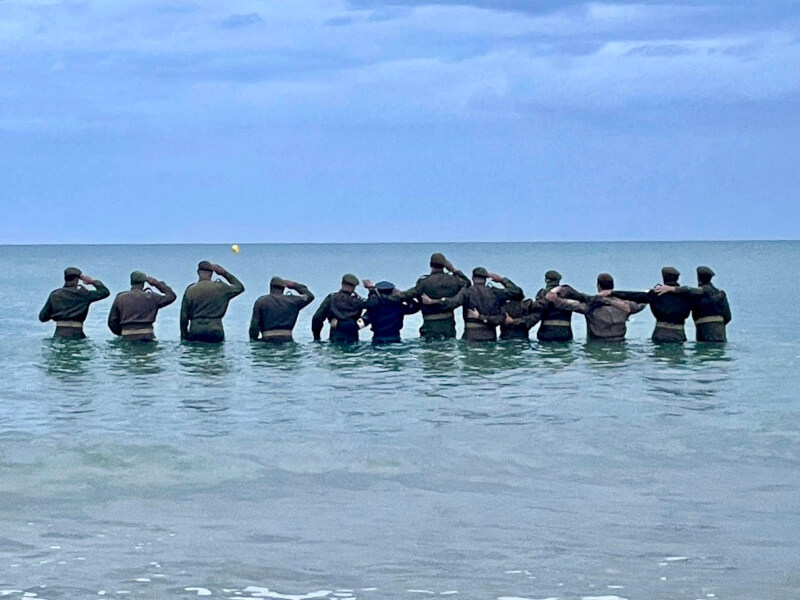
Canadian veterans watch the lantern float out to sea. [Facebook.com/La Maison des Canadiens]
Advertisement