

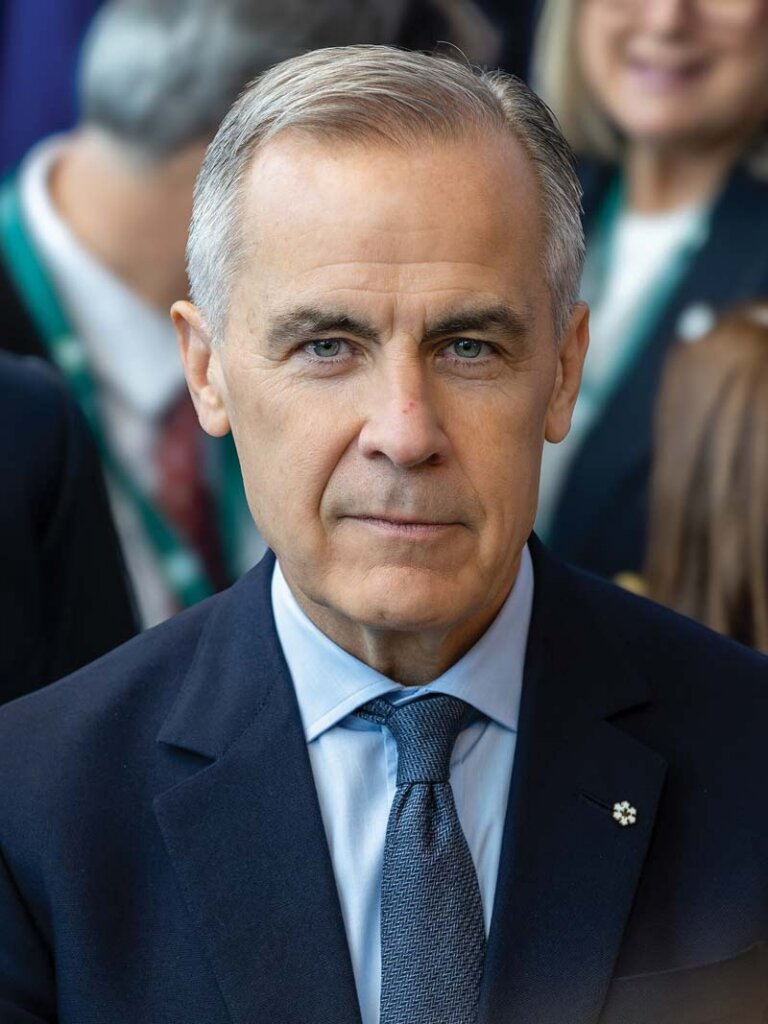
Prime Minister Mark Carney urged middle powers to unite during a speech earlier this year. [Wikimedia]
In a now-famous speech at the 56th World Economic Forum this past January, Prime Minister Mark Carney gave a stark warning to the world’s middle powers: “If we’re not at the table, we’re on the menu.”
The statement wasn’t without cause. With long-standing alliances faltering, economies buckling from geopolitical uncertainty and globalization seemingly at a nadir, the planet is in a precarious position. What then is the planet to do?
The Institute for Economics & Peace identifies the middle powers as 16 countries that, largely unable to independently shape major international outcomes, can still exercise meaningful regional influence through multilateral institutions and niche specializations. The middle powers include Australia, Belgium, Brazil, Canada, Indonesia, Israel, Mexico, Netherlands, Poland, Saudi Arabia, South Korea, Spain, Sweden, Turkey, Ukraine and the United Arab Emirates.
It was this group to which Carney presented a choice in his address: “negotiate bilaterally” with the superpowers, “compete with each other for favour” or follow Canada in choosing a third path of “genuine co-operation.”
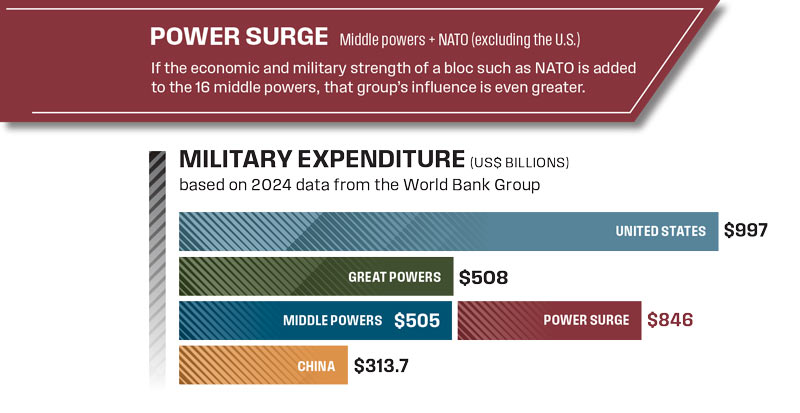
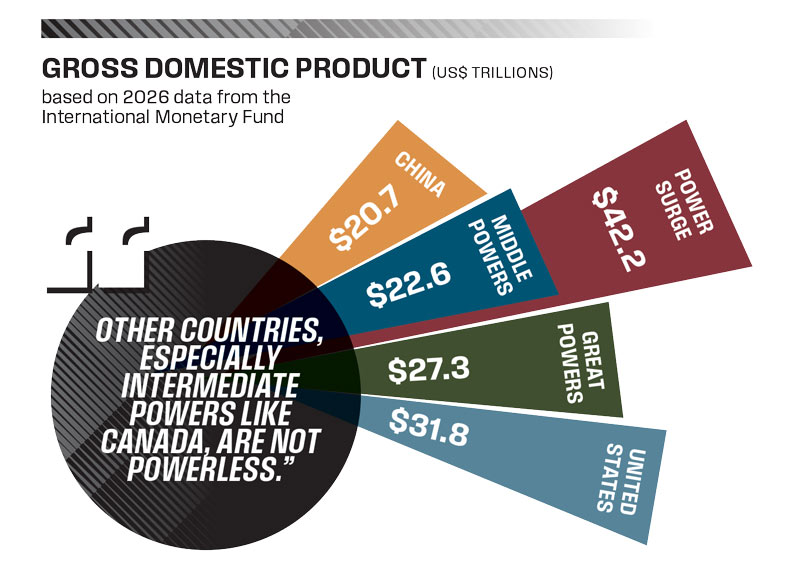
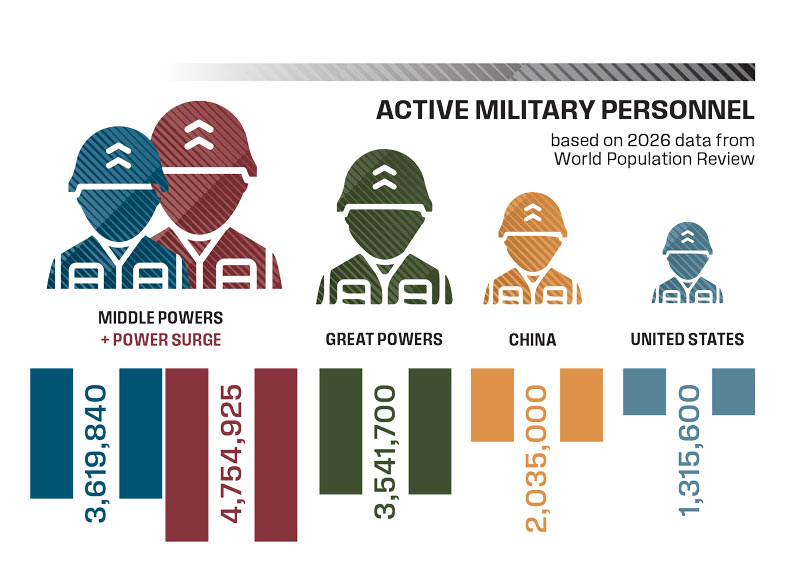
The U.S. and China stand alone today as global hegemons yet, when considered as a collective, the influence of middle powers begins to emerge. The graphics here compare the relative economic and military might of the middle powers to the superpowers and the so-called great powers
—Japan, Germany, India, the U.K., France, Italy and Russia.
“We are in the midst of a rupture, not a transition,” said Carney. The following shows the potential of challenging the divisions for those willing to take a seat.
Advertisement