

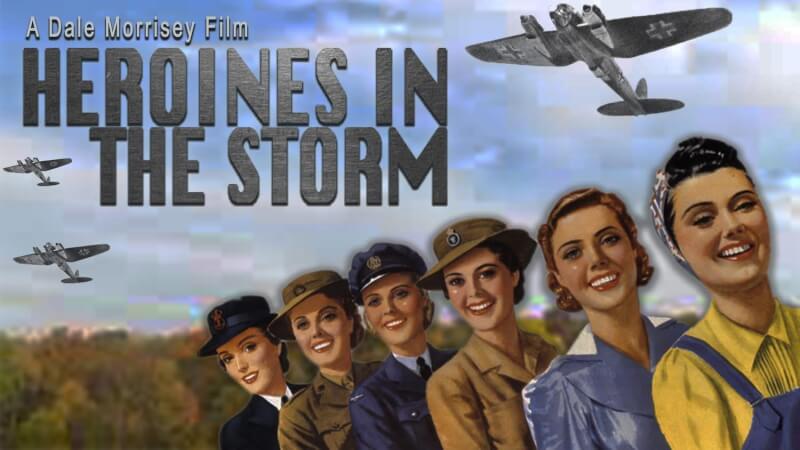
A promo screen for Dale Morrisey’s documentary film. [Wandering Journalist Productions]
“Time and money are the enemy of Canadian history documentaries,” remarked filmmaker Dale Morrisey, the founder of Wandering Journalist Productions. “You’re fighting to find that money, and you’re up against a loudly ticking clock.”
More than 80 years after the end of the Second World War, the urgency he describes has never been more apparent: “People you want to include in your stories are dying before you can get to them.”
Few doubt the increasing difficulty of preserving such voices, but in focusing on the fast-fading number of women who navigated the period—military veteran or otherwise—Morrisey confronted a struggle. Nevertheless, the Ontario-based producer has since overcome that hurdle with the release of his latest documentary, Heroines in the Storm.
In crafting the four-part series, now available via the U.S. Public Broadcast Service (PBS), Morrisey hopes that those who tune in will “view World War II through a different lens.” More than just retelling the stories of women who lived through the conflict, however, Heroines in the Storm seeks to offer an intimate portrait of individual exploits and experiences—often delivered from a distinctly Canadian perspective.
Morrisey spoke to Legion Magazine about his work.

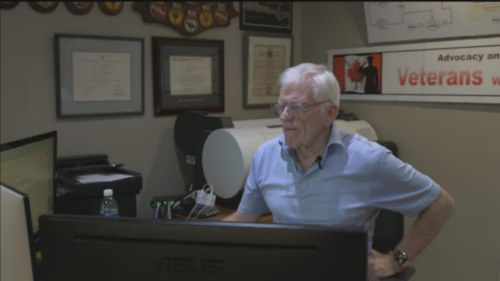
Filmmaker Dale Morrisey at work. [puckjunk.com]
On the project’s origins
What happened was, several years ago, local author Sherry Pringle published a book called Extraordinary Women, Extraordinary Times. It was basically a book with vignettes of women—all of whom were either Canadian at the time or became Canadian—who took part in World War II. It had everything from people in espionage to women who survived the Holocaust. It was all-encompassing.
I did a little video for her, and we struck up a friendship. She said to me, “I kind of want to do something with this,” and I said, “Why don’t we do a documentary?” So, we started work on it.
We quickly realized that we had a lot of stories, and that we were going to have trouble trying to squeeze all of that into an 85-minute film. Ultimately, we decided to break things up thematically and create a series.
On determining episode themes
We picked certain stories from the book where we could get someone to speak on camera—be it the person whose story it was, a family relative, or a historian.
It seemed to us that we’d broken it up into four pieces. There’s the secret war that takes place, where Churchill says they’re going to “set Europe ablaze,” and Bletchley Park is one of those stories.
There’s then a section about military service, where women join up in the women’s auxiliary forces for all these different military branches.
The third one, which is the darkest, is where we talk about the horrors of war—of Hitler’s evil. We discuss the concentration camps and displaced persons camps after the war. We even have a woman local to me whom we interviewed. She was in one of the Japanese internment camps because she was in the Dutch East Indies at the time.
Episode four is maybe my favourite. I think that’s because my grandmother was a war bride, and part of the episode focuses on war brides. More and more, women were called upon to carry the manufacturing and farming sectors in Canada. Women step up and fill labour shortages at defence plants. They take part in volunteer scrap drives, help organize daycare for the children of women working in factories, and step up to help harvest food through the Farmerette program. It’s made really clear to these women that this is a temporary need, however, and as soon as the men come home from war, they’re expected to head back to domesticity.
Each episode is designed so that you can watch it on its own. We start at the beginning of the conflict, and we end with these women having to settle—quote, unquote—into normal life afterward, discussing the legacy of that.
On the importance of highlighting individual stories
We wanted to create a sense of intimacy with each episode. You felt like you were really being pulled into these stories from these women. From there, we further explored these individual stories by using archival materials, images, footage and stuff that had never really been broadly seen by the public.
We told a broader story, but we wanted to focus on that individual experience. It’s those experiences that add gravitas to the narrative that we’ve all been taught at school.
Interviewing these women was fascinating. It was almost like sitting and chatting with my grandmother again. Here were these kindly older ladies who had led these entirely different lives, who were just happy to sit and chat. When you start asking questions, they’re like, “that’s not important.” Well, it is important.
Meanwhile, when we spoke to sons and daughters of women who had passed away, they’re so proud—and rightly so.
On why women’s wartime stories have been underrepresented
This, of course, applies to many—both men and women—but there was a reticence to talk about the war. Even when my grandfather was alive, his stories were all about the pranks they pulled and the little scraps they got into on leave. He had fought in Italy, so he saw some stuff. It was the same thing with my grandmother, who worked in wartime factories in the U.K.
I would also say that until the late 1980s, early 1990s, we didn’t care much about women in history as a society, but thankfully, we’ve started to shift that. Sexism played a role in this, and we devalued women’s contributions to society, and certainly during the war. The further we are from those events, and as we have an ever-shrinking pool of first-person knowledge, the harder it is to teach that to a younger generation.
This interview has been edited for brevity and clarity.
Advertisement