

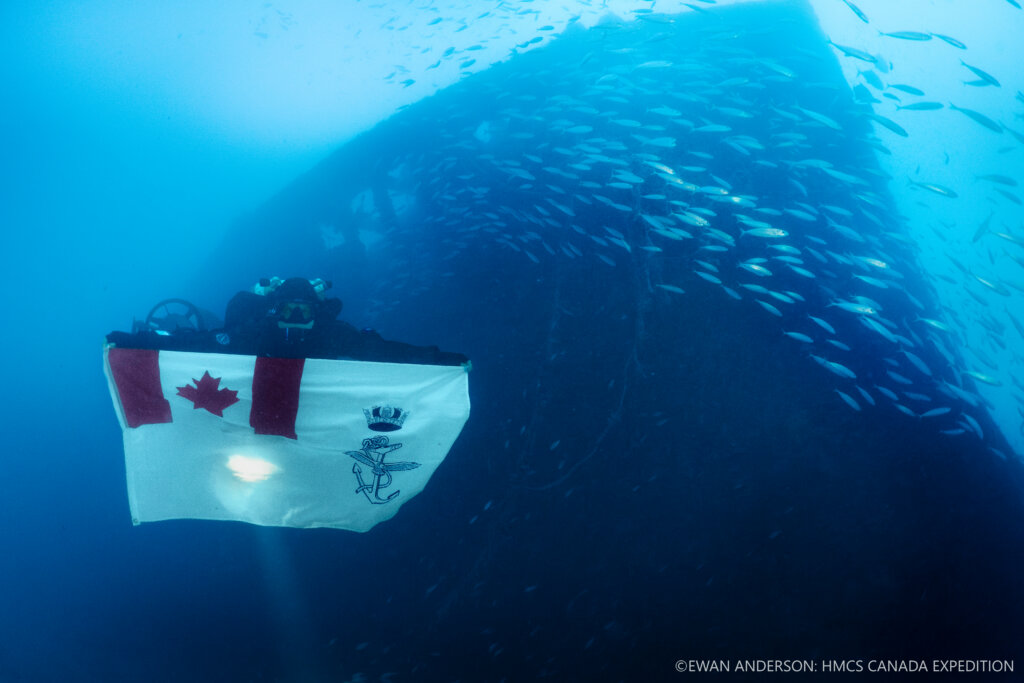
A diver holds the ensign of the Royal Canadian Navy by the wreck of HMCS Canada during a 2025 expedition. [Courtesy Joseph Frey]
Ernest Hemingway had a hand in leading scuba diver Joseph Frey to the wreck of HMCS Canada—though the famed novelist could hardly have known it.
In 1928, the American author sought sanctuary in the Florida Keys, likely unaware that just two years earlier—on July 2, 1926—a former flagship of the Royal Canadian Navy had sunk off the coast.
Nor was Frey, a self-described “Hemingway aficionado,” privy to such facts when he followed in the footsteps of his literary hero decades later—at least not at first.
“I always went down to Hemingway Home in Key West for a tour,” explained the military veteran of 21 years, “and one time, I noticed that the National Oceanic and Atmospheric Administration—NOAA—had an office in Key Largo.”
There, he spied the poster of an unfamiliar wreck resting in nearby waters. Despite having been renamed SS Queen of Nassau in its final days, the converted passenger ship remained a piece of long-forgotten Canadian heritage.
“Being an ex-RCN officer,” said Frey, “I had to know more about this.”
In 2025, that curiosity led to an expedition seeking to better understand the ship’s history, sinking and ongoing ecological significance. Utilizing state-of-the-art photogrammetry, Frey’s team generated high-resolution 3D modelling of the site. Analyzing the digital representation—as well as exploring the submerged vessel itself—has since led to numerous discoveries, including new evidence about its fate.
Here, in a Legion Magazine exclusive, the expedition lead recounts the unsung story of HMCS Canada—and how its tale continues beneath the surface.

Diver and historian Josephy Frey. [Trevor Wallace]
On the vessel’s prewar history
She was built in Britain in 1904, starting off as Canadian Government Ship [CGS] Canada for the Marine Department. With her ram bow, steel hull, twin screws and four quick-firing guns, she resembled a British Royal Navy third-class cruiser of her day.
When most Canadians think of our first warship, we think of HMCS Niobe or HMCS Rainbow. In reality, our first purpose-built warship was HMCS Canada.
Initially, she was commissioned for two reasons. One was for fisheries patrols, her main station being Halifax. The second was to become a naval training ship. At that point in time, the government knew that Canada was going to have a navy but didn’t know when.
The Royal Canadian Navy was founded in 1910, and Canada was then used to train the midshipmen for Niobe and Rainbow. In 1912, she was up gunned. Firstly, they built up her forecastle, making it higher so that it could cut through rougher oceans, and they also strengthened her armament.
On HMCS Canada during the Great War
In 1915, she was transferred to the Royal Canadian Navy, becoming HMCS Canada. During the war, she was used for patrols against U-boats and to escort convoys from Quebec City to Halifax. She was also used for the defence of Halifax Harbour, for minesweeping and to train new crews. She did some 16,000 kilometres a year in military patrols, and still did some fisheries patrols during that period.
She became the [RCN’s second] flagship in 1917 because by that stage, HMCS Niobe was worn out. Canada was even in the naval dockyard on the day of the Halifax Explosion. She survived largely intact.
On the ship’s final years
She continued until the end of the war. In 1919, she was paid off as a warship and transferred back to the Canadian government, which decided to sell her. She was eventually sold in 1924, but there’s not much more info on her fate. She went from being HMCS Canada to SS Canada to SS Queen of Nassau, and that’s where it starts falling through the cracks.
There is, however, a theory of how she sank. Today, you can see that the port propeller is intact. The starboard propeller, meanwhile, is missing. What they think happened was that the drive shaft sheared off and slid out. Water started flooding her, first slowly, then quickly, and that’s the point the captain decided to abandon ship. She sank 15-20 minutes later.
On the 2001 discovery of the wreck
Technical divers accidentally came across her in Florida in 2001. When NOAA tried to find out what the ship was, they knew it was a unique ship based on the distinct shape of the bow.
She’s not an overly impressive ship, but for what she was built for, she was top of her line. In reality, she was the only ship of her type ever built—and that’s one of the reasons they were able to identify her.
On the origins of the 2025 expedition
For the 115th anniversary [of the RCN in 2025], I thought we could get some divers to go down there with the Royal Canadian Navy ensign and get some photographs taken in front of the ship’s hull. Maybe we could even leave a little plaque.
I then found out that because she sank in what’s now the Florida Keys National Marine Sanctuary, a federal government marine sanctuary, to put a plaque on the ship would have been a bureaucratic nightmare. So, we decided that we couldn’t do the plaque—but we’d still go down and take the photograph.
That’s when one of NOAA’s marine archeologists, Matthew Lawrence, suggested that we try to do some photogrammetry, which could be used not only for underwater archeology, but also to inform marine heritage protection regulations and laws in the Florida Keys.
There were seven of us in total. I was the expedition lead and support diver. Six of us were Canadian and four of us are former Canadian Forces members, so everything was run like a military operation. It was a solid team.
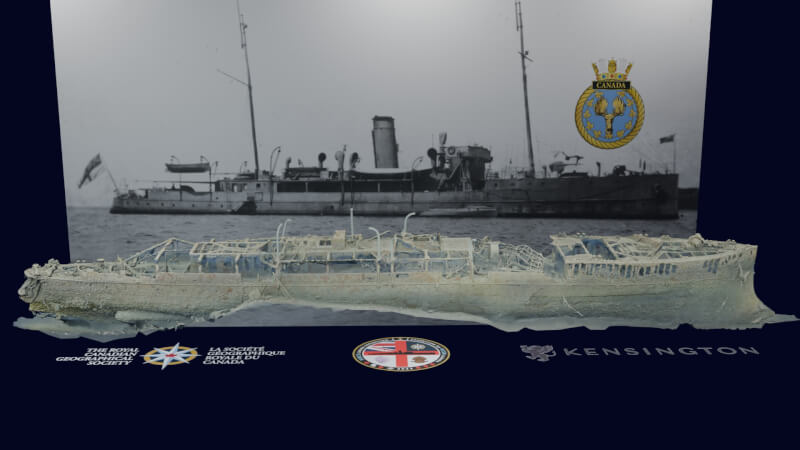
A historic photo of HMCS Canada (background) and a 3D model of the ship’s wreck produced by photogrammetry following the 2025 expedition. [Roger Lacasse]
On new discoveries
Fortunately, we were able to get 10,600 photographs of the ship, which then allowed our head of photogrammetry, Roger Lacasse, to build the 3D photogrammetry model that you see on our website.
While Roger was on the ship doing the photogrammetry, he noticed something visually that he later confirmed when he stitched the 3D model together. When the ship sank, the crew said that the boilers exploded and severely damaged the hull. In early expeditions, however, you couldn’t see any damage, so the exploding boiler theory didn’t have evidence behind it. But Roger noticed a bit of buckling in the steel and, when he pieced everything together and looked at the photographs, he could see cracks on the side.
The crew was right: the boilers did explode, but the extent of the damage to the hull wasn’t as great as they said. With the technology we have now, we were able to prove it.
On the broader importance of the expedition
This will allow Canadians and the international community to see a part of Canadian maritime history, fisheries history and naval history all in one place.
Hopefully, it’ll draw people into better understanding not only the ship, but also the early years of Canadian government fisheries patrolling and the evolution of the Royal Canadian Navy itself.
HMCS Canada is a fascinating ship that most people don’t know about. I like to think that we’ve been able to bring her back to life.
This interview has been edited for brevity and clarity.
Advertisement