

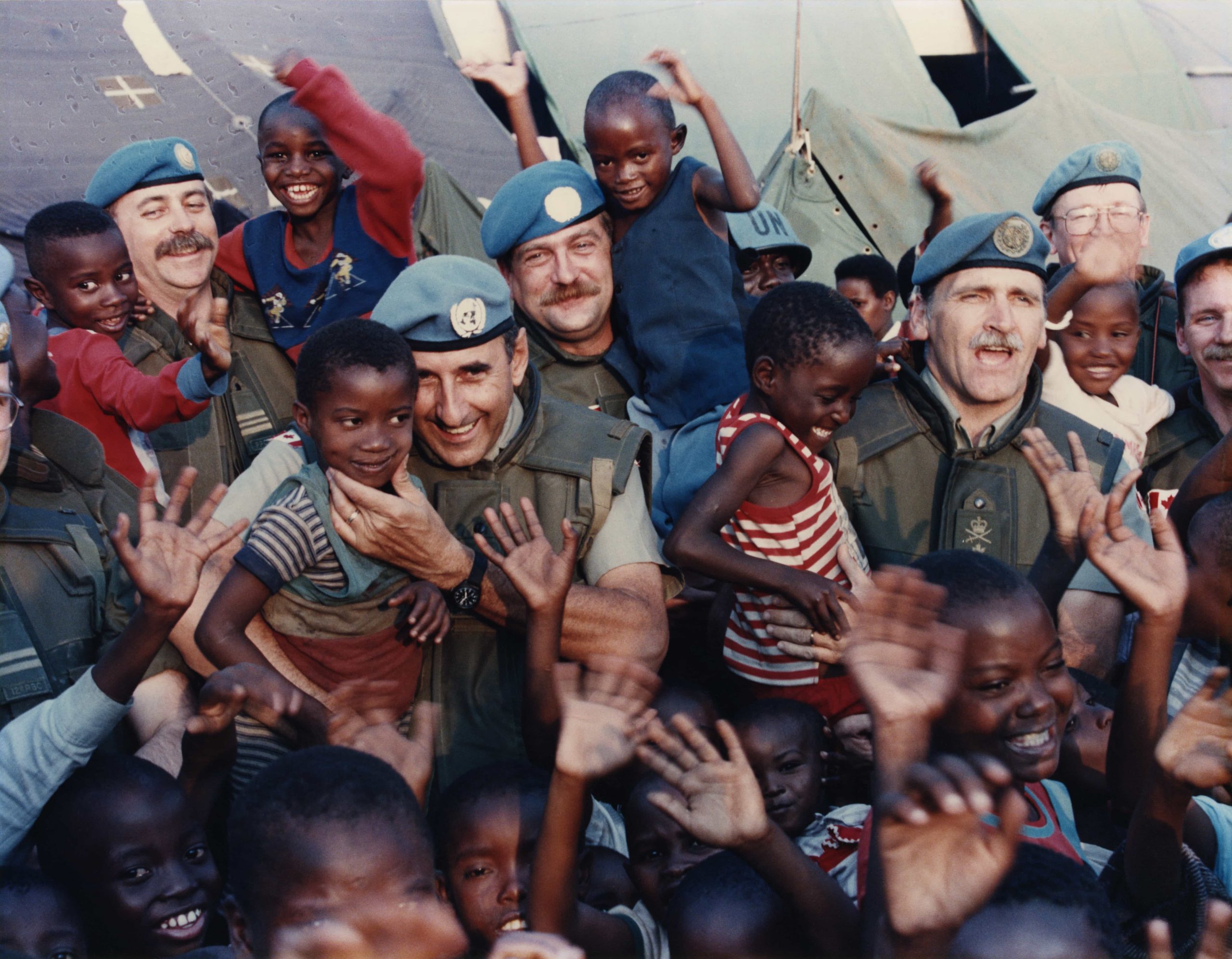
During the 1994 United Nations Assistance Mission for Rwanda, Major-General Roméo Dallaire (right) and other peacekeepers pose with local children. [Corrine Dufka/courtesy Roméo Dallaire]
Retired general Roméo Dallaire doesn’t pretend to have all the solutions, but he strives to ask the right questions. He sees a world of geopolitical strife and uncertainty; a world of inequity and social injustice; a world, fundamentally, in need of change.
The former Canadian senator has witnessed such things, such failures of humanity, not only through news coverage but before his very eyes. In 1994, while serving as force commander of the United Nations peacekeeping mission to Rwanda, Dallaire was left without a sufficient mandate to intervene in a genocide that claimed some 800,000 lives. As UN bureaucracy and dubious decision-making played out behind desks, blue beret wearers on the ground remained all but powerless, relegated to the role of observers amid the devastation.
Despite the horrors that left him with post-traumatic stress, Dallaire maintains hope that people, as a collective, can transcend a proneness for conflict to attain a better tomorrow. It’s why, in 2024, he published The Peace: A Warrior’s Journey with Jessica Dee Humphreys, a book that details his vision for the future.
Here, in a Legion Magazine exclusive, Dallaire offers an insight into that vision amid an already turbulent 2026.
On the book’s origins
It’s the fourth in a series. My first book, Shake Hands with the Devil, was the operational level of conflict [focused on] the mission that I did in Rwanda during the genocide. The second book was the tactical level, which was on facing child soldiers in conflict: They Fight Like Soldiers, They Die Like Children. The third one was on an individual, personal level, Waiting for First Light, which was about living with my injury for so many years and trying to find ways of helping people with PTSD.
My plan was to next write something at the strategic level, something that had a much broader perspective of the situation. That took damn near seven years to put together. The aim of The Peace was to be a reference for people looking into the state of peace, war, humanitarian crises and the planet—to ask, “where are we going with all of this?”
I thought using Dante’s Divine Comedy would be a good way of explaining how there are countries still in proverbial hell and having a hard time getting out of that. There are countries that are in purgatory, that are working out some truces that are only temporary, countries that keep falling backward. Dante then used heaven because he was aiming to speak to God. I believe in spirituality, but for me, it wasn’t about finding God [in the context of his book]; it was about how we communicate with the universe—that’s the highest objective of humanity.
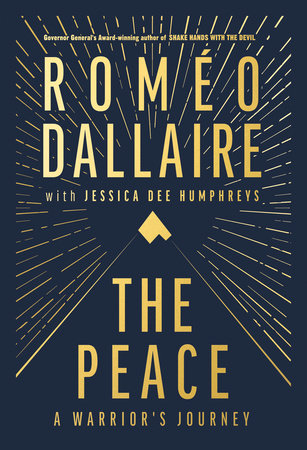
Retired general Roméo Dallaire’s fourth book, The Peace. [courtesy Penguin Random House Canada]
On what peace looks like
We’ve stumbled into a revolutionary time where we might even have the opportunity to bring communion between the planet and humanity.
The reality is that we’ve never had peace; all we’ve had are truces. We ended the Second World War, and the next morning, we were taking it up against the Russians.
To me, peace is mostly no want for needs, to be in an atmosphere of respect and dignity, and ultimately, to be able to thrive by linking all of humanity with the planet. The question is: what are the things not being done that can get us out of this male-dominated, paternalistic, egocentric world that we’ve created and into something new?
On the role of women and younger generations
Everything that we’re doing is so egocentric and so male-dominated that we’ve lost the complete dimension of women and what they are in the continuum of humanity. Unless women are brought in as equals, unless we rewrite and realign our philosophies of leadership, governance and institutional constructs…we’ll never, ever have lasting peace.
Shifting technology has also rendered the younger generation borderless. Just having an iPhone, you can talk to anybody. So, what can the younger generation bring to the revolution? They’re impatient with the way we’ve built [society] so far. They don’t want technology to replace human beings; they want technology to enable human beings to be more effective, to achieve higher objectives and maximize their potential.
These two components are instrumental in moving us in a positive way.
On current geopolitical instability
Peace through power, force or strength isn’t peace; that’s a truce. That way of thinking is preventing us from getting above this era of the old.
Greed, meanwhile, is undermining our fundamental systems for meeting our needs. If greed continues to be used as a reference for power—be it from the individual right to the nation state—that hinders our ability to bring forward innovative ideas. The male ego is the source of that, dominating the decision-making.
Look at the peace committee that President Donald Trump is putting together for Gaza. They’re all men, the whole goddamned lot of them, yet it’s women and children who died in the thousands and thousands in Gaza.
Look at the solutions they’re coming up with for Ukraine. They’re absolutely stupid. Thousands have died, been injured, or are suffering. Millions are in want, yet an arbitrary line is going to be drawn…and you write-off a bunch of people on one side. You think that’s peace?
How many years have we been in Cyprus? We still have a goddamned green line [armistice border] there.
[Leaders of 2026] are subsumed by the tactical, near-term solutions. They have become risk-averse, and once you become risk-averse, you kill the initiative. You kill the opportunities for innovative thinking to happen. Yes, you may screw up some stuff [with innovative thinking], but you’ll certainly build things. If you’re risk-adverse, however, you won’t even try, and you stagnate. You establish an unsustainable status quo, one that isn’t a straight line but a regression.
On hopes for readers
What I’m looking for is a movement of people based on some references. I hope my book is one reference they can use to shift gears.
I didn’t necessarily write it for the leaders of today because I’m not sure they can handle what we’re doing; I’m writing it for the 13-, 14-, 15-year-olds who are going to grow up searching for change and making that shift.
I’m not pessimistic about the future. On the contrary, I think that humanity is here not just to survive on this planet. Humanity is here to thrive on this planet, to go beyond it. But that means all of humanity.
Advertisement