

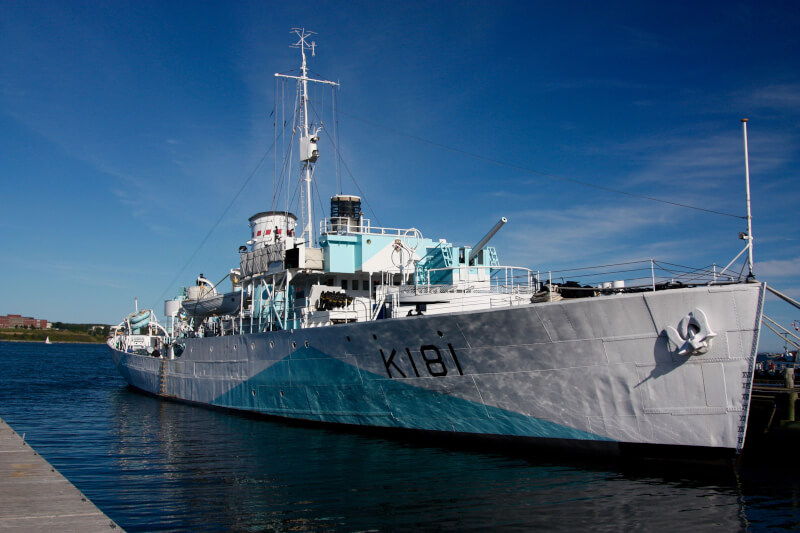
HMCS Sackville, the last surviving Flower-class corvette of the Second World War, is now a museum in Halifax. [Halifax Military Heritage Preservation Society]
HMCS Sackville, the last-surviving Flower-class corvette of the Second World War, will soon be recommissioned into the Royal Canadian Navy, a symbolic gesture in recognition of its historic service.
Spearheaded by the Canadian Naval Memorial Trust (CNMT), which has long preserved the now-museum ship, and facilitated by the RCN’s own commemorative endeavours, the ceremony will take place by the Halifax waterfront on May 15, 2026—exactly 85 years after Sackville’s launch.
The roughly 62-metre (205-foot) Sackville, despite its relatively small size compared to other warships of the time, belonged to a class of vessels that British Prime Minister Winston Churchill dubbed the “cheap and nasties” of the Atlantic campaign. Far from perfect in design and capabilities, corvettes nevertheless acted as workhorses on the high seas, escorting Allied convoys and engaging German U-boats. Sackville was no exception on both counts.
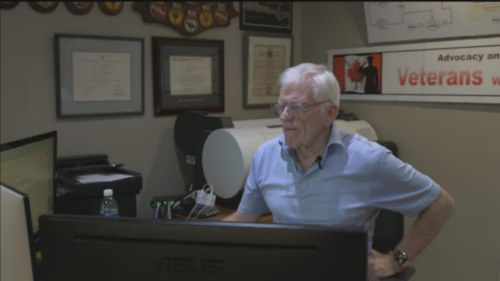
Retired lieutenant-commander (N) Greg Cottingham, current CNMT chair, spoke to Legion Magazine about the vessel’s proud heritage, ongoing conservation efforts and the upcoming event to honour it anew.
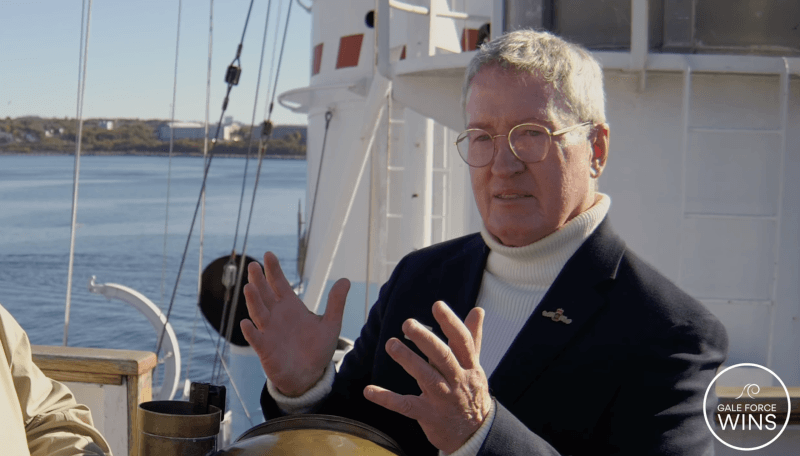
Retired lieutenant-commander Greg Cottingham, chair of the Canadian Naval Memorial Trust. [youtube.com/@GaleForceWins]
On Sackville’s construction
Sackville is a Flower-class corvette. The class was prolific, developed after the British Royal Navy Admiralty Board sought designs beginning in the spring of 1938. The board had recognized that a new war was coming and that convoys, and convoy escorts, would be needed again.
Britain began building Flower-class ships in July 1939, ordering the first 26. They continued placing orders through the year until, by Dec. 15, there were 106 orders under build in Britain.
Just days after the start of the war, Canadian naval officials were shown these plans. They sent a proposal to the Admiralty suggesting that Canadian shipyards were capable of building this type of ship. Canada placed orders with 12 different shipyards for 64 corvettes. Of these, 10 were transferred to the Royal Navy. This was the 1940-1941 building program.
Construction of Sackville began in Saint John, N.B. It was launched on May 15, 1941, and commissioned in December.
On Sackville’s WW II service
Most of Sackville’s direct battle experience came in a 24-hour period in August 1942. The crew encountered U-boats on three separate times and drove them to dive three separate times.
The first two happened in very heavy fog, and they didn’t sight the submarines until coming into very near range. With the first one, they managed to fire the four-inch gun toward it. The submarine dived and Sackville dropped depth charges. The corvette’s crew thought they had sunk the U-boat, but in fact, it wasn’t until after the war that they checked German records and realized that it had made it back to France, where it went through heavy maintenance and got back into operational condition.
Sackville was also involved in the recovery of survivors and the shepherding of ships that had been torpedoed. Often placed in situations of extreme danger, it eventually escorted 30 convoys before the end of the war.

HMCS Sackville circa WW II. [Canadian Naval Memorial Trust]
On preserving Sackville as a museum
The Canadian Naval Memorial Trust was started in the early 1980s by a group of mainly retired naval officers. They recognized that Sackville was probably going to be retired soon. The group managed to encourage a great deal of interest from government, industry and private donors, so they created the trust. In 1983, ownership of Sackville was transferred to the trust.
It commissioned the work to restore the ship to its wartime configuration. They would have liked to have rolled it back to what it was like in August 1942, but that required more extensive structural change, so they instead rolled it back to what it looked like in the summer of 1944.
On recommissioning Sackville into the RCN
Today, some of our trustees are retired senior officers, a couple of them retired vice admirals who have continued to meet with their contemporaries in the RCN. One of the things they got the navy to do, which I think the navy really wanted, was to strengthen its ties to Sackville. The idea of formally recommissioning the ship came from that. It’s purely symbolic, but it’s important.
On plans for the May 15, 2026, ceremony
It’s going to be as big as we can make it. We’re a small ship on a finite jetty, but we’re going to have a celebration—an 85th birthday party, if you will.
We’re structuring it much like the commissioning ceremony for a new ship. We will have a sponsor, who is the person that breaks the champagne bottle against the vessel. For Sackville’s original ceremony, that was Mrs. Oland, the wife of Saint John, N.B., port Captain Eric Oland. We’re trying to get a direct descendant for the honour on May 15.
We’re going to have senior naval staff there. We’re going to have the Stadacona Band. We’ll have a colour guard. We’re going to have all the pomp and circumstance.
We’re also sending invitations to the prime minister and defence minister. Vice-Admiral Angus Topshee, commander of the RCN, is expected to be there, as is Rear-Admiral Josée Kurtz, the Maritime Forces Atlantic commander. We’re inviting Nova Scotia Premier Tim Houston. Unfortunately, Lt.-Gov. Mike Savage will be out of the country, but he’s sending representatives, while both the mayors of Halifax and Sackville, N.B., are due to attend.
The recommissioning signifies the importance of maintaining Sackville, as well as what the ship means to the Royal Canadian Navy and the Government of Canada. I think we really have to keep reminding those in positions of power that in addition to building the future, we have to recognize the past and what has been done to get us where we are today.
This interview has been edited for brevity and clarity.
Advertisement