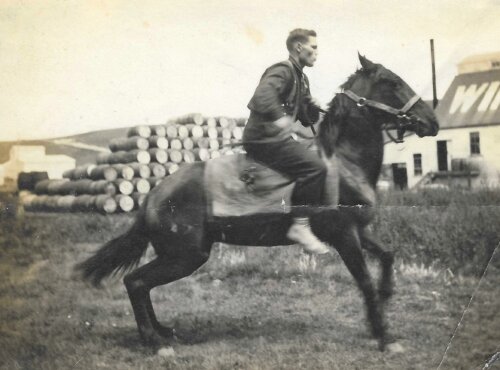





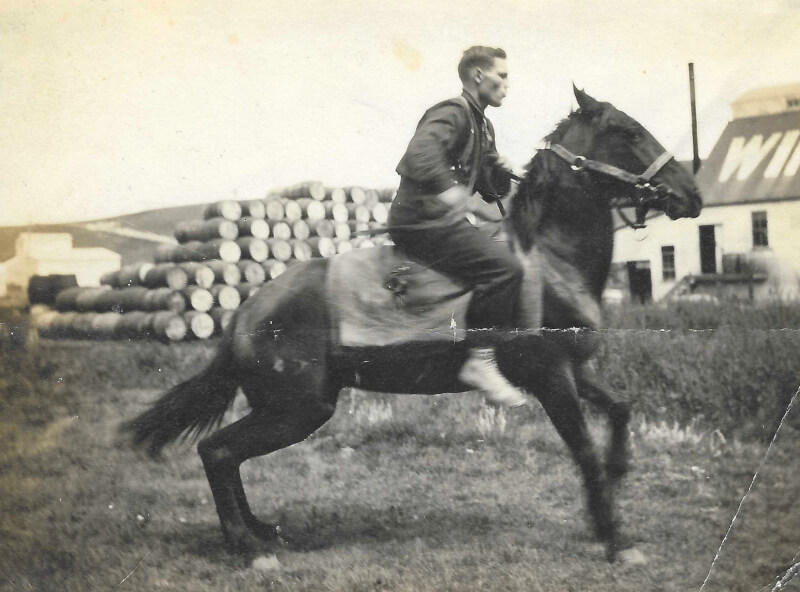
A young Scotty Davidson rides a horse in his prewar days. [courtesy Peter Carew]
For 90 years, the Canadian National Vimy Memorial has stood above the Douai Plain of northern France, its soaring towers a testament to 11,285 unfinished stories. Each Canadian name carved into the Seget limestone represented a Great War soldier killed with no known grave. All speak to a tomorrow that never arrived—of a future that never emerged from the mud and horror of the Western Front.
Even now, across that haunting white facade, everything that might have been continues to be laid bare: sons who never followed in their father’s footsteps; painters and performers who never realized the full measure of their talents; athletes who never learned how far they could truly go.
Of these, rising hockey star-turned-soldier Allan McLean (Scotty) Davidson was one. Though the Kingston, Ont., native didn’t participate in the April 9-12, 1917, Battle of Vimy Ridge—having fallen some two years before—he, like many others, is commemorated on the monument. His remarkable exploits, from the ice rinks of Ontario to the trenches stretching through no man’s land, have largely disappeared from public memory in the years and decades since his final fight.
Author Matthew Walthert has now shed light on that story with his new book Scotty Davidson: The Extraordinary Life and Mysterious Death of Canada’s Forgotten Hockey Hero. Here, in a Legion Magazine exclusive, the biographer offers some brief insights into Davidson’s life.

Author Matthew Walthert. [Ava Walthert]
On the origins of the book
When I first came across Davidson’s story, there hadn’t been much written about him. The first time I saw him was stumbling across his Wikipedia entry, which is very minimal. As I started to look closer, I picked up on some details that were inaccurate or couldn’t be true, so I decided to dig a little bit.
I quickly realized that here was a hockey player who was obviously quite accomplished. He’s in the Hockey Hall of Fame, he won the Stanley Cup and he had a military career where, by all accounts, he served with distinction in the Great War, although he was killed on June 15-16, 1915.
After the war, these stories had been built up around the way he had died and his service—about whether he should have earned the Victoria Cross for an earlier battle. Had he ultimately refused to surrender and been killed by German soldiers in the trenches? It turned out that none of that was true, either.
There were two things that really made me think that this could be more than just the article I wrote for The Athletic. One was that his legacy had been forgotten, despite his being such an accomplished hockey player and soldier. The second was the mystery surrounding his death. I wanted to tell the true story.
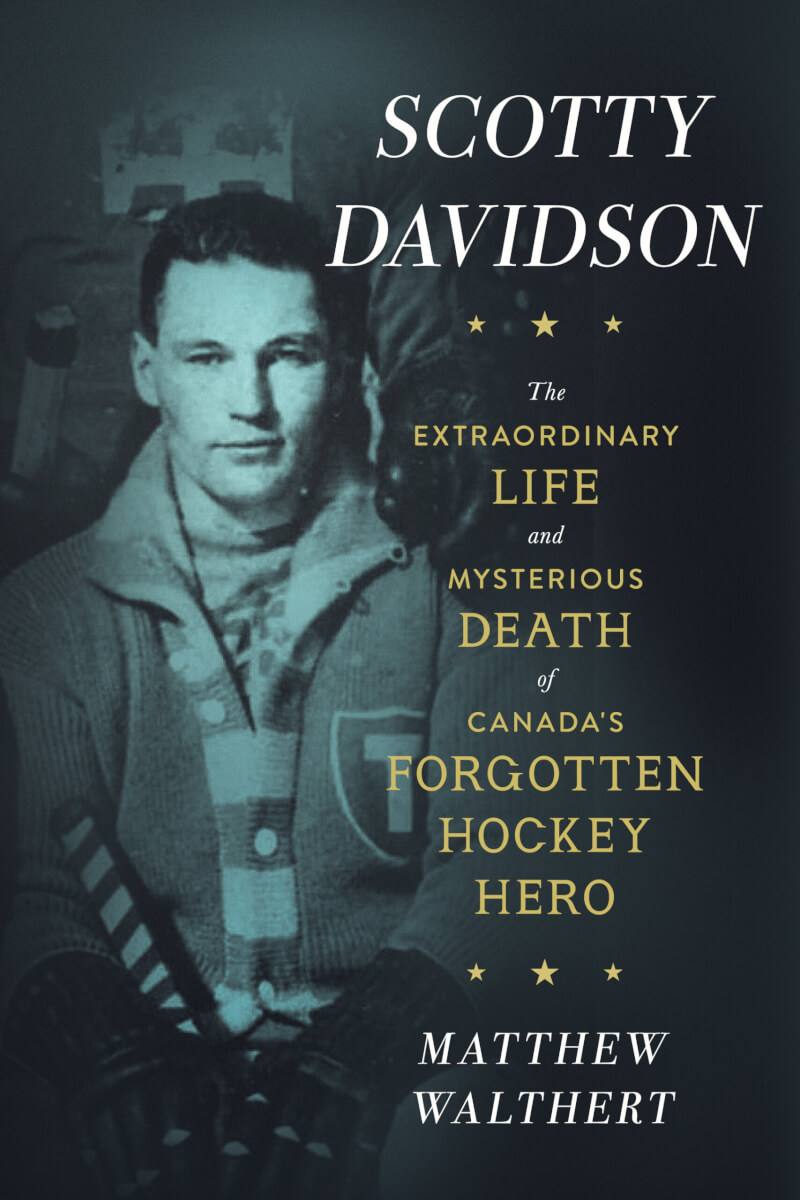
Walthert’s new book. [Sutherland House Books]
On Davidson’s early life
Davidson was born in Kingston in 1891. He came from a working-class background and later worked at a foundry as a machinist. Alongside his schooling and that work experience, he became a well-known hockey player when he was a teenager.
He then played for the first iteration of the Kingston Frontenacs in his junior years, winning the Ontario championship a couple of times. He was the captain of the team.
Davidson went out West for a year, to Calgary, and came back to Toronto as a professional. Now, these were the early days of pro hockey, so he signed a contract in Toronto, played there for two years before the war, and was the team’s leading scorer the second season when they won the Stanley Cup—the first time that any team from the city of Toronto had won it.
In terms of his personality, he was popular among his teammates. I think he was probably quite gregarious—he played with a little bit of an edge, which I think manifested itself off the ice, too. He liked to party and have a good time with his friends and teammates.
On his Great War service
It was a big deal when he enlisted and later when he was killed.
In the military, he wasn’t an officer, but I think he was looked at among the enlisted men as a leader on the battlefield. He was promoted relatively quickly to lance corporal and was selected for some special duties as a scout and grenadier.
There is a relative dearth of material directly about him during the war. There’s his personnel file, which gives the basic outline of his service, and there are remnants of some letters that he wrote home that were published because he was so well known. But that was still a challenge in writing the book. I had to draw on some sources that weren’t necessarily directly talking about him—unit war diaries, other histories that had been published, and archival records from Library and Archives Canada and the Canadian War Museum.
On the truth behind his death
Wikipedia and a few newspaper features all talk about these stories of him refusing to surrender, surrounded by Germans, and smashing a grenade against a German officer—or of him carrying a wounded officer back to his own lines and getting shot.
When I looked at his personnel file, which was one of the first things I did, it’s unequivocal that he was killed in his own trench while preparing for an attack—possibly by friendly fire, although I don’t think we can know that for sure.
I then started to dig into where all these stories originally came from. It seems like it was his friend George Richardson, who had already written to Davidson’s mother telling her what had actually happened. But he then tells this big story about Davidson refusing to surrender, and that kind of got picked up later.
Even though the truth was there—and it had even been shared by people who had known Davidson—it just wasn’t as good a story as the heroic one. People wanted to believe that he had died a heroic death. They were more willing to accept it.
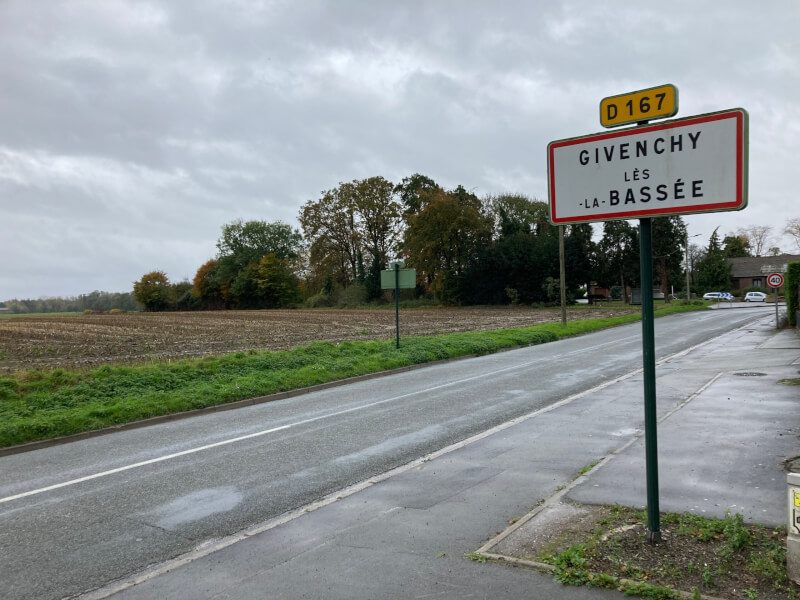
The field today in Givenchy-lès-la-Bassée, France, where Davidson was killed during WW I. [Matthew Walthert]
On why his story has been forgotten
One of the big things was the break between the National Hockey Association (NHA)—the league that Davidson played in—and the National Hockey League (NHL), which obviously still exists today, and which came after.
In 1917, the owners of the existing NHA teams, clustered in Ontario and Quebec at the time, couldn’t stand the owner of the Toronto team that Davidson played for. They wanted to get rid of Eddie Livingstone, but the bylaws didn’t allow for it. To circumvent this, they formed a new league—which would become the NHL—and they just didn’t invite Livingstone.
Even today, neither the NHL nor the Toronto Maple Leafs, which are the direct descendants of that original Toronto team, recognize Davidson or any other player who didn’t cross over from the NHA into the NHL. There were many players who did play in both the earlier league and the new one, but the ones who didn’t got left behind. They’re not honoured. For example, when they talk about the best Leafs players of all time, or the best early NHL players of all time, Davidson doesn’t make those lists just by the fact that he was killed before the new league started.
On the military side, the fact that he didn’t get a medal probably played a role, too. Had he been honoured that way, I think that would have played a bigger role in keeping his legacy alive. But he wasn’t—and his story has since faded.
On his hopes for readers
I’d like them to know him better, to know his story, because I think these types of stories are important for Canadians to remember. They’re not the kind of thing that American or British historians are going to tell.
Davidson was a Canadian. He fought for the Canadian Expeditionary Force. And it’s a quintessentially Canadian story about a hockey player who goes to war.
This book will draw in lots of hockey fans, and I want to use that as almost a gateway for someone who might not ordinarily read about the First World War and the sacrifices of Canadians. I’d like them to learn a little bit about that and see what it was like for these young men to go over to the trenches of the Western Front and face these horrible conditions.
Men like Scotty Davidson answered the call—and, in many cases, gave their lives to do it.
This interview has been edited for brevity and clarity.
Advertisement