




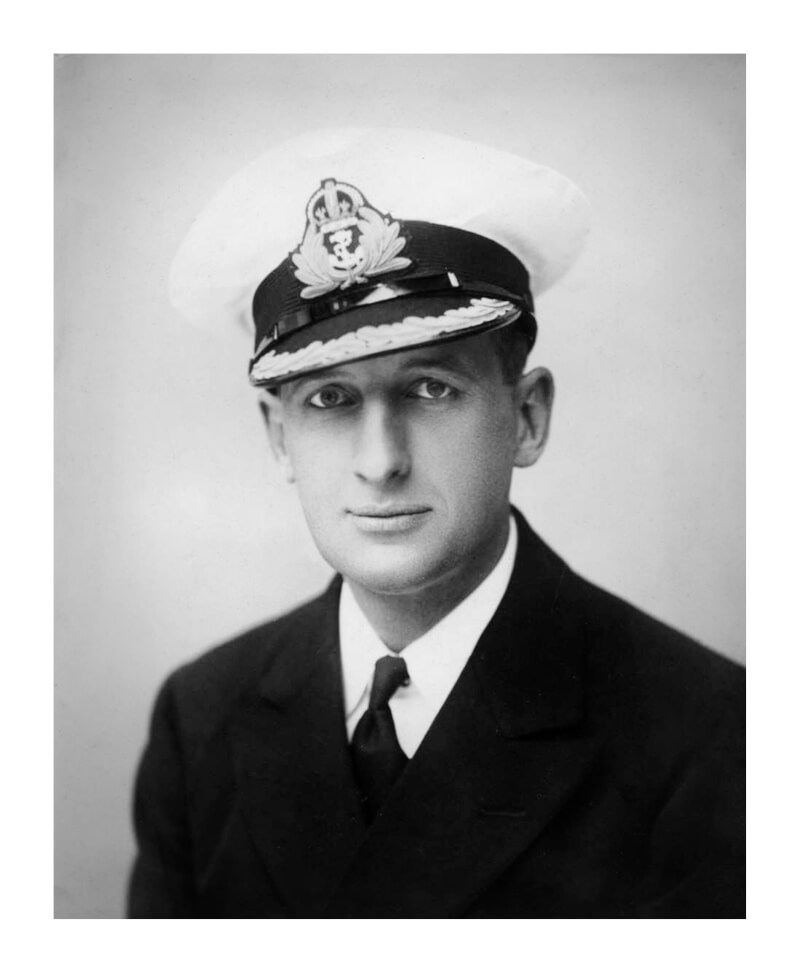
Naval Commander James Campbell Clouston. [Courtesy Clouston family via Brian Jeffrey Street]
“He’s been with me for a long time,” said biographer Brian Jeffrey Street of the largely forgotten Canadian war hero he has chronicled for decades. Naval Commander James Campbell Clouston’s efforts during the Dunkirk evacuations were vital to its success.
From May 26 to June 4, 1940, as German forces closed in on the French port and dominated the skies above, the British Royal Navy, alongside a fleet of civilian vessels, ferried more than 338,000 beleaguered Allied troops across the English Channel. The retreat from continental Europe was an undeniable defeat that precipitated the fall of France, but the evacuation itself—code-named Operation Dynamo—would epitomize British pluck and determination to many at home, despite the debacle.
Typically lost in the “Miracle of Dunkirk” story, however, is the Montreal-born pier master who, Street affirms, played an outsized role in co-ordinating the withdrawal of some 200,000 troops from one of two long breakwaters that protected the harbour entrance.
No survivors remain today to recall first-hand Clouston’s actions during six gruelling days of Luftwaffe air attacks and chaos on the ground. Nevertheless, his legacy will be preserved in a forthcoming book by Street.
Here, in the first of two parts, the author explores Clouston’s life and extraordinary wartime feats.

Biographer Brian Jeffrey Street. [JoAnn Mallory]
On discovering Clouston’s tale
I first learned about his story in 1989, when I was the writer and associate producer for a one-hour CBC television documentary made to mark the 50th anniversary of Dunkirk.
With the film, we were trying to tell the story of Dunkirk through a Canadian lens, which might surprise some people but, in fact, there were many Canadians who were involved on land, at sea and in the air. There were Canadians in the Royal Navy, for example. There were Canadians overseas for training who ended up participating in the evacuation. And there were Canadians in the Royal Air Force flying sorties over France.
During my research, I read Walter Lord’s book The Miracle of Dunkirk and I was astounded to learn that Clouston was Canadian.
On Clouston’s childhood
His early life was quite interesting, having been born in Montreal at the end of August 1900 and raised in comfortable surroundings. He always went by his middle name—Campbell—or to his family, Cam.
When he was only a few years old, the family moved to a grand property in Pointe-Claire, Que., near the shores of Lake Saint-Louis. There, Clouston spent a lot of his youth messing about in small boats.
From an early age, I think he was fixated on the Royal Navy as opposed to the still-young Royal Canadian Navy. He left home in June 1918, went by train from Montreal to Halifax, and somehow—likely through family connections, one can only assume—he managed to secure passage on an armed merchant vessel crossing to England as part of a convoy during the Great War.
On Clouston’s early military career
Clouston started his Royal Navy training that October. You get a sense that he established himself early as a high achiever, and that followed him throughout the next couple of decades of his career. He was often promoted early, sometimes with backdated seniority. He was also highly regarded for his humour aboard the numerous ships he was posted to, even if he could be a strict disciplinarian at times. But with his friends and colleagues, he was very well-liked.
Clouston was given command of a new destroyer, HMS Isis, after getting another early promotion to commander. He served in the Mediterranean for a couple of years and was aboard Isis when the Second World War broke out, at which point the ship was recalled to home waters.
The Norwegian Campaign started in 1940, and Isis was one of the ships sent there. Accounts of Clouston’s operations in Norway suggest that he was bold and daring in some of his actions, but unfortunately, the ship hit a submerged wreck in early May, and it had to be towed back to the U.K.
Meanwhile, things had started to unfold in France with Germany’s blitzkrieg invasion. Clouston agitated to be sent over. He felt he had to do something.
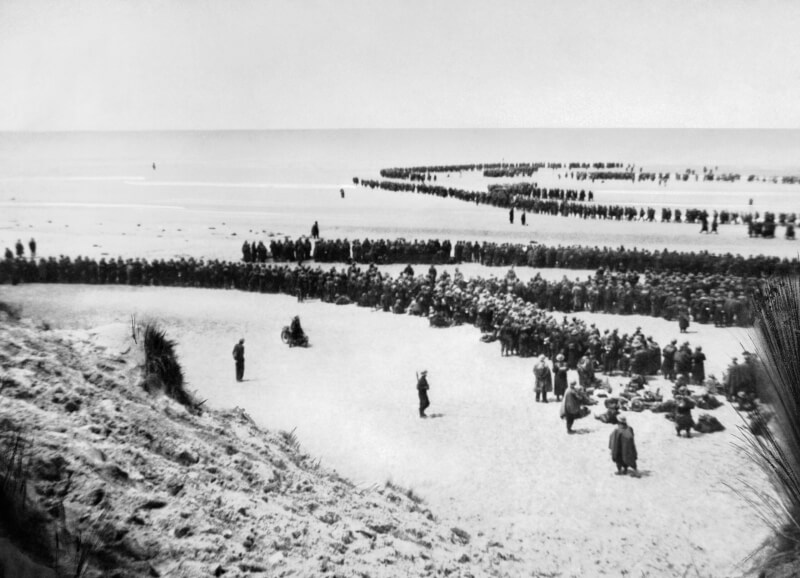
British troops line up on the beach at Dunkirk as they await evacuation. [Imperial War Museums/Wikimedia]
On Clouston’s arrival in Dunkirk
Clouston ended up being assigned to a naval party of 12 officers, accompanied by 160 or so ratings led by Captain William Tennant, who was appointed the senior naval officer ashore at Dunkirk to oversee the evacuation.
Together, they left in the afternoon of May 27 and arrived at Dunkirk under an intense air attack. The port had already been pounded for days by the Luftwaffe, and oil refineries near the harbour were aflame as dark palls of thick black smoke blew eastward across the beaches.
Tennant dispersed his officers, each with a platoon of about 20 ratings. A couple of those officers were sent to the beaches to try and see what the situation was like there, while Tennant himself proceeded to a bastion in the town to meet with the French and get a sense of what was possible.
It was clear that the harbour was unusable as some of its gates had been destroyed, rendering it completely tidal. It also would have been just suicidal to take any ships in there to dock and load troops. The breakwater provided an obvious, if risky, alternative, so Clouston assumed the role of pier master.
He, a lieutenant commander and some ratings were then sent to the seaward end of the breakwater, where they took charge of co-ordinating ships, securing their lines, loading troops and getting them out of there. And it was only the beginning.
This interview has been edited for brevity and clarity. A second part will appear next week, June 3.
Advertisement




A huge thank you to Mr. Street for his dedication and tireless work in bringing this overlooked Canadian war hero back into the spotlight. Commander Clouston, a Montreal native, played a pivotal role in the Dunkirk evacuation and ultimately gave his life in doing so. It is remarkable that so few Canadians know his name today. Thanks to the efforts of author Street, that may finally begin to change.