

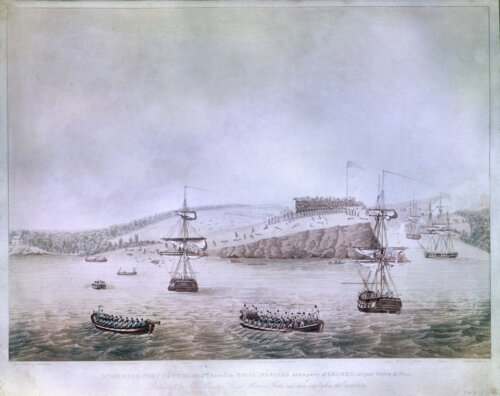
An artist depicts the British attack at Fort Oswego on the New York shoreline of Lake Ontario in May 1814. The War of 1812 was part of the larger Napoleonic Wars. [U.K. National Army Museum/NAM.1971-02-33-289-1]
They called it the Great War, an industrial-scale conflict that spanned four years and more than 30 countries across the globe. When the Armistice was at last declared on Nov. 11, 1918, millions had died in its calamitous wake.
Over time, the so-called “war to end all wars” would instead be known as the First World War. The new name, however, was something of a misnomer.
“Great” it was, devastatingly so, but perhaps not the first. That title, assert countless chroniclers, goes to the 1756-1763 Seven Years’ War, which involved dozens of belligerents in theatres extending from Europe to the Americas to Asia and Africa. It would be followed by the Napoleonic Wars, a conflict in which numerous countries were again embroiled in desperate fighting that reached five oceans and at least four continents—the Canadian colonies of British North America among them.
Yet, what role did those same colonies play in a struggle often remembered for Austerlitz, Trafalgar and Waterloo? If the Napoleonic Wars were indeed global in nature, then how did the territories that became Canada factor into them—including but also beyond the War of 1812?
Military historian Tanya Grodzinski has dedicated a considerable portion of her career to addressing such questions. Here, in a Legion Magazine exclusive—and the first of two parts—she offers answers.

Military historian Tanya Grodzinski. [Royal Military College of Canada]
On North America in the late-18th and early-19th centuries
North America was still a dynamic continent during that period. Certainly, with the American War of Independence, you had the creation of the United States, but you also had a series of British colonies, grouped under British North America, which had very loose connections to each other.
Even though there was a governor-in-chief and commander of the forces for those colonies, there were significant unsettled territories. Indigenous Peoples still controlled a large portion of land, but that was quickly about to change. You also had Spanish holdings to the west and a Russian presence on the continent, primarily in modern-day Alaska.
British North America was sparsely populated. Around 1812, Kingston was the largest city in Upper Canada, with about 1,000 people, then other major centres included places like Montreal and Halifax. There was also a significant number of people who had moved from the U.S. We tend to call them Loyalists, but they’re also what were known as the “late Loyalists”—people who left after the initial emigration. So, the U.S.-British North American border was a fluid area.
Of course, British North America was part of the British Empire. There was a British army and Royal Navy presence; governors were British in background or held British commissions; and between 1789 and 1815, British North America was caught up in what became a global war.
On Canadian opinions concerning the conflict
There were different views held by different people as to what their role should be in the Napoleonic Wars. Some completely ignored it. Others were very much concerned about Britain’s position within the war, and some were even more interested in Napoleon, particularly in the early part of his leadership of France, seeing him as a bright new light and a symbol of how the world could be run.
For some francophones, a favourable view of France was a way to strike at English supremacy in Lower Canada and elsewhere in the British North American colonies.
The one thing that British leaders in North America did to try and cement support was to appeal to various authorities, particularly within Lower Canada. One of the most important moves was recognition of the Catholic Church, which, in British history since the Reformation during the 16th century, had been a real problem—the “old religion,” as it was referred to. This resulted in parish priests suddenly expounding support for Britain from the pulpit. That affected some of the families, and many of their sons became involved in the conflict.
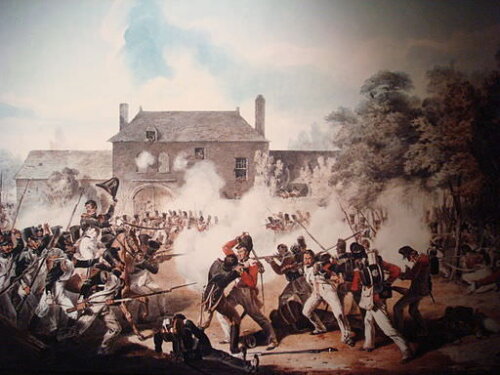
Artist Denis Dighton depicts fighting at Chateau de Hougoumont during the 1815 Battle of Waterloo. Newfoundlander Joe Gibbs was among the Coldstream Guards defending the farm. [U.K. National Army Museum/NAM.1975-05-7-1]
On how the Canadian colonies supported the British war effort
The support that British North America gave to the conflict, which consumed Britain, much of Europe and a large portion of the world for basically a generation, consisted of several things.
One was timber, which was used in the West Indies for naval installations and other building projects. Some went to Britain, too, along with foodstuffs and so forth.
Further, several citizens from British North America found their way into military service, either in the Royal Navy or the British army, with some getting commissions and others joining up in lower ranks. These individuals, both English and French, wound up being involved in what was going on in Europe and elsewhere in the world.
On the relationship between the War of 1812 and the Napoleonic Wars
The outbreak of fighting in the War of 1812 was directly related to the situation that was being driven by the Napoleonic Wars—particularly on the high seas. Napoleonic France was trying to cut Britain off from trade with Europe, whereas Britain was trying to stop all trade going to France on the high seas.
You had a series of incidents where merchant vessels were stopped by the British from a host of different countries, including the U.S., and it was primarily those incidents, combined with a few other actions elsewhere, that led to the war breaking out in June 1812.
This created a problem for officials in British North America and London because suddenly you needed to support military operations somewhere else, which would take away from what was happening in Europe. Following Napoleon’s failure to conquer Russia, the war had been renewed in Europe. Britain, meanwhile, which was already operating in Portugal and Spain, now found itself in an intensified struggle.
In British North America, the decision was made to basically hold the line, do everything to repulse the Americans, do everything to hold a frontier, but not get into a situation where significant resources would be demanded from home. The Empire would not strike back at this point. It wasn’t until 1814, when things had settled down in Europe, that Britain would redirect resources—and even then, all the British wanted to do at that point was secure the frontier because they knew negotiations were about to begin.
The funny thing is, when the Treaty of Ghent was finally signed in 1814, all the issues that led to the War of 1812 were basically going to be dealt with by various committees. You have all this fluster and fuss, then the war ends, and nothing is really resolved. In fact, with Napoleon’s abdication, the British resumed prewar shipping practices on the high seas because the French king was returned to power and the world returned to normal.
So, in effect, the end of the war in Europe ended the reasons for the war in North America.
This interview has been edited for brevity and clarity. A second part will appear next week, Aug. 26.
Advertisement