


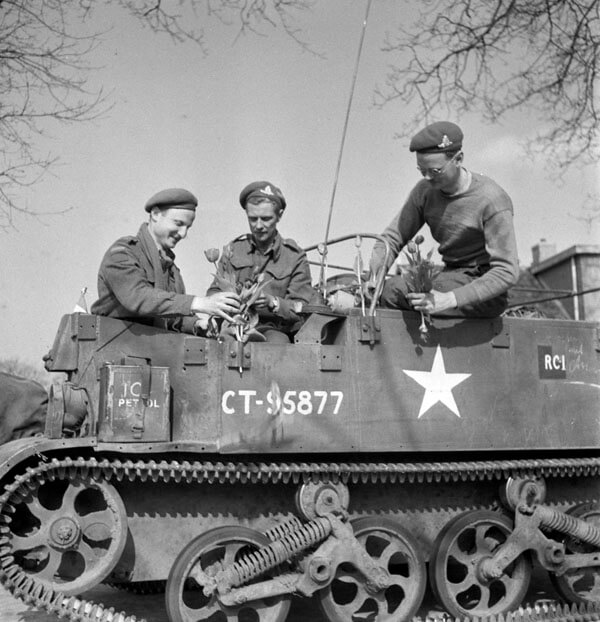
Men of the Royal Canadian Artillery move toward Groningen, Netherlands, on April 13, 1945. [Dan Guravich/DND/LAC/PA-130931]
It’s a name that resonates—at least in Canada—like few others: Ortona. An idyllic Italian town it may now be, but in December 1943, it was here that 1st Canadian Infantry Division fought through rubble-laden streets and shattered houses against fanatic German resistance.
Even today, more than 80 years later, the struggle once dubbed Little Stalingrad continues to draw significant scholarly focus. Among those gravitating to such studies is Major Jayson Geroux of The Royal Canadian Regiment.
Geroux is an urban operations instructor and urban warfare historian. Like countless compatriots, he too sees the resonance in Ortona’s name. Nevertheless, the infantry officer also believes that another name, another Canadian urban battle of the Second World War, deserves a greater place in the discourse: Groningen.
In a Legion Magazine exclusive—the first of two parts—Geroux offers a blow-by-blow account of the April 13-16, 1945, clash that occurred during the liberation of the Netherlands.

Major Jayson Geroux in a still from the 2023 documentary The Battle of Ortona. [The Battle of Ortona/imdb.com]
On the prelude to battle
It’s April 1945, and there’s only a month left of the war in Europe—something we now know in retrospect—but there is still fighting going on in the northwest. There are an estimated 200,000 German military personnel in the Netherlands, a mixture of good and bad units, and they are on the defensive.
On April 5, British Field Marshal Bernard Montgomery directs First Canadian Army, under General Harry Crerar, to clear the northern Netherlands. Eventually, the Dutch city of Groningen is in the path of 2nd Canadian Infantry Division, itself led by Major-General Bruce Matthews.
2nd Canadian Infantry Division consists of three infantry brigades. You have 4th Canadian Infantry Brigade, which has three battalions from three different regiments: The Royal Regiment of Canada, The Royal Hamilton Light Infantry (the “Rileys”), and The Essex Scottish regiment. You have 5th Canadian Infantry Brigade, made up of The Calgary Highlanders (the “Calgarys”), Le Régiment de Maisonneuve (the “Maisies”), and The Black Watch (Royal Highland Regiment) of Canada. Finally, you have 6th Canadian Infantry Brigade, with Les Fusiliers Mont-Royal, The Queen’s Own Cameron Highlanders of Canada (the “Camerons”) and The South Saskatchewan Regiment (the “South Sasks”).
The infantry also has armour support from Sherman tanks of The Fort Garry Horse and Archer 17-pounder tank destroyers; Royal Canadian Artillery support with both indirect artillery and anti-tank guns; and several other elements such as Wasp armoured flame-throwers and Kangaroo armoured personnel carriers. And they’re about to launch into the city.
Initially, the Canadians thought the German defenders would put up some weak resistance, then withdraw. Regardless, they knew they couldn’t bypass Groningen. Montgomery wants the Netherlands cleared so that First Canadian Army can then move over to Bremen, Germany, and take it over from the British Second Army, which would protect the British flank during 21st Army Group’s drive to the Elbe River. Also, leaving a large German garrison behind in a city requires troops to mask that city, and none were available.
Another factor is that the Canadians are specifically directed that they can’t use close air strikes and artillery in great abundance. They are not completely restricted but must use them sparingly. The Dutch, after all, have suffered horribly under the German occupation. There is also a large civilian population within the city. It’s close to the end of the war, too, and so there’s hope that the large-scale urban destruction that we’ve seen in other cities won’t be repeated in Groningen.
All of this makes Groningen a bit of a unique battle when it comes to the use of firepower because the Canadians need to be very careful about where the rounds land and only fire at confirmed German defensive positions.
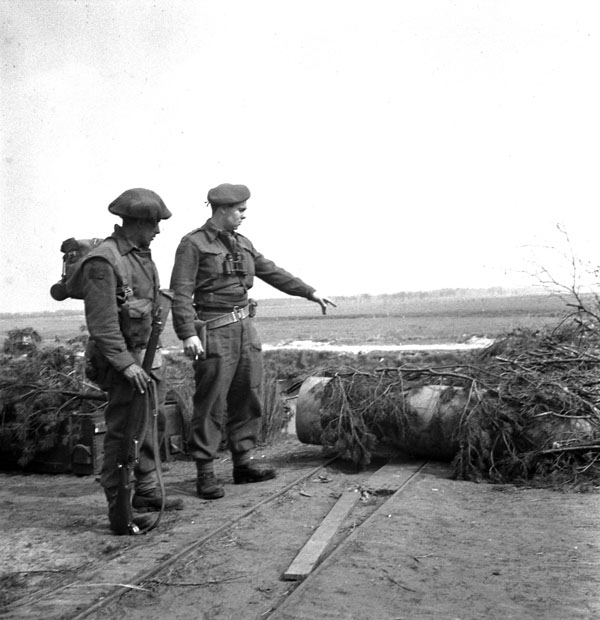
Men of The Royal Hamilton Light Infantry inspect German bombs en route to Groningen, Netherlands, on April 13, 1945. [Dan Guravich/DND/LAC/PA-130933]
On German defences
Resources differ, but there are said to be 6,000-7,500 German defenders. These forces are made up of Wehrmacht, Dutch Waffen-SS, Sicherheitsdienst personnel, Hitlerjugend, Luftwaffe ground personnel, naval marines and railroad workers. The Germans don’t have any artillery or tanks, but they’re armed with 20mm anti-tank guns, MG-42s and anti-tank Panzerfausts.
The defenders take advantage of the dense urban terrain. Groningen is split into its old city in the south and its new city in the north, surrounded by suburbs. The big challenge, though, is the number of waterways and canals. There is a ring canal that surrounds the entirety of the old city, with 14 swing bridges that allow access to it. Surprisingly, the Germans only lifted these bridges, destroying only a few of them. But there are also sunken boats, concrete roadblocks, anti-tank ditches and dismounted personnel trenches dug into the parks, as well as bunkers and additional defensive positions in buildings.
On the other hand, the big challenge for the Germans is that their commander has not coordinated the overall defensive plan. There is almost no scheme of manoeuvre, and he is just relying on German determination and an overwhelming number of defensive positions to make a last stand.
On the first day of fighting
On the first day, April 13, which I really call the initial approach, the Rileys and the Fort Garrys reach the southern outskirts of the city, close to Stadspark. This is a large open park area with numerous lakes, hills, trees, sports fields, etc. They initially run into a German defensive position at a bridge, which is quickly destroyed by several Sherman tanks, but they then run into this large anti-tank obstacle with trenches co-located and covered by Panzerfausts, 20mm guns and snipers. German reinforcements arrive, so heavy fighting breaks out until the Rileys are eventually able to clear the park by midnight at the cost of eight killed and 20 wounded. They can’t go any further north now because there is a sugar beet factory nearby with clear fields of fire, so they start laying artillery down.
The first day of fighting surprises 2nd Canadian Infantry Division—it’s very similar to what we saw in Ortona, where the Canadians had a similarly surprised initial reaction. And so, Matthews decides he will commit the whole division to it. 4th Canadian Infantry Brigade will break in and gain lodgement in the southwest portion of the city and move up to the ring canal around the old city, grabbing the bridges. 5th Canadian Infantry Brigade will go off to the west and break in and gain lodgement there, while 6th Canadian Infantry Brigade breaks in and gains lodgement from the southeast side of the city, eventually hoping to link up with 4th Brigade.
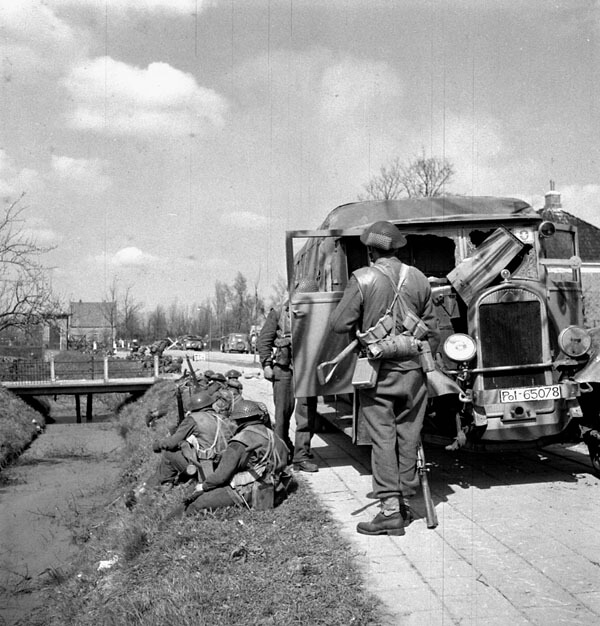
Infantrymen of The Essex Scottish regiment take cover from enemy snipers en route to Groningen, Netherlands, on April 14, 1945. [Dan Guravich/DND/LAC/PA-130949]
On April 14 in Groningen
That plan is put into action. The Rileys of 4th Brigade move forward to capture the bridge at the Hoendiep canal just southwest of the city. The Rileys are left-forward, The Royal Regiment of Canada is right-forward and The Essex Scottish regiment are going to conduct a forward passage of the lines through The Royal Regiment of Canada to try to get to the north side so they can link up with 6th Brigade. All three battalions advance under fire.
They’re clearing buildings and making very good use of urban tactics, techniques and procedures (TTPs). If they run into any challenges from defensive positions, they bring up six- and 17-pounder guns, Sherman tanks and Archer tank destroyers, and direct fire onto them. They also use smokescreens and mortars, all very good TTPs. Ultimately, 4th Brigade meets its objectives by the end of the day.
5th Brigade, meanwhile, has Le Régiment de Maisonneuve right-forward; they’re going to clear that sugar beet factory and seize the railway viaduct. The Calgary Highlanders are left-forward to seize another viaduct, while The Black Watch are in reserve. Both battalions move forward through the city’s suburbs, meeting resistance from 20mm guns, pillboxes and defensive positions, but they respond with mortar, artillery fire and PIATs. They also meet their objectives by the end of the day.
6th Brigade is different. They’re doing a single-file advance, where you’ve got The Queen’s Own Cameron Highlanders first, Les Fusiliers Mont-Royal second, and the South Sasks third. They advance up the road and through the city’s suburbs with little resistance, bypassing a German-held electrical power plant to link up with 4th Brigade at the ring canal at the old city.
That’s the end of the second day, but the most difficult part of the battle was about to begin.
This interview has been edited for brevity and clarity. A second part will appear next week, on March 18.
Advertisement