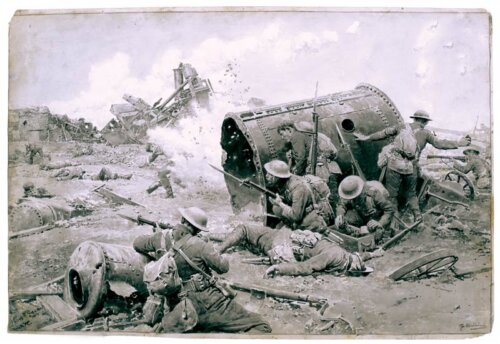


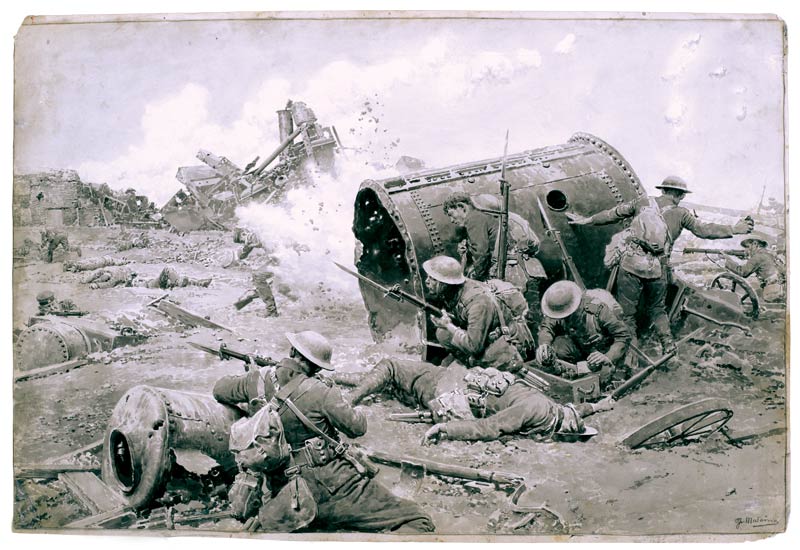
A painting by Fortunino Matania depicts the Canadian capture of the Sugar Refinery during the September 1916 Battle of Flers-Courcelette. [Fortunino Matania/CWM/19870268-001]
Following their defeat at St. Eloi Craters and the see-saw battle of Mount Sorrel, many Canadian soldiers readying to go over the top on Sept. 15, 1916, in the attack on Courcelette, anticipated serving the Germans a drubbing.
“The time is now very close and I feel we are going to get a little of our own back,” wrote Major Agar Adamson of Princess Patricia’s Canadian Light Infantry.
That such optimism prevailed stood starkly at odds with the battleground reality in which the Canadian Corps was now situated. By the time the Canadians arrived in northern France’s Somme River valley in late August, the British Expeditionary Force (BEF) had been engaged in a campaign of slaughter that started on July 1. In that single day, the British suffered 57,470 casualties, including roughly 20,000 killed. This was the bloodiest day in Britain’s long military history. Also counted in the BEF losses that day were those of the Newfoundland Regiment at Beaumont-Hamel. In about 30 minutes, 324 Newfoundlanders were killed and 386 wounded; just 68 men remained for rollcall. After that, the Somme turned into a grinding attritional campaign that, by late August, had claimed nearly 200,000 British, more than 70,000 French and an estimated 200,000 German casualties.
No great geographical objectives led to the Allies’ Somme Campaign. It was instead meant to relieve pressure on the French army, which was teetering on the edge of defeat southeast at Verdun. The July fighting achieved this purpose—the Germans mostly abandoned their Verdun offensive. This freed the French and Germans alike to send troops to the Somme. The French Tenth Army extended the Allied front dramatically to the British right while the Germans added their Sixth Army to their heavily fortified front lines. Hereafter, the Allied purpose in the Somme was to break the stalemate on the Western Front by piercing the German defensive lines to unleash a British cavalry-led breakout that would wreak havoc in the enemy rear.
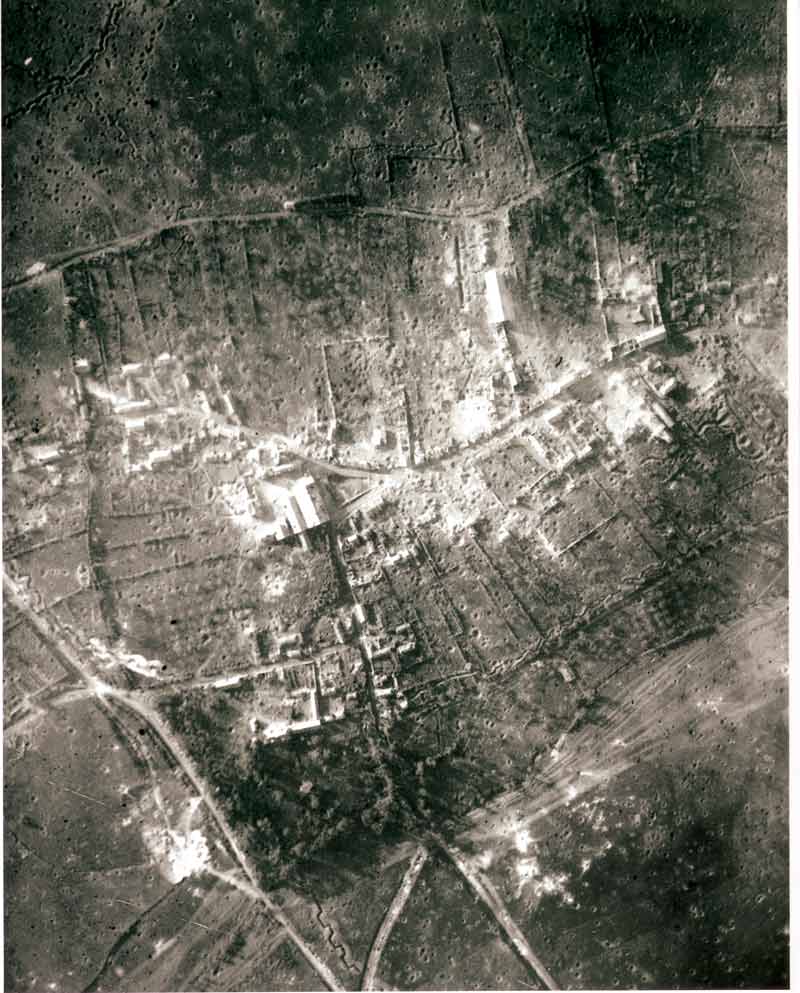
An aerial photograph of the Courcelette battlefield on Sept. 15, 1916. [LAC/C-43987]
“Not a tree, but occasionally the stump of one to accentuate the bareness, and at night when it is lit up by the flames and the flashes of guns, it leaves the impression of a very modern hell.”
The Canadians were to play an important role in this second major Somme offensive—the first since the July 1 debacle. Two British armies massed along a 16-kilometre front for the Sept. 15 Flers-Courcelette operation. The Canadians were serving as part of General Hubert Gough’s recently constituted Reserve Army on the left of Fourth Army.
Marching to the front, the Canadians passed through a hellish landscape. “What villages there were are as flat as ploughed fields, and most certainly the country is one of desolation,” wrote Lieutenant Allan B. Morkill. “Not a tree, but occasionally the stump of one to accentuate the bareness, and at night when it is lit up by the flames and the flashes of guns, it leaves the impression of a very modern hell.”
Added to the horror was the common sight of blackened flesh and broken bones scattered seemingly everywhere. Many Canadians passed “Dead Man’s Trench,” so named because it was clogged with the rotting bodies of Germans killed by an artillery barrage during a relief. The gruesome results were so awful no volunteers could be found to clean it up.
In popular culture, BEF Field Marshal Douglas Haig has come to symbolize the class-based disregard Britain’s generals had for the lives of those they commanded. Yet, their preparations for this second Somme offensive demonstrated a desperate desire to develop and utilize new tactics and weapons that could not only carry the day, but reduce casualties.
On the tactical side, the creeping barrage provided a curtain of artillery fire ahead of the advancing infantry that moved in timed lifts aimed to match their pace. The biggest fear with this approach was that the artillery’s accuracy was much compromised by gun barrels badly worn through months of firing. Rounds falling short and killing their own led gunnery officers to recommend the infantry keep a distance back that threatened to undo the barrage’s advantage.
By this point, Canadian Corps commander Lieutenant-General Julian Byng considered 1st Division’s Major-General Arthur Currie his likely successor. When Currie studied the creeping barrage timetable and the proposed safe distances for following it, he disagreed with the gunnery officers’ conclusions and recommended instead that the “infantry should be taught to follow the artillery barrage as closely as a horse will follow a nosebag filled with corn.”
Currie recognized that friendly fire casualties were probable, but countered, “in the harsh world of the Western Front…it is far better to lose a few of our men from our own artillery fire than to sacrifice hundreds by hostile machine gun fire.”
On the new weapons side, Haig decided to unleash a recently invented bulletproof machine that could overrun enemy defences by crushing barbed wire obstacles, then grinding over machine guns or destroying their crews with fire from built-in guns. Described as land cruisers, and forever after code-named tanks, the British had two Mark I variants. Both were roughly four metres wide, two metres tall, and eight metres long with a two-metre-long metal tail for stabilization and steering. The “male” version came with two 6-pounder guns and four Hotchkiss machine guns, while the “female” mounted five Vickers machine guns and one Hotchkiss machine gun. Each could spew 1,000 bullets a minute, but they were unwieldy, mechanically unreliable and had a top speed slower than a person walking. Forty-nine tanks were available, with seven going to the Canadians, one of which was held in reserve.
The Canadians would attack on a two-division front of about 2,000 metres with 3rd Division to the left and 2nd Division on the right. In support was the greatest artillery concentration for a Canadian battle to this point—234 field pieces and 64 heavy guns, many provided by the British. On the night of Sept. 14, the first waves of troops moved into trenches and awaited the 6:20 a.m. attack signal. Behind them, the guns stood wheel to wheel.
At 6:20 precisely, the guns erupted with a fire timed to catch the Germans gathering for breakfast.
“Terrific bombardment,” Sergeant John Davis wrote in his diary. “One continuous stream and din could be felt.”
The infantry moved into no man’s land behind the barrage that rolled ahead of them by 90 metres every three minutes, with the heavier guns slamming in shells 300 to 500 metres beyond. The 3rd Division’s 1st and 5th Canadian Mounted Rifles (CMR) suffered heavy casualties, more from friendly fire than anticipated but also by German fire from trenches on their northern flank. Orderly lines dissolved. Men moved in clusters by leaps and bounds from one shell crater or ground depression to another. They quickly crashed into the German line and set about bayoneting the enemy.
“Fritz is fairly cowed by the bayonet. He simply can’t face it,” wrote 5th CMR’s Sergeant Norman Lowther.
The 3rd Division’s attack had been intended to secure the left flank for 2nd Division, with its assigned objectives of secondary importance. But they won both Mouquet Farm and Fabeck Graben trench at a heavy cost—1st CMR having 70 killed, 179 wounded and 11 missing, while 5th CMR counted 55 dead, 150 wounded and 20 missing.
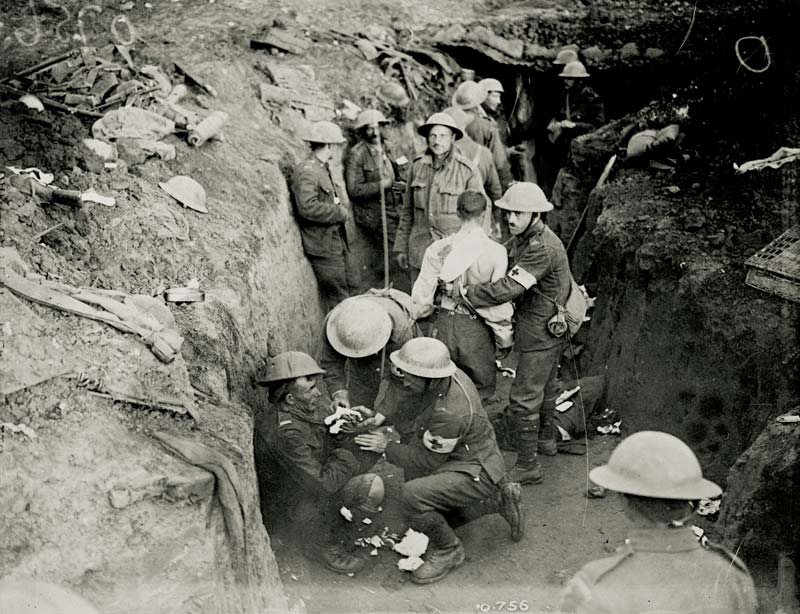
First aid is administered to wounded troops during the battle. [DND/LAC/3395787]
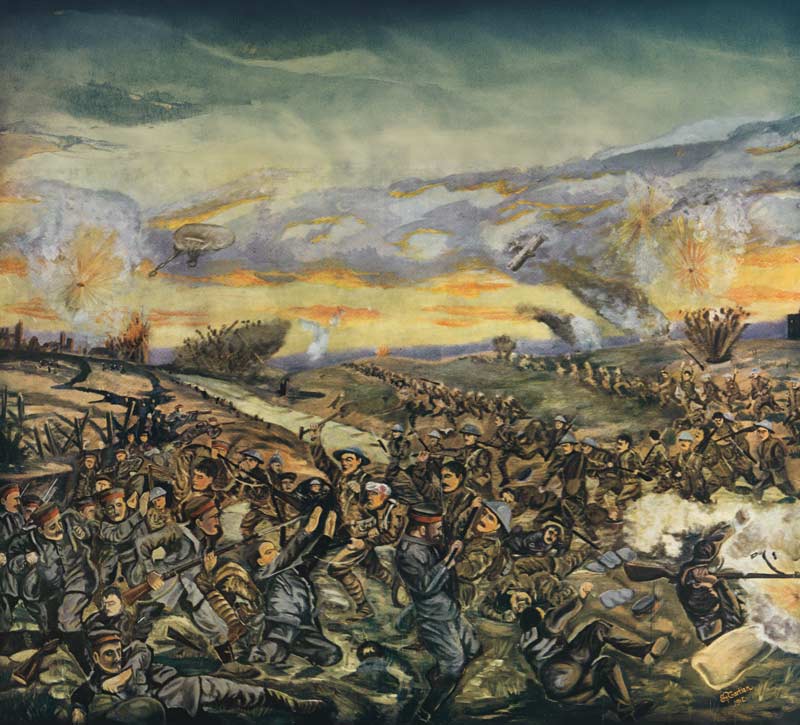
A print shows the charge of the 22nd Battalion toward the ruins of Courcelette. [CWM/19880309-005]
“Bayonet fighting is a bitter struggle to the end, with no mercy shown.”
On the right, 2nd Division stormed forward with five battalions. The creeping barrage moved through the German front lines when the Canadians were still 100 metres distant. Caught in the open, the Canadians were driven to ground by vicious machine-gun fire and forced to crawl forward, often using the bodies of dead comrades for cover.
Private C.V. Bryden’s 31st Battalion company was pinned down by an enemy machine-gunner “clipping bullets over our head and we laid there for a little while until I heard a tank approaching from the rear…the tank passed us and he took care of the German machine gunners…Without the tanks, there’s no question [that] we’d have suffered far greater casualties, and the moral effect of the tanks on the German soldiers at that time undoubtedly lent itself a great deal to the success of the attack.”
Lieutenant Maurice Arthur Pope remembered the tanks “were spitting fire. You’d see them flashing and you just wondered what on earth was going over the ground. It was quite a thrilling sight seeing the tanks going in for the first time.”
Inside the tank named Maple Leaf was Canadian Private James Fraser of 4th Battalion and a crew of five others: a New Zealander, three English crewmen and an English lieutenant in command.
“We went on through to the Sugar Refinery, knocked the wall in at the Sugar Refinery and then we just came around back and started to go up again when we got ours…hit by a nine-two [artillery piece]. They hit the turret.”
Before the morning ended, the six tanks the Canadians had taken into action were out of it—most having bogged down in the mud.
Before Fraser’s tank showed up, the 20th and 21st battalions had been stopped cold by the defences at the Sugar Refinery. Maple Leaf appeared, according to one witness, like “a queer monster of iron, which dipped into trenches and crawled crazily up the other side.”
The infantry surged through the smoke and dust cloaking the battlefield and carried the strategically vital ruin.
By 8 a.m., all positions south of Courcelette were in Canadian hands. The advance then halted as reserve elements came forward to renew the attack.
There was no subtlety to the plan. The first-wave troops in 22nd and 25th battalions were to just charge straight into the guts of the village’s ruins. The original plan had been set for the following morning, but clearly the Germans were teetering, and a hard push was ordered for 6 p.m. that evening. General Richard Turner issued his orders to 2nd Division at 1 p.m. and the officers scrambled to organize and brief their troops in time to go forward behind the barrage. That they were ready in time, the late pre-eminent historian Tim Cook wrote, “was a sign of the growing Canadian professionalism.”
The attack was to be made in broad daylight from a position with no trenches in which to form up.
“We just moved up in front there. The trenches were blown to pieces,” recalled Captain Charles B. Holmes of the 25th, “and [we] just laid out on the ground in different…companies until the zero hour and then we went through.”
Fighting inside the wrecked village was fierce. The 22nd Battalion’s Lieutenant-Colonel Thomas Tremblay led from the front and was buried three times by debris kicked up by exploding shells. Dug out each time by his men, Tremblay guided them on through a bloodbath of hand-to-hand fighting.
The “bayonet, rifle butts, shovels, feet, teeth all came into play,” wrote Captain Joseph Chabelle of the action. “Blood spurted out of punctured breasts; brains spilled from skulls shattered by rifle-butts. Bayonet fighting is a bitter struggle to the end, with no mercy shown.”
Maple Leaf appeared, according to one witness, like “a queer monster of iron, which dipped into trenches and crawled crazily up the other side.”
After a 10-minute slaughter, the Germans broke and fled Courcelette. With the village in flames around them, black smoke obscuring the ground ahead, the Canadians braced for the inevitable counter-attack. The first came soon after and was followed by 16 more during the next week before the Germans accepted the village’s loss.
Canada’s capture of Courcelette marked a stunning success for the corps. But there was no breakthrough. Enough German positions still stood by the end of the 15th that a hard fight to hold the ground and achieve gradual expansions was required. As happened so often on the Western Front, the battle soon sputtered to a halt—both sides exhausted and too battered to continue. By Sept. 22, the Canadians were only about 450 metres east of Courcelette holding a continuous front roughly one kilometre long.
Courcelette was the first major operation by the Canadian Corps as a whole, and it cost 7,230 casualties. Private Bryden survived, but his 31st Battalion paid a horrible price.
“When we went back to the brick field, they even had to put the reinforcements in the battalion before they dared to call the roll,” Bryden reported. “I think there was only 14 men in the company left.”
There would be no respite. On Sept. 26, the Canadians would attack again in the Battle of Thiepval Ridge—just a continuation of the Somme offensive. It was an assault that would include a protracted fight for a long and critical trench—code-named Regina—that would be the last major Canadian battle in the Somme in 1916.
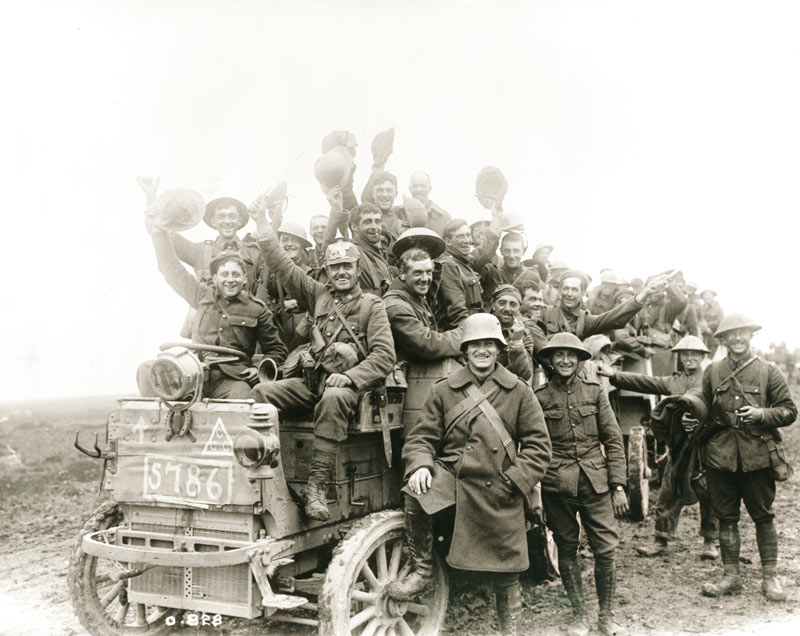
Canadians return victorious from the Battle of Flers-Courcelette. [LAC/O-828]
Advertisement