

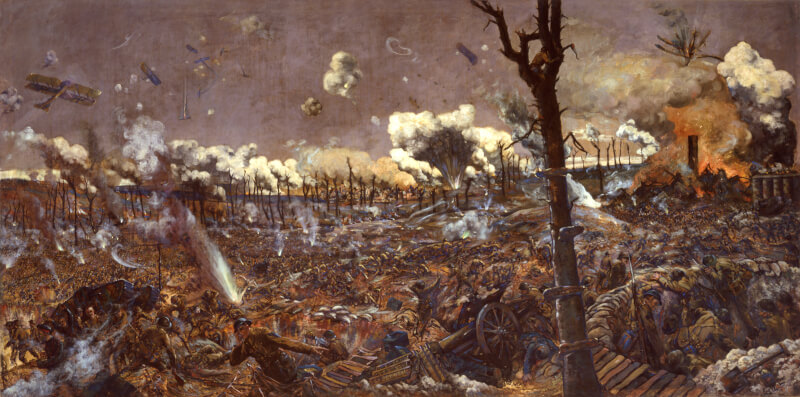
Soldier and war artist Louis Weirter depicts a scene of the chaos as Canadian troops capture the village of Courcelette, France, in September 1916. [Louis Weirter/CWM/19710261-0788]
Books can explain the horrors and hardships of the First World War. Battlefields, however, tell their own stories. To walk the ground of century-old clashes, to see the almost-boundless rows of white grave markers in cemeteries through Belgium and France, is to encounter history in a way that no printed page can ever fully replicate.
While tens of thousands of overseas visitors have embarked on pilgrimages across the former Western Front since the Armistice, few have lived it quite like military historian Paul Reed. For more than a decade, the British tour guide and author of 10 books lived in Courcelette—a community forever intertwined with Canada’s role in the 1916 Battle of the Somme.
Reed’s intimate knowledge of the site, as well as his admiration for the wider wartime contributions of the Canadian Corps, have featured prominently in his Old Front Line podcast. Here, in a Legion Magazine exclusive, he reflects on both.

British tour guide and author Paul Reed lived in Courcelette, France. [Courtesy Paul Reed]
On telling Canada’s wartime stories
I can’t really explain why, but I had once picked up a few Canadian battalion histories, which led me to visit some of the places on the Western Front that were connected to the Canadians. Of course, if you go to that landscape of the Great War in France and Flanders, Belgium, you can’t help but see nations like Canada and their involvement because there are all these incredible memorials.
Obviously, there’s Vimy, but there are many others. You also see the Canadian contribution expressed in the cemeteries. I then realized the kind of rich history that Canada had.
On living in Courcelette
It gave me the opportunity to walk across that battlefield every day. Literally in my back garden was a trench dug by Princess Patricia’s Canadian Light Infantry on the night of Sept. 15, 1916. I had a vegetable plot in it for a while, and there would be bullets and shrapnel that would surface from time to time. I could also walk out my house, take a left turn, and be standing in the lane where Talbot Papineau stood in September 1916—that was quite an incredible feeling.
Walking that ground in all kinds of weather, from bright sunshine to a thick blanket of snow, enables you to appreciate it in a different way. As good as Google Maps is, I think living there changed it for me completely, not just at Courcelette, but the entire Western Front.

This building was one of the last left standing in the aftermath of the Battle of Flers-Courcelette in September 1916. To this day, artifacts and remains of soldiers who fought in the area, including Canadians, continue to surface.
[DND/LAC]
On recovering an unknown Canadian soldier
The First World War is always there. One night, there was a knock on my door. One of the local farmers was standing there with a steel helmet in his hand, and when he turned it around, there was a skull in it.
He had been working at the back of the house clearing a bank, and fragments of a soldier had fallen out in the process. The farmer knew I was British, and he knew I was interested in the First World War, and it was kind of, “this is your problem now.”
In those days—this was back in the 1990s—the first thing I did was ring the mayor of my village, who was also effectively the representative for the local police. I called him for two reasons: to alert him to the fact that human remains had been found, and secondly, to make sure that he could get them to stop working, so that we could go down and make sure that the grave wasn’t disturbed any further.
At that time, too, they had an exhumations officer in the Commonwealth War Graves Commission based in Arras, France. I had met this guy many times because it wasn’t rare to find human remains on the battlefields—it’s a reality of living in the area. There was also the fact that there had been a couple of incidents where remains had been stolen by collectors. The War Graves guy, who was elsewhere, told me to retrieve what I could so nothing could be stolen and so there would be something to eventually rebury.
I went to the site with the mayor, who testified to the fact that it was all done properly. We recovered the remains, took them to my home, laid the lad out in a wooden box and draped him in the Union flag. I didn’t have a Canadian one, unfortunately, so that had to stand in.
I’ll never have a guest of honour of that calibre in my house again.
The commission came the next morning to take the remains. We went back to the burial site with a metal detector. Although we found artifacts to show he was, indeed, a Canadian soldier, there was no means of identification.
He was subsequently reburied with full military honours at Courcelette British Cemetery.
To have played a small part in that recovery, to have ensured that a Canadian soldier was buried properly, was a big thing for me. It reminds us that the pages of history never stop turning, and that the recovery of the dead is very much a part of the legacy of the First World War.
On the Old Front Line podcast
Podcasts probably came into their own about 10 years or so before I started mine. I remember various people saying, “You know, come on, you should be doing one,” and I just thought, well, when am I going to have the time to do something like that?
When the world came to a stop during the COVID-19 pandemic and people couldn’t get to the battlefields, I decided to bring the battlefields to everybody with a podcast.
Of course, it was a time when everyone was at home, and they had the time to sit and listen to podcasts. I thought it would be a flash in the pan—that when the world reset itself, people would lose interest or perhaps I would lose interest. But six years later, after 300 episodes and millions of downloads, it’s still chugging.
What I’ve tried to do is be a bit left field about it. For most people, if you said a First World War podcast, they would just think it’s going to be battles, regiments, divisions and dates. The Old Front Line podcast does have those elements, but I’ve done a lot of other stuff as well. There’s an episode, for example, about birds of the Western Front—not only about the use of pigeons, but how the landscape impacted birdlife, such as the massive surge of owls that ate mice and rats in no man’s land.
There’s no surprise, having followed the Canadians around the battlefields of the First World War, that there’s tons of Canadian content. You’d probably think that 300 episodes in, you’ve covered everything—but we’re only just starting.
On the continued relevancy of Canada’s Great War
I hope listeners and battlefield tourists take away the fact that the First World War is still relevant to Canada. It’s not something in the dim and distant past that should be forgotten.
Canada is a nation that’s been built on the sacrifice of people who came from all over the world to be there, to be Canadian. And when it came to defending Canada in both world wars, these people stood up and did what was required of them. Modern Canadians should be rightly proud of that.
This interview has been edited for brevity and clarity.
Advertisement