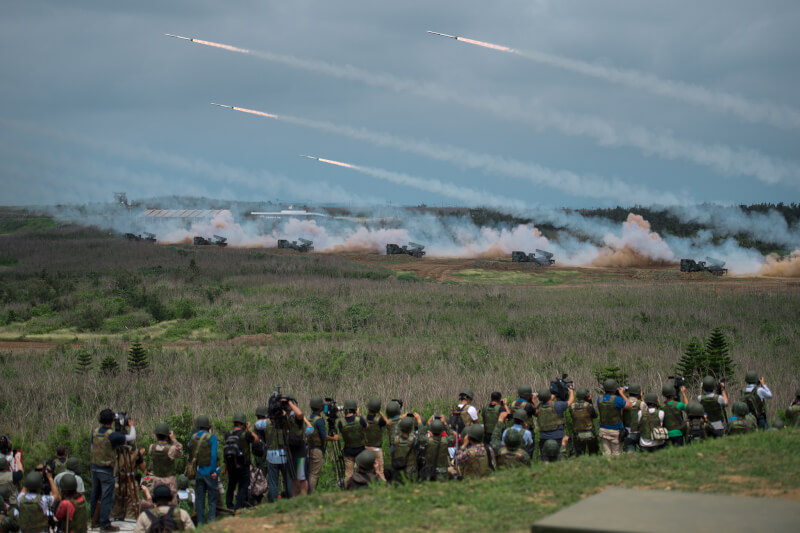
The Han Kuang Exercise is an annual military exercise in Taiwan in preparation for a possible attack from China. [Office of the President, Republic of China (Taiwan)/Wikimedia]
That’s especially true when MacMillan—a pre-eminent conflict historian—warns that the present is looking unnervingly like the past in the lead-up to both world wars.
“When a storm is coming, there will always be signs,” MacMillan wrote earlier this month in the New York Times. “A world war is not inevitable, but the threat of a catastrophic conflict between big and well-armed powers is closer than it was for decades.”
She also recently told CBC Radio’s The Current: “It’s always foolish to panic too soon and say, you know, like Chicken Little, ‘the sky is falling.’ But I think we do need to really worry.”
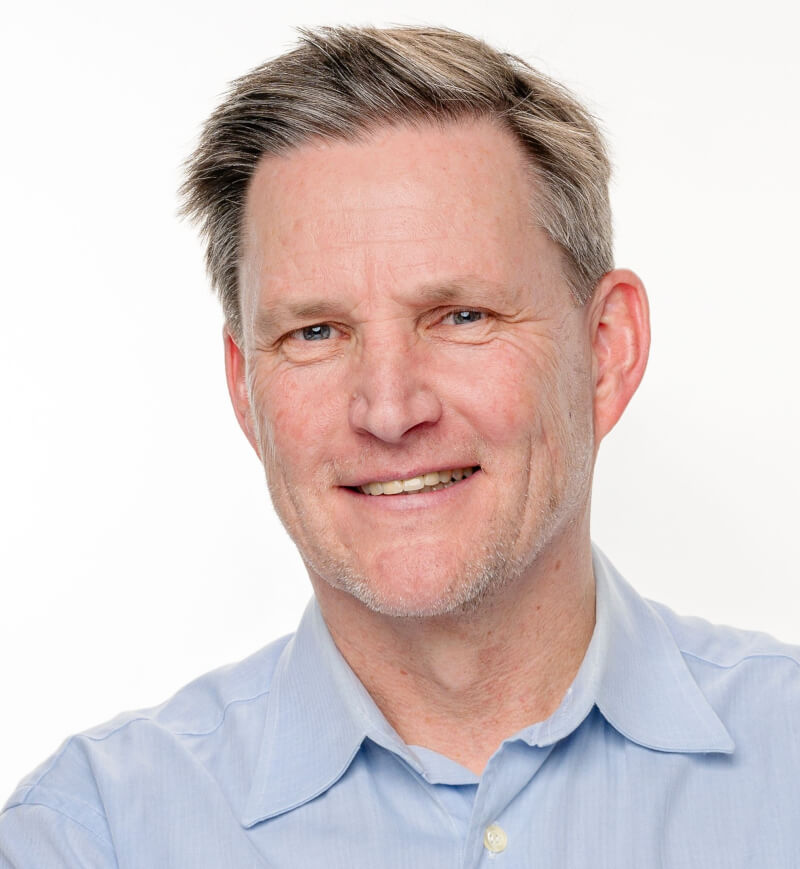
MacMillan is emeritus professor of history at Oxford University and the University of Toronto, and the author of acclaimed books, such as Paris 1919 and War: How Conflict Shaped Us.
“A world war is not inevitable, but the threat of a catastrophic conflict between big and well-armed powers is closer than it was for decades.”
MacMillan said signs of trouble are looming all around us. And yet, partly as a result of the complacency created by eight decades of postwar stability and peace in the West, she said many in Canada and other NATO countries are ignorant to the danger.
MacMillan sees multiple factors—record-high government debt; angry electorates; surging nationalism; unelected and wealthy elites influencing government; the reluctance of great powers to uphold international order; and new military technologies—as echoing the events and attitudes that preceded not only the world wars but also the revolutions in France and Russia.
Add to this volatile mix the strain of climate disruption and the doomsday threat of unregulated artificial intelligence, and “we have arrived in a new age of disorder,” MacMillan writes. “We must prepare ourselves, beginning with being honest about the seriousness of the moment we’re in and accepting that our fragile system is faltering.”
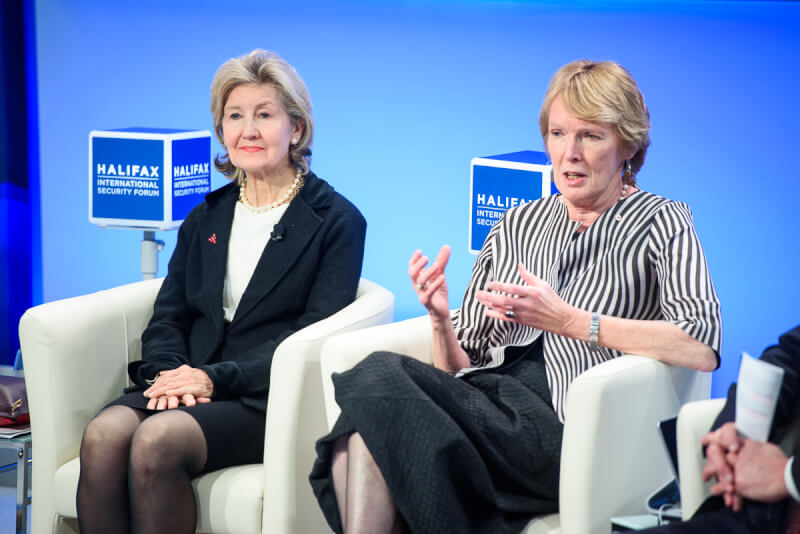
Margaret MacMillan (right) speaks at the 2017 Halifax International Security Forum. [Halifax International Security Forum/Wikimedia]
A new report by the Peace Research Institute Oslo said there were more state-based armed conflicts around the world last year than at any time since the end of the Second World War—with a record 65 conflicts, resulting in 153,000 battle deaths.
“Are we heading for World War Three?” asks a recent headline in The Week, an international news magazine, which said the multiplying connections between the wars in Ukraine, Iran and Yemen, and the tensions over Taiwan, are “creating fears of escalating global conflict.”
One such fear is that China may capitalize on the current moment—with the U.S. bogged down in the Persian Gulf and coping with depleted munitions stocks—to invade Taiwan, while at the same time Russia distracts NATO with an attack on alliance members in eastern Europe.
An analysis last month by the Australian Strategic Policy Institute said Russia’s robust Pacific fleet of attack submarines poses an additional threat, because “Russia may be preparing to undertake meaningful military action in the Indo-Pacific in co-ordination with China”—including during an invasion of Taiwan.
Similar concerns prompted retired British army officer Richard Shirreff, the former deputy supreme allied commander of NATO forces in Europe, to write in London’s Daily Mail that, “I fear we are living through the outbreak of World War III.”
Added David French, an Iraq War veteran and columnist with the New York Times: “The world is walking a path toward a world war and no-one—including the president of the United States—seems to be in command of events.
“I fear we are living through the outbreak of World War III.”
“I’ve often wondered what it was like to be alive in the summer of 1914, much less in 1938 and 1939,” wrote French. “When did people start to realize that the world was on the brink of catastrophe?”
The problem in 1914 was that the leaders who ordered their armies into battle that year all expected the fighting to be over in a matter of months.
“The Kaiser thought a short, sharp war would reshape the Balkans to Germany’s advantage and boost his own standing at home. He doubted that many other countries would get involved,” said a recent article in the Economist.
“He failed to plan for the predictable consequences of his actions, let alone for a global conflict that claimed tens of millions of lives and toppled four empires, including his own.”

A residential building in Avdiivka (Donetsk Oblast, Ukraine) after a Russian rocket strike on May 23, 2023. [Wikimedia]
The conflict, once contained to eastern Ukraine, is also spreading, with Ukraine recently bombing an Iranian ship in the Caspian Sea, North Korea contributing troops to the front line, and Russia testing NATO with missiles and drone flights over eastern Europe.
Similarly, U.S. President Donald Trump predicted a fast, easy victory in Iran, followed by a popular uprising by the Iranian people, when the U.S. began its bombing campaign in February 2026. Seven months later, the Iranian regime remains intact, in control of the Strait of Hormuz and inflicting ongoing damage on U.S. ships, bases and allies in the region.
“One disquieting lesson of history,” said the Economist, “is that although world wars affect nearly everyone, the task of avoiding them falls to a tiny number of decision makers. And those decision makers are sometimes fools.”
“Although world wars affect nearly everyone, the task of avoiding them falls to a tiny number of decision makers. And those decision makers are sometimes fools.”
As Margaret MacMillan sees it, “dark clouds” now shadow the world. However, she also believes there is a chance to avoid disaster if enough nations find the will to rediscover the co-operative spirit that characterized the years after the Second World War, taking on the hard work of building a new era of peace in the 21st century.
“The end of the old system does not have to mean the end of co-operation,” she said.
“We still have many of the components of an effective world order. We have a rich web of international institutions, many of them largely invisible, that manage the links among nations, from civil aviation to the internet…. A number of middle powers, including Canada, Australia and Japan are working together to fill the gap left by the withdrawal of the United States from its role as benevolent superpower.
“Unwarranted optimism is a dead end. But that doesn’t mean we cannot do what has so often been done before and embark on the laborious process of building something afresh.”
Advertisement