

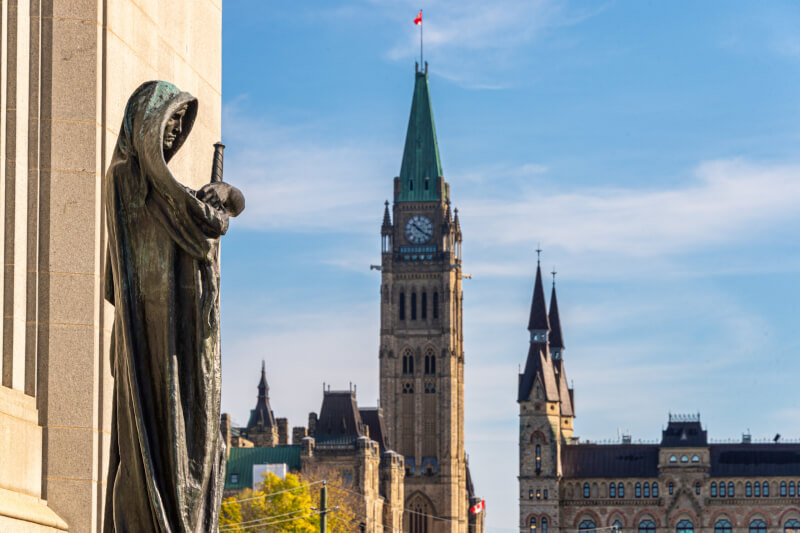
Walter Seymour Allward’s “Ivstitia” (Justice) statue stands in front of the Supreme Court of Canada building in Ottawa. [Marc Bruxelle/istock]
Amid the 10-year, $1-billion project to restore the structure, care will also be taken to preserve its character, including two bronze statues guarding the main entrance—“Veritas” (Truth) and “Ivstitia” (Justice)—designed by Walter Seymour Allward, the artistic genius who also created the Canadian National Vimy Memorial.
The statues are a reminder that one doesn’t have to cross an ocean to experience the splendour of Allward’s work—there are examples of it throughout Ontario. They also show that the radical vision Allward expressed at Vimy was developed steadily over his career in Canada, an evolution evident in many of his public artworks still standing on home soil today.
Consider the twin sisters of “Veritas” and “Ivstitia” themselves, which were originally intended as supporting characters in a monument to King Edward VII. During his reign, King Edward had been celebrated as a peacemaker for fostering closer relations between Britain and other European powers. Canadian officials planned to honour that legacy with a memorial to him on Parliament Hill.
Allward, who won the project commission in 1912, designed a monument with a statue of Edward standing in front of a wide wall atop a series of steps, accompanied by three figures: Peace, Truth and Justice.
Those concepts—expansive steps, a broad horizontal wall, a series of highly-interpretive allegorical figures—were a daring departure from the typical way memorials were created at the time, which favoured realistic portrayals of solitary statues (standing or on horseback) atop concrete pedestals. Allward would later incorporate and expand upon his unconventional approach at Vimy.
In fact, the brooding “Ivstitia” statue—cloaked, with its arms crossed over the handle of a sword—very closely resembles the Justice figure carved out of limestone that adorns one of the twin towers on the Vimy memorial.
While Allward completed “Veritas” and “Ivstitia,” progress on the Edward VII monument was interrupted by the outbreak of the First World War and the project was never finished. The statues were then forgotten for more than 50 years, until they were discovered in crates in a government warehouse. In 1970, they were finally installed on concrete pylons outside the Supreme Court building. (An urban myth has the statues buried for decades below an Ottawa parking lot, but no evidence supports that.)
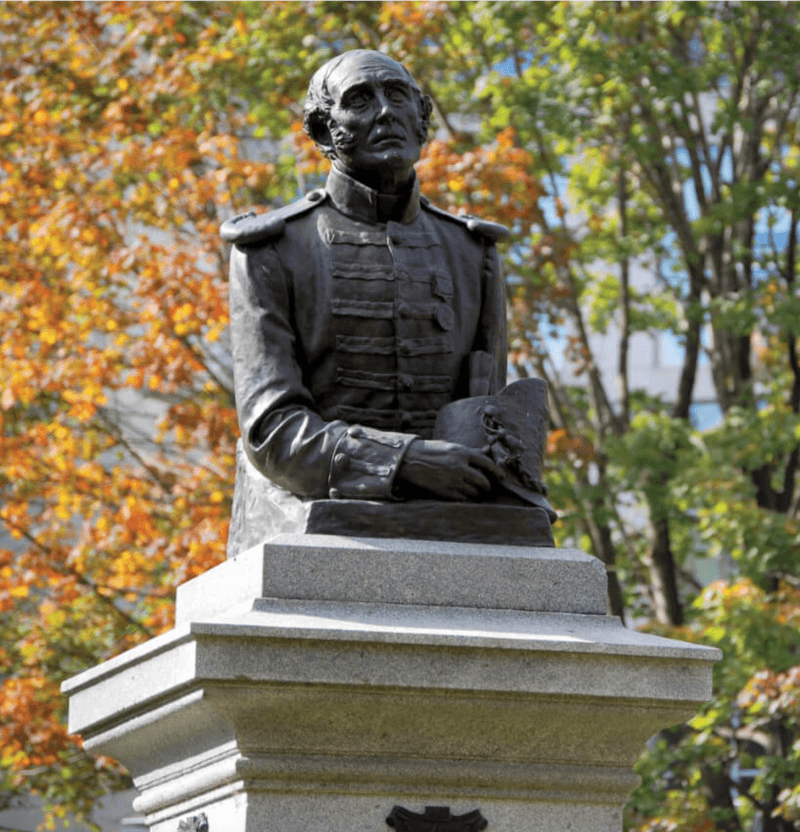
Allward’s “The Old Soldier” statue for the War of 1812 Memorial in Queen’s Park, Toronto. [Art Institute of Canada]

A portrait of Allward taken in July 1913. [F 1075-16-0-0-123/Archives of Ontario]
Hamilton MacCarthy, another prominent sculptor of the period whose war memorials can be found in town squares throughout Canada, once described statues as “witnesses to the power and pride which every citizen should feel in the heritage which he possesses.”
It was amid this patriotic national mood that Allward burst onto the scene in his hometown of Toronto at only 19. In 1894, he had won a commission to produce a bronze female statue symbolizing peace to top a monument commemorating those who died in the Northwest Rebellion (now called Resistance).
Allward delivered a statue in the typical, beaux arts style. The monument was unveiled on June 27, 1896—exactly 130 years ago this week—and still stands at Queen’s Park, the grounds of Ontario’s legislature. That project also revealed Allward’s behaviours that would plague many of his later projects, including Vimy: obsessive attention to detail, perfectionism, glacial progress and delays.
In 1903, while making a living sculpting busts and statues of Canadian politicians, Allward began work on his second war memorial commission, this time to honour the War of 1812 on behalf of the Army and Navy Veterans’ Association of Toronto. What he produced was strikingly unique. Rather than depict a tall, heroic figure with his arms or his rifle raised in victory, Allward sculpted an old, wounded soldier presented from the waist up, gazing at the heavens in anguish and reflection.
Despite breaking with convention, “The Old Solider” was met with enthusiasm when it was unveiled in 1907. Today it stands in Victoria Memorial Square in downtown Toronto.
The end of the Boer War in 1902 triggered a monument-building frenzy, as communities across the country sought to memorialize the drama of Canada’s first official dispatch of soldiers overseas. Allward won the competition to create a monument for Toronto, his most ambitious project to date.
The result, which still commands attention on the city’s University Avenue, was another departure from the single-person memorials in vogue. Allward placed an allegorical winged figure of Victory atop a 21-metre granite column inscribed with the main battles where Canadians fought in South Africa. At the base, three more bronze sculptures depict the female figure of Canada—modelled on Allward’s own mother—sending her sons off to war.
According to art historian Philip Dombowsky, Allward prevailed in a “disagreement over the positioning of names,” insisting that the roughly 270 Canadians who died in South Africa be listed at the base of the monument alphabetically in a single, continuous paragraph, rather than in vertical rows by regiment. This was another innovation Allward would revisit on the Vimy memorial.
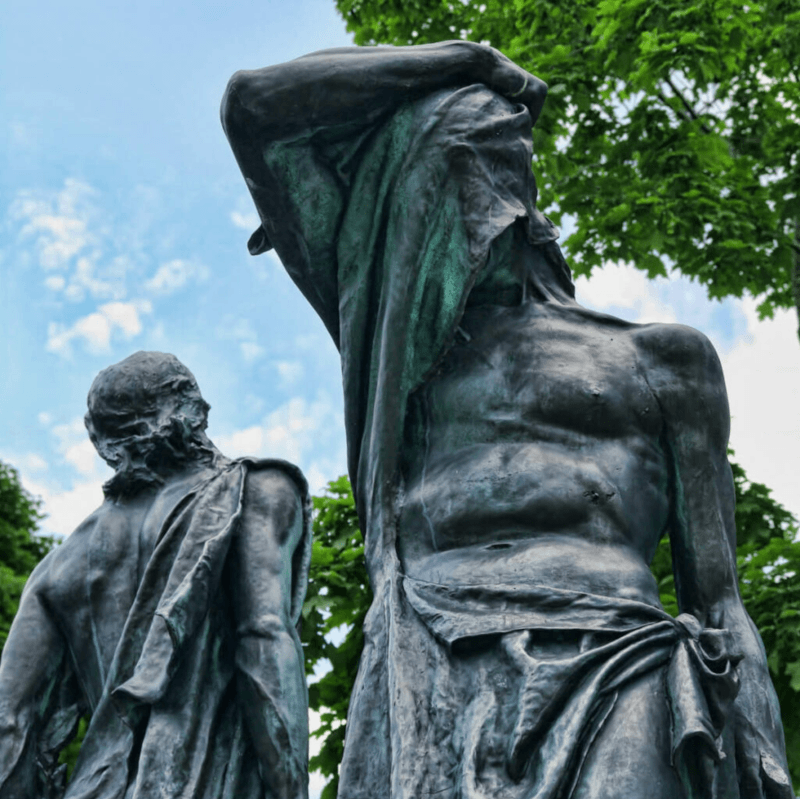
The war memorial in Stratford, Ontario. [Art Institute of Canada]
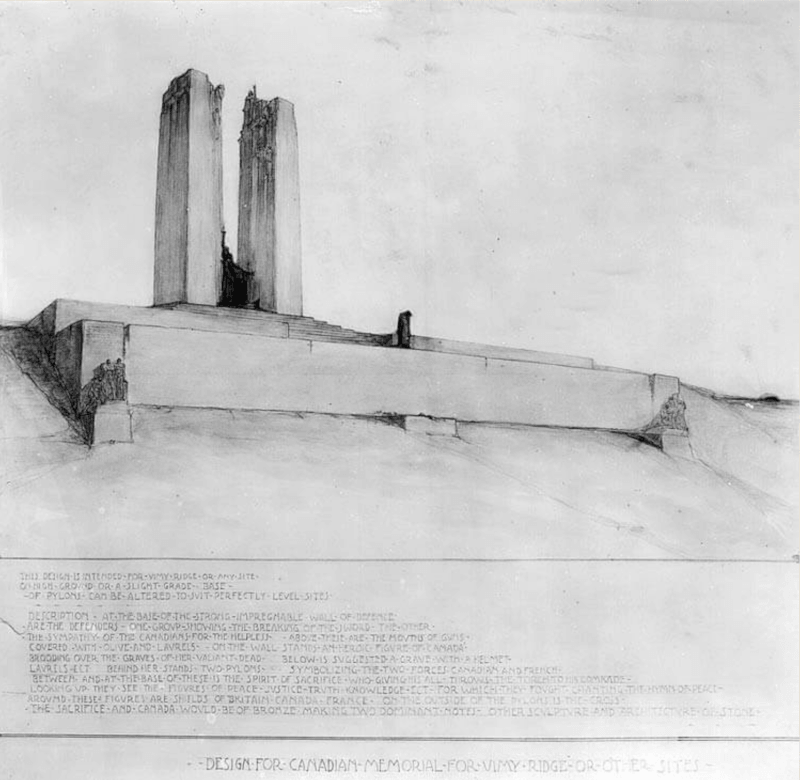
Allward’s submission sketch for the Vimy Memorial. [Veterans Affairs Canada]
The focus of both monuments is a wide, horizontal wall and—at the Bell Memorial—a series of symbolic, allegorical figures arranged in a narrative, showcasing what, by this time, had become Allward’s signature style.
Allegory turned out to be a powerful means of expressing the sorrow felt across Canada at the shocking losses of the First World War. Allward himself was haunted by the slaughter on the Western Front, a sentiment made clear in two of his early Great War memorials, erected in Peterborough, Ont., and Stratford, Ont.
There are no realistic portrayals of soldiers on either memorial, only symbols of sacrifice. At the Stratford War Memorial, for example, two bronze, allegorical figures are dramatically posed back-to-back, illustrating what Allward described as spiritual man—depicted looking up and holding a palm branch, symbolizing peace—and strife, shown looking down and holding a broken sword.
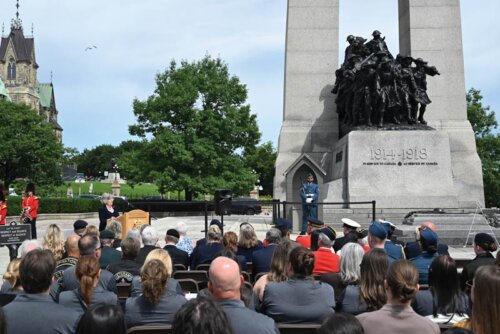
By the time the Stratford memorial was unveiled in 1922, Allward was already consumed by his grandest project yet, the design and construction of Canada’s national memorial on Vimy Ridge. The masterful vision he brought to France was not a new approach for Allward—it had developed over decades of experimentation and daring design at home in Canada.
Advertisement