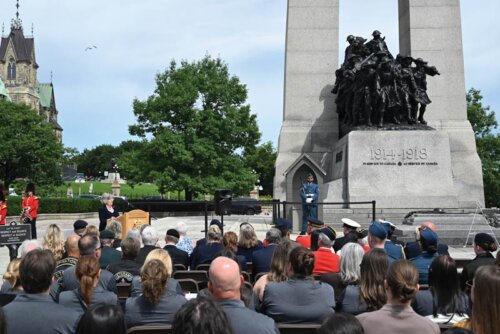

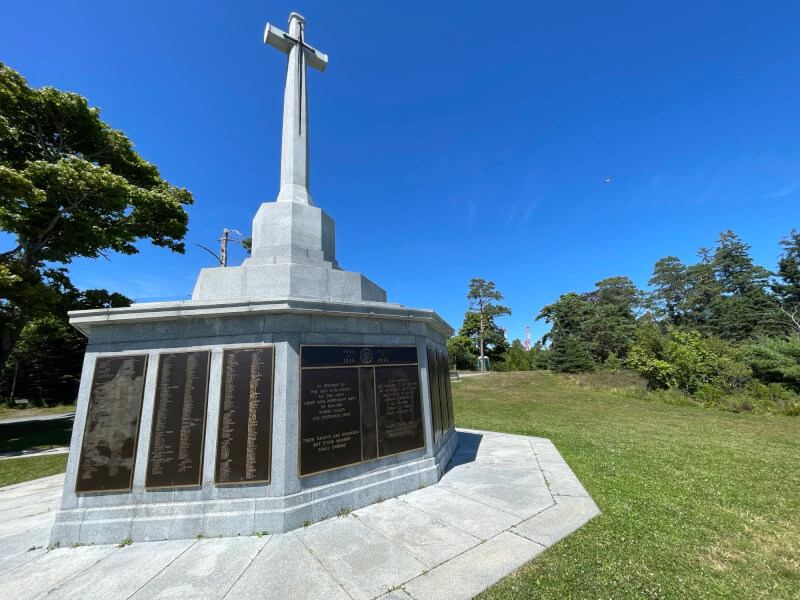
The Halifax Memorial with the port’s Halterm container terminal in the distance. [Richard Foot/LM]
On the Halifax Memorial, just steps from the water’s edge, bronze panels bear the names of 3,267 Canadians and Newfoundlanders who died at sea in unknown graves during the First and Second world wars. Most (including many merchant seamen) were lost in transatlantic convoys bringing war supplies to Europe.
Meanwhile, every day within sight of the memorial, ships carrying cargo from across the Americas, Asia and Europe enter the harbour and dock at a container-loading terminal, whose giant cranes can be seen and heard throughout the park. According to the Port of Halifax, more than 8.5 million metric tonnes of cargo passed through in 2025.
All of that cargo—plus the billions of additional tonnage shipped across the world’s oceans each year, fuelling the global economy—is made possible because of the sacrifices of those, like the sailors and soldiers honoured on the Halifax Memorial, who fought in the Battle of the Atlantic and in other 20th-century campaigns aimed at ensuring freedom of the seas.
Today, that freedom is under greater threat than at any other time in the postwar era.
“We take those sea lanes for granted,” wrote Colin Robertson, a former Canadian diplomat, in a recent article in Policy, a Montreal-based online public policy magazine. “Canada’s prosperity floats on salt water. But the illusion of safety is breaking down.”
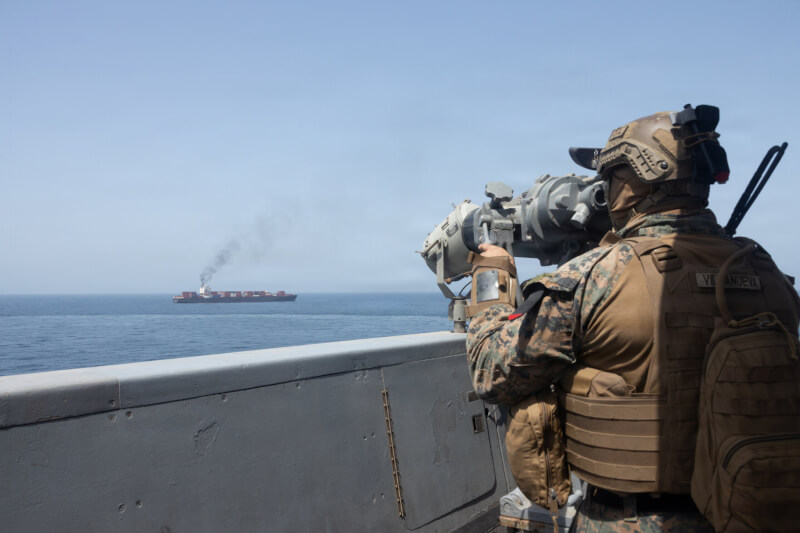
U.S. forces patrol the Arabian Sea during their naval blockade on Iran in April 20, 2026. [U.S. Navy]
Iran has vowed to attack ships transiting the Strait of Hormuz, while Houthi militants, an Iranian proxy force in Yemen, have bombed oil tankers attempting to leave or enter the Red Sea—in both cases as a means of exerting pressure on the U.S. in its war on Iran.
One quarter of the world’s oil and one-fifth of all gas shipments typically run through the Strait of Hormuz, while about 12 per cent of all global trade and 30 per cent of all container traffic passes through the Red Sea.
These are not the only chokepoints being squeezed by geopolitical tensions. Free navigation through the Strait of Malacca, which links the Andaman Sea and the South China Sea—“the world’s most consequential maritime corridor,” according to the Washington D.C.-based Center for Strategic and International Studies—has come under strain in recent years as China exerts pressure on Taiwan, the Philippines and other countries whose ships transit what are widely considered international waters.
Shipping across parts of the Black Sea has also been disrupted by Russia’s war on Ukraine.
“States and non-state actors alike have learned that you do not need a blue water navy to disrupt global trade,” Robertson wrote. “Mines, missiles, drones, even the threat of harassment can drive up insurance costs, reroute shipping, and unsettle markets.”

A convoy crosses the Atlantic, from Newfoundland to France, on D-Day during the Battle of the Atlantic. [Gilbert Alexander Milne/DND/LAC/PA-137014]
The First World War severely disrupted free navigation in European waters, with Britain blockading German shipping in the North Sea, and German submarines sinking merchant vessels throughout the British Isles.
The German sinking of the British ocean liner Lusitania off the coast of Ireland in 1915, with the loss of 1,198 lives including 128 U.S. citizens and dozens of Canadians, shocked the world. This awakening, coupled in the following years with Germany’s policy of unrestricted submarine warfare and the sinking of U.S. merchant ships, helped push the U.S. out of neutrality and into the war in 1917.
More than two decades later, the Battle of the Atlantic was fought not simply to ensure the delivery of troops, aircraft, food, timber and other supplies to Europe for the war effort against the Nazis, but to uphold the broader principle of freedom of the seas.
“Nazi Germany sought to strangle Britain by cutting its maritime lifelines,” Robertson wrote. “For Winston Churchill, the U-boat peril was the only thing ‘that ever really frightened him.’
“The lesson was clear. If sea lanes fail, everything else follows.”
The Battle of the Atlantic, the longest campaign of the Second World War, was Canada’s most important contribution to the war. More than 4,300 Canadians died during the campaign. Canada emerged at the end of it with one of the largest navies in the world—roughly 370 warships and 110,000 members—the bulk of which had been devoted to keeping the Atlantic sea lanes open.
“The lesson was clear. If sea lanes fail, everything else follows.”
Throughout the postwar era, freedom of navigation was one of the essential elements underpinning the international rules-based order. NATO members, including Canada, routinely dispatched warships on long missions with standing NATO fleets to, among other things, enforce freedom of the seas.
Robertson says that as this freedom begins to break down, a new alliance of nations committed to maritime security is needed to maintain and enforce open sea lanes.
“Prime Minister Mark Carney has spoken of ‘coalitions of the willing’—a flexible alignment of states prepared to defend shared interests when universal consensus fails,” he wrote. “What is more vital to our interests than protection of international sea lanes?
“A coalition of middle powers—including NATO allies and Indo-Pacific partners—should co-ordinate patrols, share intelligence and work to keep critical waters open.”
For Canada to take part in such a project, the Royal Canadian Navy needs not only new surface ships (currently in production) and submarines (recently ordered), but also new technologies: “unmanned surface and underwater vehicles, advanced sonar, and air and space surveillance,” said Robertson.
“Because the oceans are becoming contested again. Choke points are becoming pressure points. And the freedom to sail—so essential, so long assumed—is no longer guaranteed.”
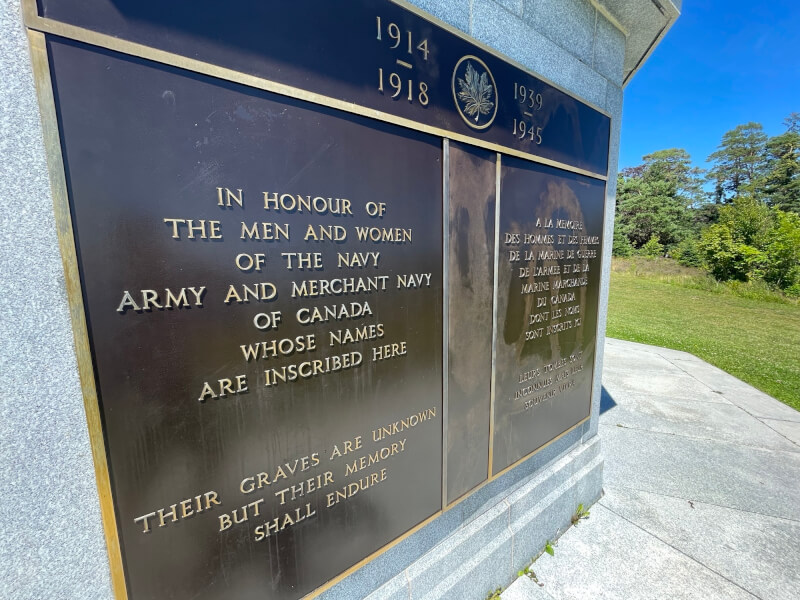
The Halifax Memorial holds the names of Canadian sailors and soldiers who died in unknown graves at sea during the two world wars. [Richard Foot/LM]
Advertisement