






King George VI and Queen Elizabeth on the platform of the royal train that carried them across Canada during their 1939 royal tour. (William Lyon Mackenzie King /LAC/PA-203283)
Here’s a reminder of how much the world has changed—and how much it hasn’t.
In June 1939, King George VI, at the end of his and Queen Elizabeth’s royal tour of North America, paid tribute to the friendship they had witnessed between Canada and the United States:
“From the Atlantic to the Pacific, and from the tropics to the Arctic, lies a large part of the earth where there is no possibility of war between neighbours, whose peoples are wholly dedicated to the pursuits of peace, a pattern to all men of how civilized nations should live together,” the king said.
“It is good to know that such a region exists, for what man can do once he can do again. By God’s grace yours may yet be the example which all the world will follow.”
It was a sombre moment for King George and Queen Elizabeth (later known as the Queen Mother), who were returning home from Canada to a continent in crisis, with fascism on the march across Europe, soon to be enveloped by war.
In fact, the threat of war was the real reason why the king and queen had embarked that summer on the first ever visit to North America by a reigning Canadian sovereign. Already Hitler had annexed Austria, marched his army into Czechoslovakia and was making demands on Poland.
A shaken British government, unprepared for war, asked the king and queen to travel to North America to unite Canadians behind Britain and try to turn the tide of American isolationism that so worried Westminster.
The royal tour of 1939 was a spectacle like no other. Elizabeth and her husband “Bertie”—only recently elevated to the throne following the 1936 abdication of his brother Edward VIII—traveled 7,000 kilometres across Canada and back again, from Quebec City to Victoria and then east to Halifax, on a dazzling blue and silver royal train.

A large crowd watches the king and queen in Toronto during their royal tour. [CN003721/Canadian Science and Technology Museum/Wikimedia]
At every stop, tens of thousands, sometimes millions, came to see them, including in Quebec where people happily sang Dieu Sauve le Roi.
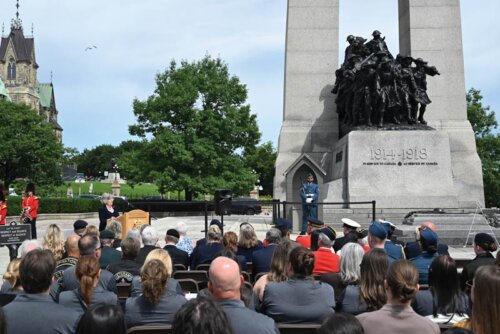
The tour made history in many ways. In Ottawa, for example, a Canadian monarch met his Parliament for the first time and signed legislation into law. In the city’s downtown, the king and queen dedicated the new National War Memorial, where the couple then strolled spontaneously into a throng of thousands of First World War veterans on the first ever royal walkabout.
As the queen famously said of the tour: “It made us, the king and I. It came at just the right time.”
In early June the royal train crossed into the U.S. at Niagara Falls and proceeded to Washington, D.C., where President Franklin Roosevelt and first lady Eleanor hosted the royals at a state dinner. In his speech at the White House, Roosevelt told the king and queen that the U.S. and Canada offered an example to the world.
“It is because each nation is lacking in fear of the other that we have unfortified borders between us,” he said. “It is because neither of us fears aggression on the part of the other that we have entered no race of armaments, the one against the other.”
A week later, after returning to Canada via New York, the royals bid farewell from Halifax before boarding a ship for Britain, cheered by 150,000 people in the city’s downtown. King George, echoing the sentiment expressed earlier by Roosevelt, made his wistful remarks about the uniquely peaceful example provided by two North American neighbours.

King George VI (left) and Canadian Prime Minister Mackenzie King (right) seated in the back of the presidential state car with President Franklin Roosevelt (centre) in June 1939. [72-25(2)/FDR Presidential Library & Museum/Wikimedia]
Today, those words are a powerful reminder of the harmony the U.S. and Canada once enjoyed through the 20th century and beyond, and how much is now at risk.
It’s true that the Gordie Howe International Bridge is finally open, providing another cross-border link between Ontario and Michigan. But the Americans were disinvited from the bridge’s opening ceremonies, in response to the Trump administration’s efforts to obstruct the bridge’s opening and its latest tariff threats to Canada.
In 1939, could anyone have imagined that building a bridge between the two countries could be saddled with so much ill-will?
Could anyone from that time have imagined an American president openly declaring economic war on Canada, or musing about making Canada the 51st state—and where, in response, millions of Canadians would boycott American products and U.S. travel amid a rising tide of anger and mistrust?
In 1939, could anyone have imagined that building a bridge between the two countries could be saddled with so much ill-will?
In the New York Times last week, Chrystia Freeland, Canada’s former deputy prime minister, warned Americans that Canadians, along with the citizens of other one-time U.S. allies whose countries have been threatened by the Trump administration, “are wrong to think all will be forgiven when the White House has a new occupant.” They must appreciate, she said, “the depth of the damage being done.”
Certainly, much has changed from the cross-border camaraderie that so impressed a young king and queen and was once the envy of the world.
Yet elsewhere, much remains the same. Where the clouds of war once darkened the future outside North America, so they do again—in Ukraine, in Lebanon, in Iran, in Sudan and, possibly, Taiwan.
On a planet beset by growing fear and tension, can the U.S and Canada again find a way to lead by example, by returning to what in 1939 Queen Elizabeth lovingly called “this great friendly continent”?
Advertisement






“warned Americans that Canadians, along with the citizens of other one-time U.S. allies” – Wasn’t aware Canada was no longer a US ally. Will be news to the Cdn troops returning from exercise with the 11th Armoured Cavalry at Fort Irwin, California along with UK, Aussie and Kiwis. Interesting to read about the 1939 Royal tour but don’t see the point of indirect Trump bashing at the end of the article. As far as quoting Freeland, well she should know something about economic damage to Canada